This article first appeared in Issue 13 of our free digital magazine CURIOUS.
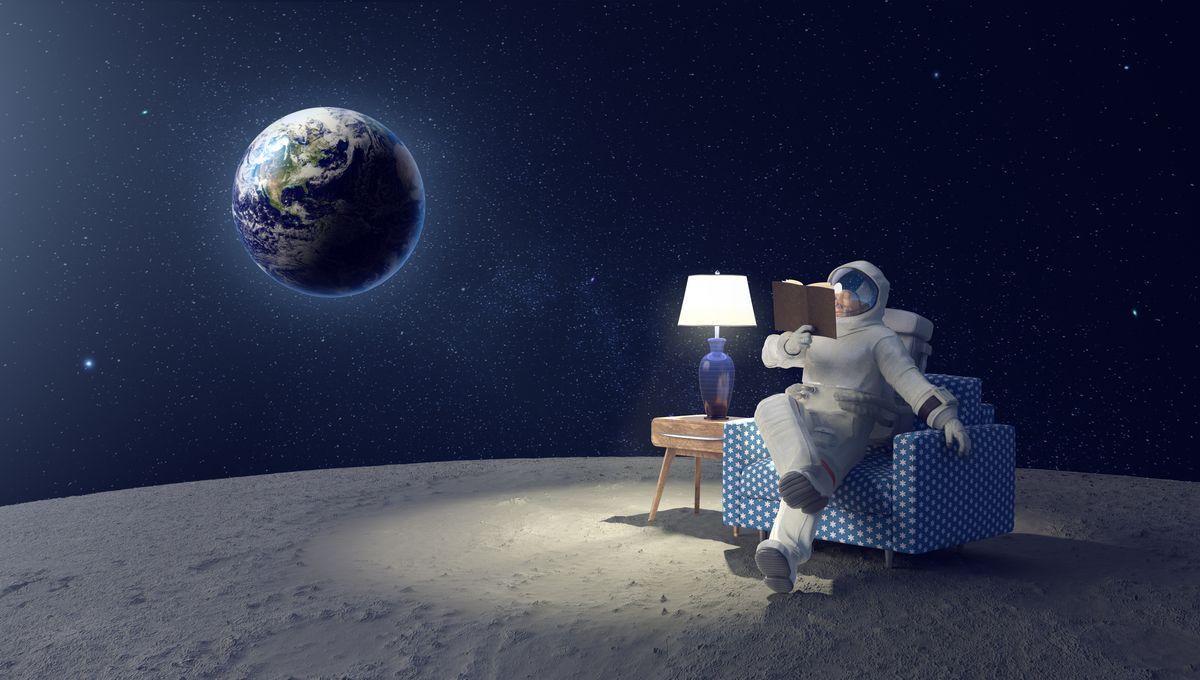
Would you move to the Moon? It’s probably the cosmic world you’re most familiar with other than, you know, Earth – and where better to brag about having a holiday home? One thing − can you even buy real estate on the Moon?
If you build a house on the Moon, according to the Outer Space Treaty, anybody can come traveling through it.
As luck would have it, we crossed paths with a Space Lawyer last month, giving us the opportunity to ask just that. And before you ask, yes, Space Lawyer is a real job title. Not only is Michelle Hanlon, Air and Space Law Instructor, Research Counsel, using her legal knowledge to reshape our understanding of the Outer Space Treaty, but she’s contributed towards creating the first ever off-planet heritage sites for humankind, while also considering what allowances we need to make should life on other worlds end up sharing space with the human race.
What does being a Space Lawyer involve?
MH: We have a treaty in place that governs activities in outer space and it is really like the Magna Carta of space activity. The most important precept of the Outer Space Treaty is that space is for everyone, and everyone shall have freedom of exploration and access to all areas. The other really important precept is that no state may claim territory in space. So fundamentally, then the question is, if you can’t claim territory, how can we build communities in space? Because that concept is based on the idea of property of ownership.
What my work is focused on is understanding how to thread the needle between the idea of freedom of access, for everybody. If you think about it, if you build a house on the Moon, according to the Outer Space Treaty, anybody can come traveling through it.
But is that really freedom of access? How do we balance this freedom against what we know we need? And so, for example, here on Earth, the [United Nations] Declaration of Human Rights says everybody has a right to own property. And so that can’t just be taken away when you go to space. So, we’re really trying to find that balance and understand how we’re going to build communities peacefully, within the framework that’s set up by this Outer Space Treaty.
Are there any Earthly concepts that help you do this?
Space is infinite, and we have to be mindful that perhaps there are other beings in space that are sentient.
MH: There are places on Earth that are not governed by any jurisdiction: the high seas. So, we do have a little bit of a concept of what it looks like to be active in an area that has no sovereign jurisdiction. The problem is that we still have flags, and we’re talking about boats floating, there are no islands in the high seas that aren’t claimed by anybody.
So, we can’t quite move that concept to space. A lot of people try saying the high seas are considered a global commons, and from an economic and philosophical standpoint, space is a global commons. But space is infinite, and we have to be mindful that perhaps there are other beings in space that are sentient. So, this concept that all of space belongs to all of humanity, it’s kind of bunk, right? Certainly, when we look at low-Earth orbit, that is a finite resource. I view low-Earth orbit like the high seas. We’re junking it up because nobody’s taking responsibility, and that’s a problem. But when you get beyond low Earth orbit, when you get beyond our Moon, then you really have no Earthly precedents.
Is the increase in space activity making your life more complicated?
MH: It is, but in only the best way possible. This is the period that historians will look back on and say, this is the democratization of space. It used to be only nations could go, and it was only Russia, the US, and China. Thank goodness for these billionaires who are spending their own money to figure out how to get to space, because certainly the taxpayers don’t have the money to do that and shouldn’t be funding it.
Subscribe to our newsletter and get every issue of CURIOUS delivered to your inbox free each month.
Article Six of the Outer Space Treaty says that states have to take responsibility for their nationals in space, whether they’re governmental entities or not. Elon Musk and Jeff Bezos are American nationals, their companies are American companies, and the United States has a responsibility to make sure that their activities conform with the Outer Space Treaty.
It just opens up so many questions from a legal standpoint; what does conform mean? Does that mean they have to follow the letter of the law of the Outer Space Treaty? Which itself doesn’t say you’re obligated to meet all the responsibilities; it just says conform. Article Two says you cannot claim territory by means of sovereignty, or any other means, but it doesn’t say that just a human individual can’t. And now we’re seeing that possibility. I love the Outer Space Treaty, it’s a wonderful document, but it has a lot of gaps, and we really need to start thinking about filling those gaps.
What about building a hotel on the Moon? There’s nobody who has the authority to say, yes, you can build that hotel.
So… could we one day buy real estate on the Moon?
MH: That’s a really interesting question. We could, but I think it would be sad if we did. The problem, when you think about buying something, is who owns it in the first place. When you purchase a property, you go to a government who has the authority to say you will now own this plot of land. Nobody has that authority over the Moon.
If you’re building lunar research stations, the Outer Space Treaty has this concept that if it’s for science it’s OK, so long as you share all your information with everybody. But what about building a hotel on the Moon? There’s nobody who has the authority to say, yes, you can build that hotel.
It’s a difficult process, but it has to happen if we are going to explore beyond our orbits. We’re going to need to allow people to build houses and claim land. I personally would like to see the Moon treated a little bit differently from the rest of space, let’s keep the Moon as pristine as we can.
Is it cool being a Space Lawyer?
MH: Oh my goodness, I love every day. I pinch myself all the time. I was a business attorney for 25 years before I became a Space Lawyer. I’m very detail-oriented and like to read contracts, and get into the weeds of things. So, I really enjoy it every time I read the Outer Space Treaty. I see different interpretations and different things in different ways.
It’s just such an exciting field of law to be in because there are no laws; we’re really making it up as we go along. Hopefully, I’m contributing to the responsible management of our space activities, but what I really love about what I do is every day seeing endless possibilities. I’m very optimistic that the more we interact with space, the more humans we send to space, the more we’re going to remember our kinship with each other.
CURIOUS magazine is a digital magazine from IFLScience featuring interviews, experts, deep dives, fun facts, news, book excerpts, and much more. Issue 16 is out now.

Source Link: Can You Buy Real Estate On The Moon?
