Humanity has never observed the very first stars that shone in the universe. They lived fast and died young, but they were the ones that created the heavier elements that eventually ended up making us. Astronomers now suggest that some recent observations of very distant galaxies can only be explained by the presence of enormous stars.
The team called them “celestial monsters”, and they are not kidding. These are stars between 5,000 and 10,000 times the mass of our Sun that lived at most for two million years. At their cores, they were five times hotter than the center of the Sun.
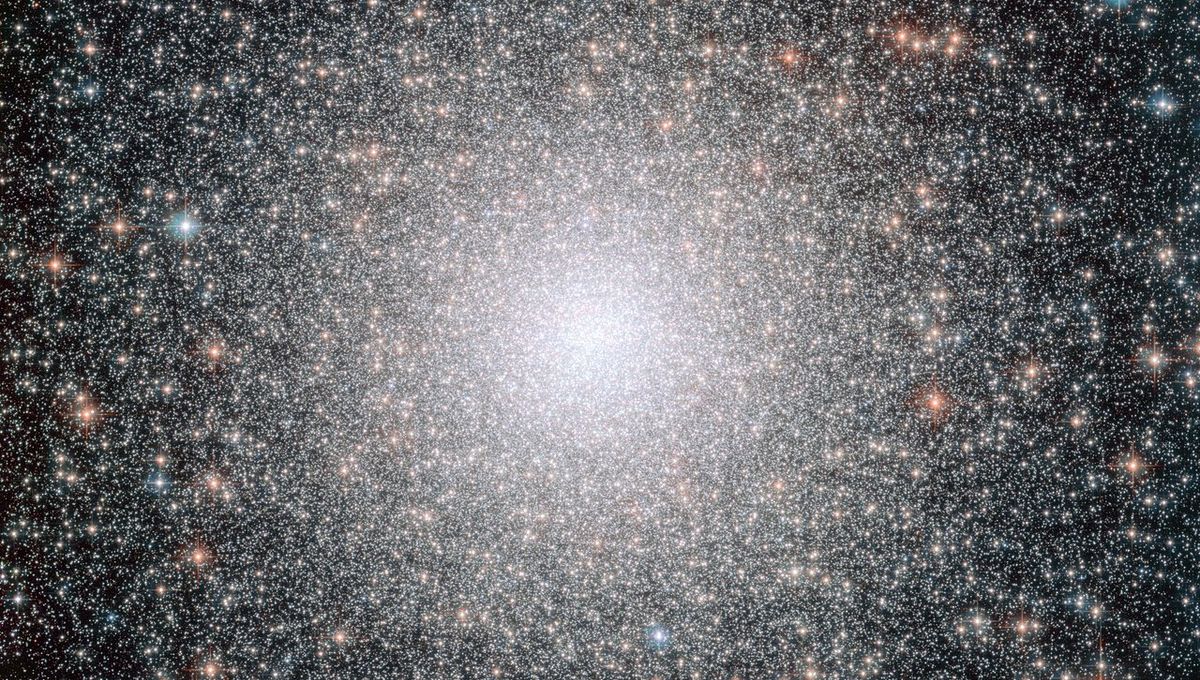
These supermassive stars formed in many different environments, but the one that intrigued researchers was globular clusters. These are the most massive and oldest clusters of stars in the universe, and they are very dense. Astronomers believe that these supermassive stars formed in globular clusters as well – not that they can be seen directly yet, unfortunately.
“Globular clusters are between 10 and 13 billion years old, whereas the maximum lifespan of superstars is two million years. They therefore disappeared very early from the clusters that are currently observable. Only indirect traces remain,” co-author Mark Gieles, ICREA professor at the University of Barcelona, said in a statement.
But they do leave something behind: heavier elements. And it is this signature that JWST has spotted in galaxy GN-z11, an object that for a while held the title of the most distant known galaxy. Thanks to JWST’s observations, astronomers have learned a lot more about this object whose light comes from just 400 million years after the Big Bang.
“It has been established that it contains very high proportions of nitrogen and a very high density of stars,” added co-author Daniel Schaerer from the University of Geneva.
And the extra nitrogen is seen as a telltale sign of the fleeting but crucial presence of the supermassive stars in these globular clusters. You wouldn’t get as much of that element unless you had stars massive enough.
“The strong presence of nitrogen can only be explained by the combustion of hydrogen at extremely high temperatures, which only the core of supermassive stars can reach, as shown by the models of Laura Ramirez-Galeano, a Master’s student in our team,” explained lead author Professor Corinne Charbonnel, also from the University of Geneva.
The model can explain the anomaly in the abundance of nitrogen but it is not definite proof of the supermassive stars having been there. The team plans to use more JWST observations of distant galaxies to further strengthen their work.
The study is published in the journal Astronomy and Astrophysics.

Source Link: "Celestial Monster" Stars Up To 10,000 Times Our Sun's Mass Left Clues For JWST
