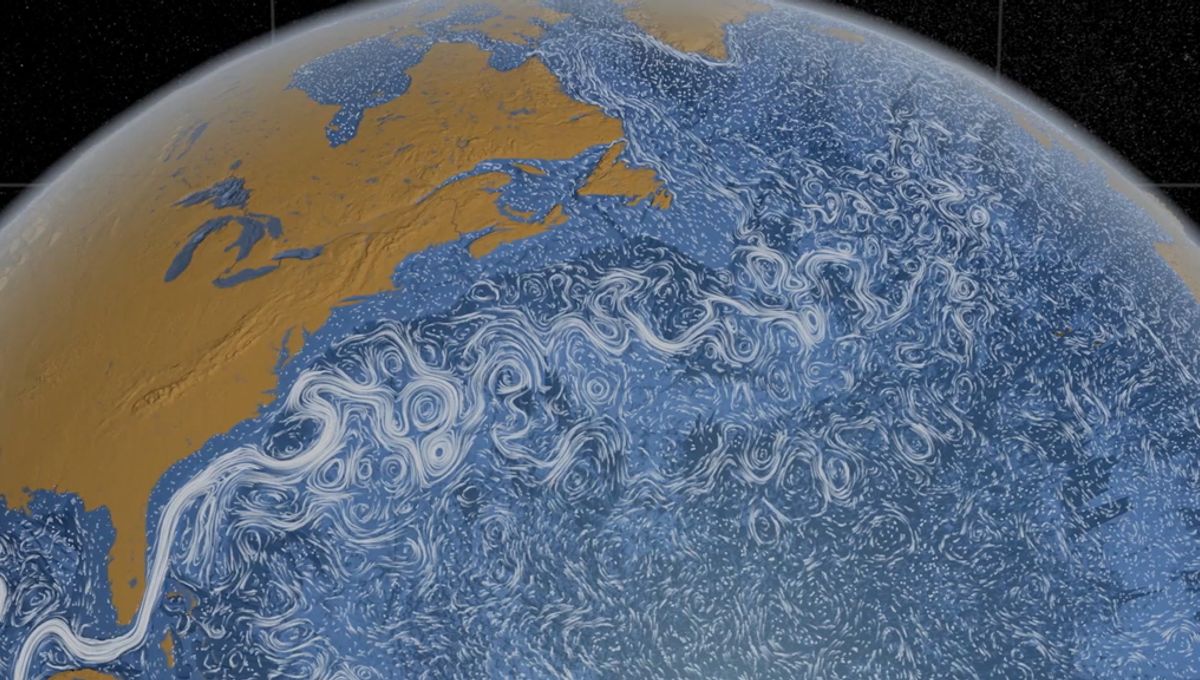
Colossal changes to ocean circulation have caused the waters of the North Atlantic to become significantly saltier in the past 50 years when compared to the world’s other great ocean, the Pacific.
The Atlantic Ocean is saltier than the Pacific Ocean. Evaporation is more intense in the Atlantic compared to the Pacific, especially in the tropics and subtropics, which increases its salinity by sapping its water content. Furthermore, the Pacific is connected to more major river systems, allowing it to be constantly refreshed with more water from mountains and inland streams.
In a new study, scientists found that changes to the world’s climate and weather system are starting to amplify this effect, increasing the difference in salinity between the two oceans.
Researchers from the Chinese Academy of Sciences found that the contrast in Atlantic–Pacific salinity has increased by nearly 6 percent between 1965 and 2018, an effect that’s seen most significantly in the upper 800 meters (2,624 feet) of water in the northern mid-latitudes.
The two main suspects behind the shift are warming and wind. Increased ocean temperatures have caused the thermocline (an ocean layer defined by rapid change in temperature) to move towards the poles. Simultaneously, changes in winds have pushed water together in mid-latitude oceans.
Both of these effects have also been seen in the Pacific, but it’s most pronounced in the Atlantic, accounting for its massive change in salinity.
However, the researchers note that they don’t fully understand the mechanism behind these complex relationships. When they used ocean models driven by real-world atmospheric data, the models struggled to accurately reproduce observed conditions in certain regions, leading to “uncertainties in the mechanistic understanding,” they write in the paper.
Nevertheless, the findings appear to show another unexpected way in which human-driven climate change is reshaping Earth’s fundamental systems.
The shifts in saltiness might also spark a knock-on effect that impacts many aspects of the marine environment. For one, the researchers wonder whether the changes in Atlantic salinity could destabilize its different layers, which are formed of water of differing densities and temperatures. In turn, this could drive anthropogenic heat deeper into the ocean where it will linger as a literal “hot spot.”
As another example, rising salt levels in the ocean might make it harder for oxygen and nutrients to move between surface and deeper waters, reducing its ability to support plant and algae growth. Since these lifeforms underpin much of the ocean’s food chains, the impact could be profound.
The study is published in the journal Nature Climate Change.

Source Link: Changes To Ocean Circulation Are Causing The North Atlantic To Get Even Saltier
