• Email Us: [email protected]
  • Contact Us: +1 718 874 1545
  • Skip to main content
  • Skip to primary sidebar

Medical Market Report

  • Home
  • All Reports
  • About Us
  • Contact Us

Chia Seeds Confirm Alan Turing’s Predictions On Patterns In Nature

August 23, 2023 by Deborah Bloomfield

We often think of patterns and visualize something with geometric regularity, but those are not the only patterns that exist. There are plenty of patterns in nature that are hardly geometrical but are clearly distinctive – think of the spots on a giraffe (although they now come in plain too!). We might not instinctively understand the rules behind that pattern, but luckily Alan Turing did it for us. The same rules have now been shown in how chia seeds germinate.

Alan Turing is famous as the father of the field of computing, the person who worked out how to crack the German Enigma machine, shortening World War 2 saving countless lives, and for being persecuted by the British State for being gay. Among his less celebrated accomplishments, there is a 1952 paper titled “The Chemical Basis of Morphogenesis“. In it, Turing describes how certain patterns emerge from a homogenous and uniform state.

Advertisement

“When you think about the spots on a leopard or the stripes on a tiger, those are patterns where there is this element, the stripe or the spot, that’s repeated, but it’s not repeated perfectly. There’s not that perfect regularity you get from, say, a checkerboard. But there’s still this shape, this feature that is repeated across space,” Ben Balas, a professor of psychology at North Dakota State University, told IFLScience in a previous feature about patterns.

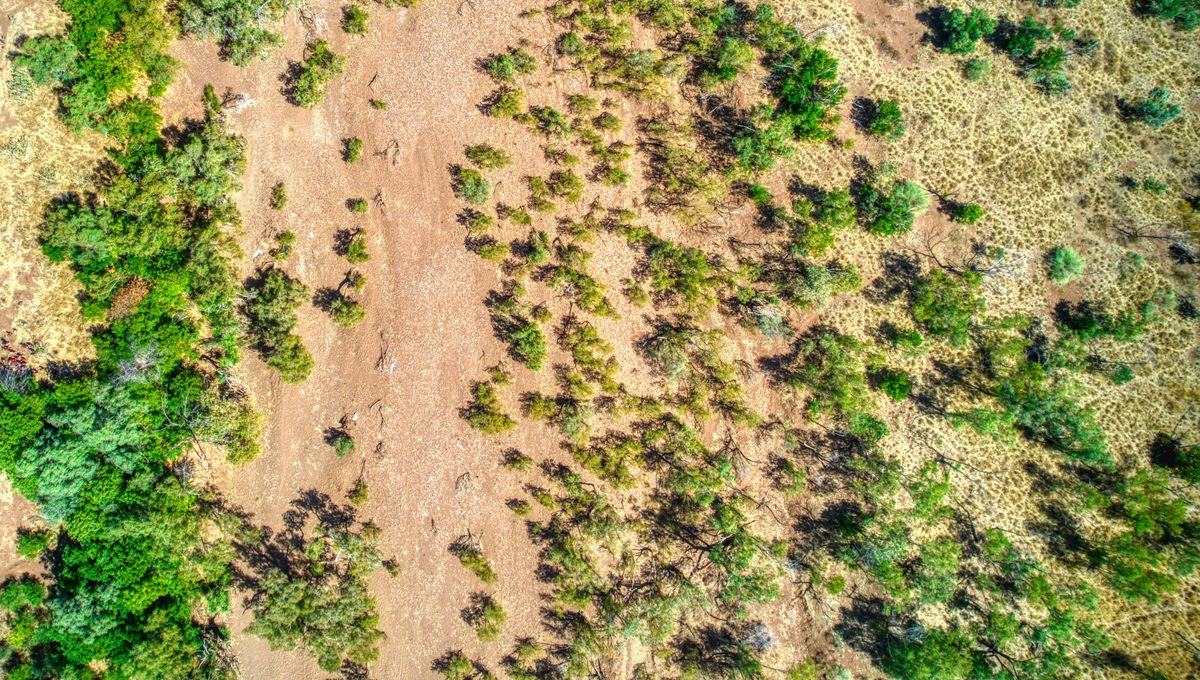
Scientists suspected that these same patterns can be applied to the behavior of growing plants, especially in locations where the availability of resources such as water is scarce, like semi-arid regions. But proving it was easier said than done.

Researchers have now been able to simulate the emergence of these patterns in a biological system. They believe it is the first time that Turing patterns in vegetation growth have been validated with experiments.

The team had chia seeds growing in four substrates with different levels of diffusion, irrigation, and evaporation. They had simulations set with the same parameters. They showed that no matter the availability of water, chia seeds match expectations from mathematical models.

Advertisement

“In previous studies, people kind of retroactively fit models to observe Turing patterns that they found in the world, ” lead researcher Brendan D’Aquino, who is an undergraduate computer science student at Northeastern University, told ScienceNews. “But here we were actually able to show that changing the relevant parameters in the model produces experimental results that we would expect.”

The research was presented earlier this year at the American Physical Society March Meeting.

[h/t: ScienceNews]

Deborah Bloomfield
Deborah Bloomfield

Related posts:

  1. Daily Crunch: Hyundai to provide hydrogen fuel cell versions of all commercial vehicles by 2028
  2. Illumina expects EU order to keep Grail a separate company
  3. Britain to say Brexit arrangements for Northern Ireland are too harmful to retain
  4. Bird Flu Vaccines Could Take Just Months, And Rich Nations Are Already Hoarding Them

Source Link: Chia Seeds Confirm Alan Turing’s Predictions On Patterns In Nature

Filed Under: News

Primary Sidebar

  • Do Any Animal Species Actively Hunt Humans As Prey?
  • “What The Heck Is This?”: JWST Reveals Bizarre Exoplanet With Inexplicable Composition
  • The Animal With The Strongest Bite Chomps Down With A Force Of Over 16,000 Newtons
  • The Eschatian Hypothesis: Why Our First Contact From Aliens May Be Particularly Bleak, And Nothing Like The Movies
  • The Great Mountain Meltdown Is Coming: We Could Reach “Peak Glacier Extinction” By 2041
  • Comet 3I/ATLAS Is Experiencing A Non-Gravitational Acceleration – What Does That Mean?
  • The First Human Ancestor To Leave Africa Wasn’t Who We Thought It Was
  • Why Do Warm Hugs Make Us Feel So Good? Here’s The Science
  • “Unidentified Human Relative”: Little Foot, One Of Most Complete Early Hominin Fossils, May Be New Species
  • Thought Arctic Foxes Only Came In White? Think Again – They Come In Beautiful Blue Too
  • COVID Shots In Pregnancy Are Safe And Effective, Cutting Risk Of Hospitalization By 60 Percent
  • Ramanujan’s Unexpected Formulas Are Still Unraveling The Mysteries Of The Universe
  • First-Ever Footage of A Squid Disguising Itself On Seafloor 4,100 Meters Below Surface
  • Your Daily Coffee Might Be Keeping You Young – Especially If You Have Poor Mental Health
  • Why Do Cats And Dogs Eat Grass?
  • What Did Carl Sagan Actually Mean When He Said “We Are All Made Of Star Stuff”?
  • Lonesome George: The Giant Tortoise Who Was The Very Last Of His Kind
  • Bermuda Sits On A Strange, 20-Kilometer-Thick Structure That’s Like No Other In The World
  • Time Moves Faster Up A Mountain – And That’s Why Earth’s Core Is 2.5 Years Younger Than Its Surface
  • Bio-Hybrid Robots Made Of Dead Lobsters Are The Latest Breakthrough In “Necrobotics”
  • Business
  • Health
  • News
  • Science
  • Technology
  • +1 718 874 1545
  • +91 78878 22626
  • [email protected]
Office Address
Prudour Pvt. Ltd. 420 Lexington Avenue Suite 300 New York City, NY 10170.

Powered by Prudour Network

Copyrights © 2025 · Medical Market Report. All Rights Reserved.

Go to mobile version