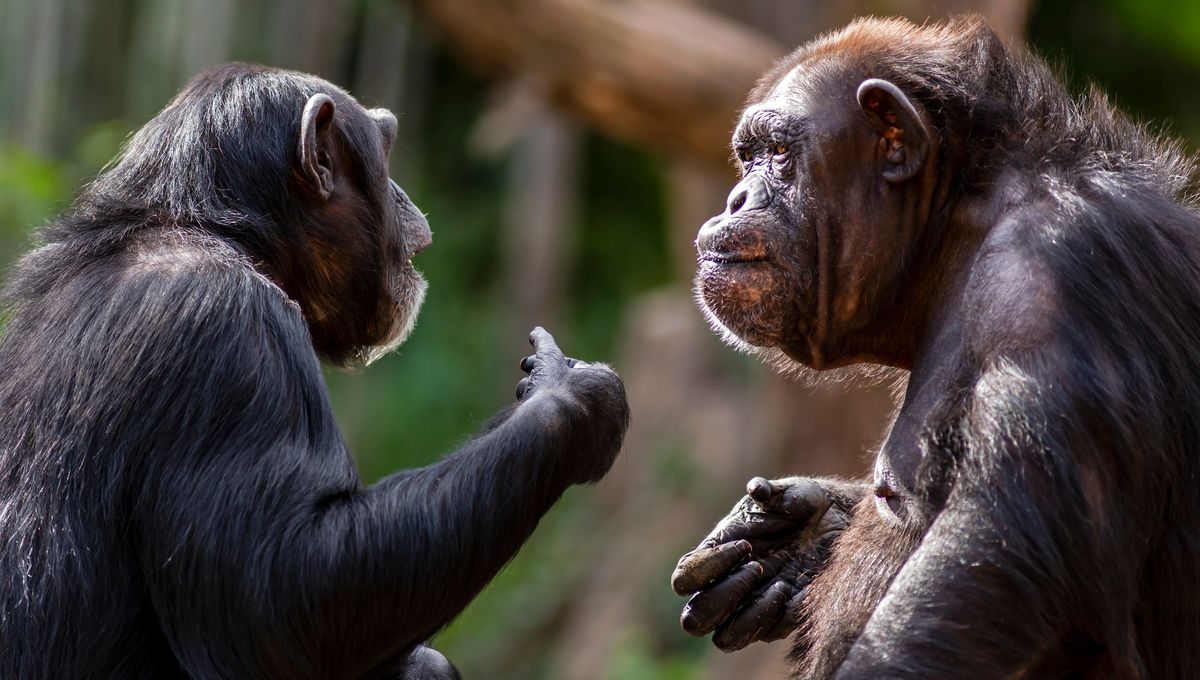
At the end of the day, humans are just another kind of ape – sharing DNA, anatomy, and apparently, even basic thought patterns. At least, that’s according to a new study out of the University of St Andrews in Scotland, which finds that, while chimps may not have the language capabilities that humans do, they’re nevertheless capable of the kind of logical reasoning we often assume is unique to humanity.
“Chimpanzees understand that, when making some choices, they are relying on lucky guesses,” reports a statement from The Royal Society, who published the research in their journal Biology Letters.
“Nine chimpanzees housed at Edinburgh Zoo were given a series of tasks where food rewards were hidden under cups. Chimpanzees were more likely to take a smaller, visible reward than take a risk choosing a cup potentially hiding food,” it explains. “Taken together, the experiments show that these logical reasoning abilities are present in non-human animals, and language is not an essential pre-requisite.”
In the world of non-human cognition, this is a pretty bold statement. Both children and non-human animals seem able to appreciate when odds are better or worse in object search or population-to-sample choice tasks, but their comprehension has one glaring hole: they “fail to appreciate the unique value of a certain outcome (p = 1), choosing it approximately equally to an alternative with p = 0.50,” the researchers write.
The reason for that, previous researchers have posited, is that they lack the language capabilities to fully understand probability. Instead of picking the certain win, the theory goes, preverbal children and animals “instead […] chooses indiscriminately between the certain and the simulated certain outcomes, because in the eyes of the minimal agent, both are known.”
Theoretically, this should mean that chimps presented with, say, two containers, one of which held some hidden tasty treat, will find the food about half the time. But according to the new research, that simply wasn’t the case.
“The chimps were shown pairs of cups, one hiding a delicious snack, the other empty,” the statement reports. “Sometimes, the chimps were shown where the food was being hidden, but sometimes they weren’t. After picking a cup, the chimps were offered the opportunity to pick between the remaining cup, with the risk that it was another dud, or a smaller, but certain, snack.”
“They were more likely to opt for the safe, smaller snack if they hadn’t seen the original cup and food setup,” it explains.
The effect was reduced, however, when the researchers upped the number of cups: immediately, the chimps’ success rate went down to chance levels. For that reason, while the team suggests that future research may be able to counter this primate stumbling block, they can’t completely dismiss the longstanding hypothesis that language is needed to properly understand probability for now.
But that doesn’t mean the chimps were helpless in the face of an extra cup. With food hidden in one of three cups, the chimps changed their responses based on whether they were successful with their first choice or not: “Following a failure with their first choice, the chimps again went for the small but secure reward,” the statement notes. That’s still evidence of some pretty high-level thinking: “apes not only consider that a food item might be located under cup A or cup B […] but additionally, that the likelihood that the food item will be in cup B increases or decreases depending on whether they observe that cup A is empty or baited, respectively,” the paper points out.
“It has been suggested that apes’ failure to appreciate a certain outcome is owing to an incapacity to discriminate p = 1 from p = 0.5,” the researchers write. “However, the data presented here challenge that.”
“Chimpanzee choices are not governed by a singular simulation of reality,” they conclude, “and reflect the dependent relationship between mutually exclusive possibilities.”
The paper is published in the journal Royal Society: Biology Letters.

Source Link: Chimpanzees Wing It Too, And They Know When They're Doing It
