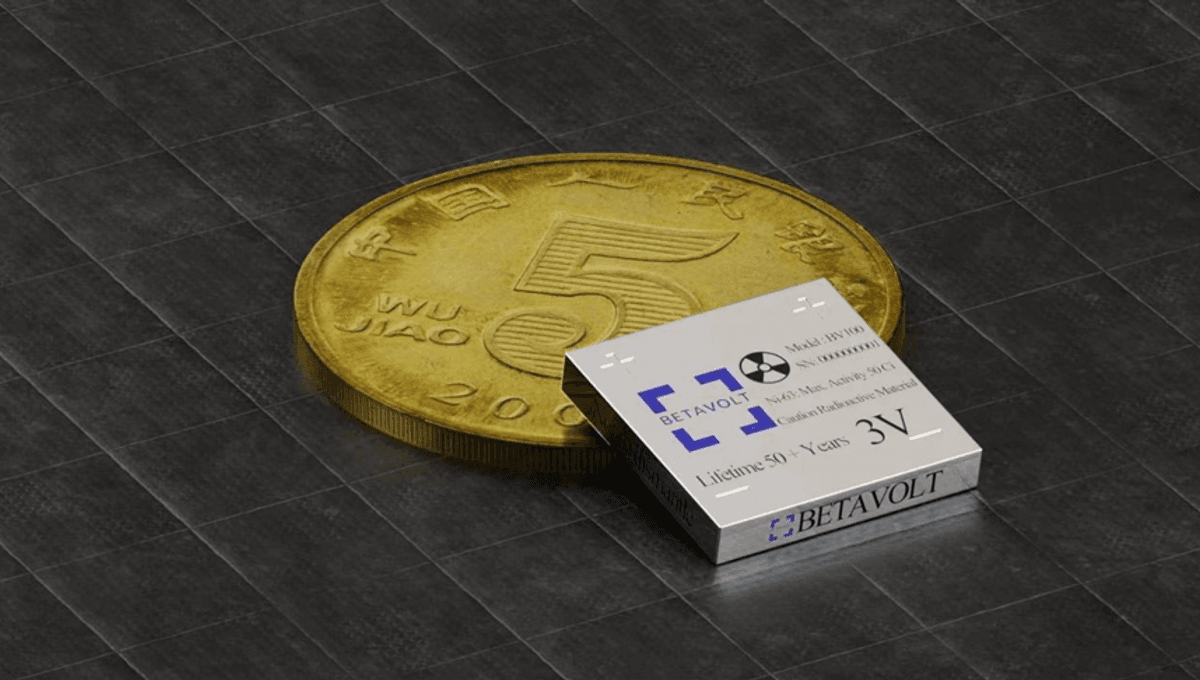
A Chinese startup has developed a tiny nuclear battery that it claims can generate electricity for 50 years without the need for charging. Just the size of a small coin, the company suggests that this technology has the potential to power a smartphone in the future (although there’s a lot of work ahead before that becomes a reality).
Beijing-based Betavolt unveiled the miniature atomic energy battery on January 8, boasting in a press release that the technology is “way ahead of European and American scientific research institutions and enterprises.”
Called BV100, the battery produces electricity by utilizing the energy emitted by a decaying radioactive isotope of nickel (nickel-63). In between the layers of nickel-63 are sheets of a single-crystal diamond semiconductor that are just 10 microns thick.
It can store 3,300 megawatt hours and reportedly holds an energy density that’s more than 10 times that of conventional lithium batteries. According to Betavolt, it will be able to sustain its output for up to 50 years without the need for charging or maintenance.
Measuring 15 x 15 x 15 millimeters, the battery’s power is 100 microwatts and the voltage is 3 volts. Bear in mind, that capacity is pretty meager and isn’t yet nearly strong enough to power an electronic device like a smartphone, let alone a laptop.
That said, Betavolt notes that several of the batteries could potentially be used in series or parallel to power more demanding devices.
Keeping a capsule of radioactive decay in your pocket might sound like risky business, but the company insists the battery is “absolutely safe.” So safe, in fact, they believe it could eventually be used to power medical devices such as pacemakers and artificial hearts.
The company states there is no external radiation, adding that the battery “will not catch fire or explode in response to acupuncture and gunshots,” which is always a plus.
Today, thermonuclear batteries are only used in aerospace engineering. For instance, the Voyager probes were fitted with a form of nuclear battery developed during the Cold War. Launched in 1977, the pair of Voyager spacecraft are still cruising through the outskirts of our Solar System.
However, Betavolt believes their new product shows how nuclear batteries could even be used by consumers in everyday use.
They say the battery is currently in its “pilot stage” and will soon be put into mass production. Looking ahead, the company plans to create more powerful batteries and wants to explore the use of different radioactive isotopes.
“The company plans to launch a battery with a power of 1 watt in 2025. If policies permit, atomic energy batteries can allow a mobile phone to never be charged, and drones that can only fly for 15 minutes can fly continuously,” Betavolt said in their statement.

Source Link: China Unveils Coin-Sized Nuclear Battery That Lasts For 50 Years
