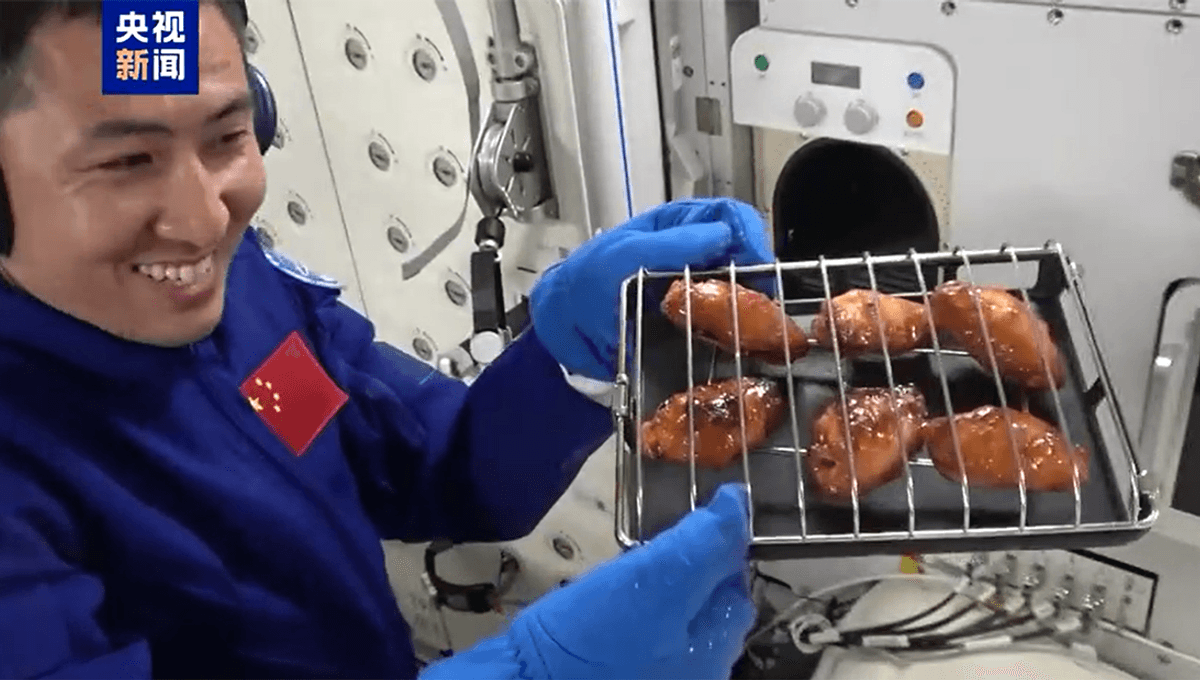
Chinese astronauts aboard the Tiangong space station orbiting the Earth have enjoyed humanity’s first-ever barbecue in space.
While developing food that can be conveniently stored and eaten is space became a priority as humanity took longer missions into our Solar System, so far astronaut and cosmonaut menus have been somewhat restricted. The first person to eat in space was also the first person in space; Yuri Gagarin. It wasn’t the most appetizing of meals, consisting of a tube of beef and liver paste, with a chocolate sauce for pudding.
“John Glenn, America’s first man to eat anything in the near-weightless environment of Earth orbit, found the task of eating fairly easy, but the menu limited,” NASA explains.
“Other Mercury astronauts had to endure bite-sized cubes, freeze-dried powders and semi-liquids packaged in aluminum tubes. Most agreed the foods were unappetizing and disliked squeezing the tubes. Moreover, freeze-dried foods were hard to rehydrate and crumbs had to be prevented from fouling instruments.”
Over the years, space food and space food safety has improved. During the Gemini missions, the freeze-dried food cubes were coated in a gel to prevent them crumbling so much, while the Apollo missions saw further advancements.
“Some improvements were made in the course of the Apollo program, including the addition of hot water to rehydrate some food items and food that could be eaten out of its bag using a spoon,” NASA explains. “Sandwiches were tried but proved less than ideal, as the bread didn’t stay very fresh and caused crumbs that would float away in the cabin and possibly cause harm to sensitive equipment or even get in the astronaut’s eyes or lungs.”
After humanity began creating space stations, space food began to improve too. Skylab was the first to have a freezer on board, while the Space Shuttle was fitted with a galley to rehydrate and reheat food. Astronauts and cosmonauts on the International Space Station (ISS) now enjoy a varied diet, even if it still doesn’t look too appetizing.
Fire in space is not ideal, acting differently there to on Earth (for example, being spherical).
“As the gravity field is reduced on Mars (0.38 g) or on the Moon (0.16 g), buoyancy decreases and the typical time required to detect a fire with regular equipment is consequently greater,” Guillaume Legros of France’s Institut de Combustion, Aérothermique, Réactivité et Environnement told the European Space Agency.
“Worse still, in a spacecraft, there is no buoyant flow and the smoke will consequently follow the complex air motion imposed by the ventilation system, leading to a longer fire detection time by smoke detectors typically placed along the vent lines.”
While astronauts and cosmonauts have heated food in space, they have never truly cooked anything, until now. A new hot air oven, delivered to the Tiangong space station by the Shenzhou-21 spacecraft has provided astronauts with the first-ever food cooked in space. The first meal the astronauts ate was barbecued chicken wings, followed by a beef dish.
“By raising the temperature to 190 degrees Celsius, astronauts can now really cook in orbit. Previous food heating is purely physical warming, but this is actual cooking, with chemical reactions included. The food can now come out golden and crispy,” Liu Weibo, deputy chief designer of astronaut systems at the China Astronaut Research and Training Center, explained in a statement to Chinese national broadcaster CCTV.
“They can bake cakes, roast peanuts, or grill meat, and it’s really delicious. This means astronauts can enjoy special meals on weekends, birthdays, or holidays. It greatly helps to enrich their dining experience and improves overall living conditions in orbit.”
Safety is, of course, paramount. The oven keeps food securely in place, preventing it from floating away, while a built-in purification system prevents smoke from causing issues for the astronauts.
“We used high-temperature catalysis and multi-layer filtration technologies to enable smoke-free baking,” Xian Yong, researcher, China Astronaut Research and Training Center, added.
“Given the special conditions in orbit, we have made sure that the hot air oven is completely reliable and safe. Every part of the oven astronauts may touch remains cool so as to prevent burns.”
Cooking time is a little slow, with the wings reportedly taking 28 minutes to come out as crispy as they did. But it’s a huge leap forward for food technology in space, and could allow for a much more appetizing and varied diet. It’s one wing for man, one giant bucket of wings for mankind.

Source Link: Chinese Astronauts Just Had Humanity's First-Ever Barbecue In Space
