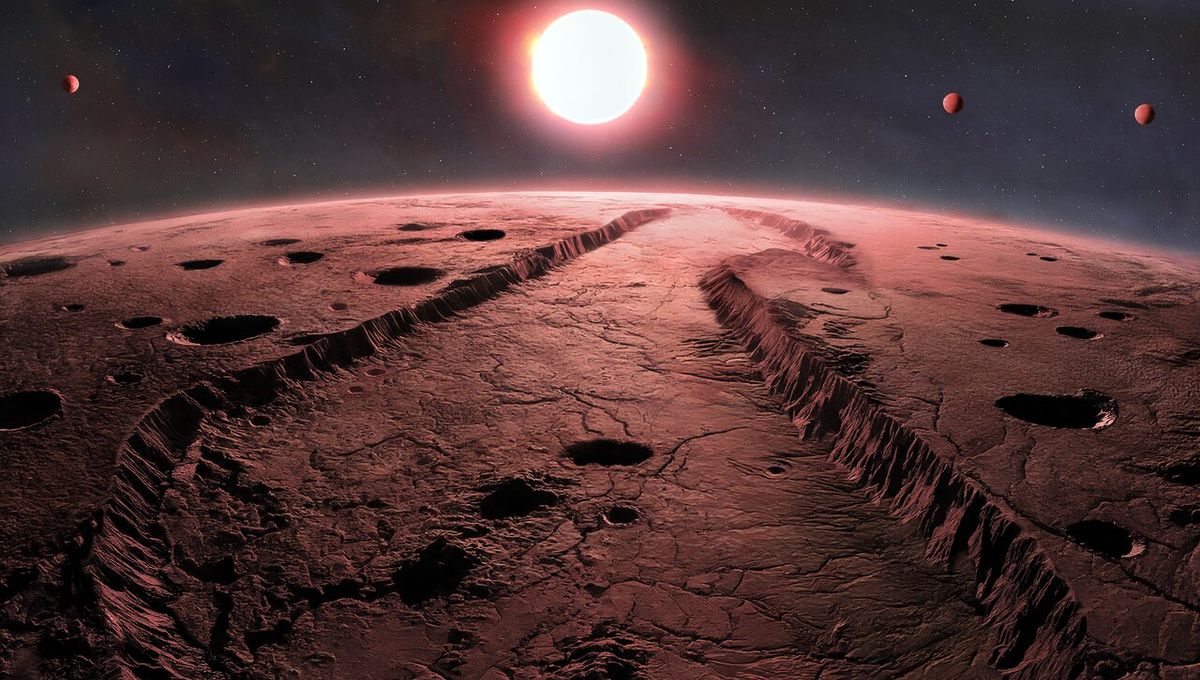
Barnard’s Star is located just 6 light-years away from us. It is the closest single star to the Sun and the fourth closest star overall, after the three stars in the Alpha Centauri system. Just a few months ago, it was discovered that it had a little planet around it. Now three more have been discovered and they are all tiny.
Barnard’s Star is an old M dwarf star, much smaller and much cooler than our Sun. Very few planets smaller than Earth have been found at all so the fact this nearby star has four is curious. These tiny planets orbit around the star in a matter of days: the closest in just 2.3 days and the farthest in 6.7. This places them too close to the star to be in the habitable zone as they are too hot.
The planets have minimum masses between 20 percent and 34 percent of the mass of the Earth, so two to three times the mass of Mars. The observational data in this work currently excludes planets larger than 57 percent the mass of Earth within Barnard’s Star’s habitable zone, that’s for planets with a year of 10 to 42 days, so chances of habitable environments in these nearby planets are pretty low.
“It’s a really exciting find — Barnard’s Star is our cosmic neighbor, and yet we know so little about it,” lead author Ritvik Basant, a graduate researcher at the University of Chicago, said in a statement. “It’s signaling a breakthrough with the precision of these new instruments from previous generations.”
From our point of view, the planets do not cross the disk of the star, so we can’t study them in transit – that means when they block some of the starlight as they orbit, which is how we often detect the presence of planets around a star. Instead, they were discovered by looking at the little wobble of the star due to their gravitational pull. The most distant planet is actually the smallest ever found with this method.
Not seeing them directly makes it a challenge to study them but also a challenge to discover them in the first place. Barnard’s Star is infamous among astronomers as many claims over the last century have suggested planets around it but only now we have the combined power of high-precision technology like the MAROON-X instrument on the Gemini North telescope and the ESPRESSO instrument at the European Southern Observatory’s Very Large Telescope have we been able to confirm their presence.
“We observed at different times of night on different days. They’re in Chile; we’re in Hawai‘i. Our teams didn’t coordinate with each other at all,” added Basant. “That gives us a lot of assurance that these aren’t phantoms in the data.”
A paper detailing the discovery is published in The Astrophysical Journal Letters.

Source Link: Closest Single Star To The Sun Discovered To Have Four Little Planets Around It
