


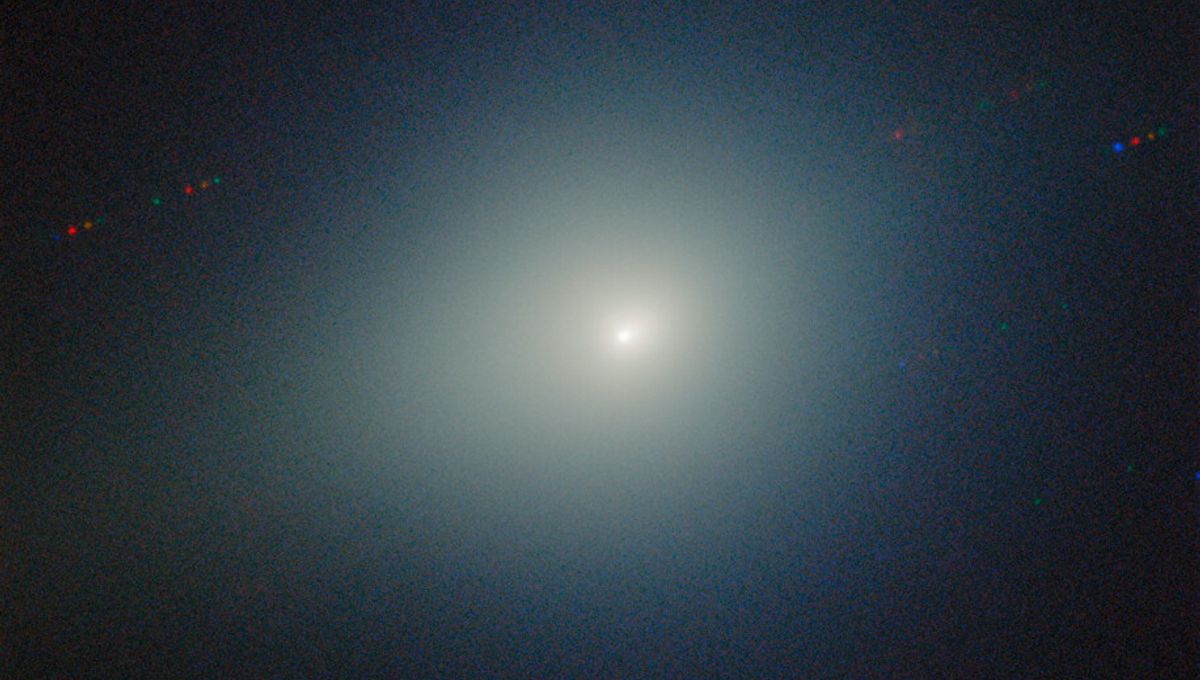
Interstellar comet 3I/ATLAS was discovered just five and a half months ago, and in that time has taken the world by storm. This peculiar object, only the third interstellar object discovered among the thousands estimated to be passing through our Solar System, is endlessly fascinating. There have been a few studies in the last several weeks explaining that 3I/ATLAS is experiencing a non-gravitational acceleration. However, since that sounds a bit like something else could be powering it (an engine of a spacecraft, according to some people, for example), we wanted to make sure people know what that actually means.
The rest of this article is behind a paywall. Please sign in or subscribe to access the full content.
There has been a lot of misinformation about this comet, including claims that it was a spacecraft in disguise using its close passage to the Sun back in October – a time when the comet was invisible to us due to the Sun’s brightness – to perform an unseen maneuver and attack our planet. Since none of that happened, the focus is now on the non-gravitational acceleration, which is perfectly normal for comets, but sounds like sci-fi, so why not throw in some perfidious aliens?
What is non-gravitational acceleration?
Non-gravitational acceleration means that a celestial body is experiencing an acceleration that is not due to the gravitational force of other planetary bodies or the Sun. Is it rockets? No, it’s due to outgassing.
Comets are large chunks of ice and rock, often called “dirty snowballs”, and when they come close to the Sun, they get heated up and begin to sublimate. This means the body’s frozen ices (water, carbon dioxide etc) turn from solid to gas without passing through the liquid phase. This is not a smooth process, and often comets (and at least one asteroid we know of, 3200 Phaeton) release jets of material that form the tail and coma (the cloud of gas and dust surrounding the nucleus) you often see in images.
These jets can and often do affect the motion of the comet, producing the non-gravitational acceleration. The exact dynamics cannot be worked out because the nucleus of comets is tiny, all things considered. Despite a coma that stretches over 100,000 kilometers, the famous Halley’s comet nucleus is just 15 kilometers (almost 10 miles) on its longest axis; 3I/ATLAS might be much shorter than that.
A comet also rotates, showing different regions to the sunlight at different times. Comets are not perfectly uniform spheres; they are messy potato-shaped chunks. This uneven list tells us that the jets and outgassing might happen more on one part of the body than another, at different intervals, and with different effects.

Still, cumulatively, the loss of material shifts the comets. For 3I/ATLAS, researchers were able to measure it using Earth-based telescopes (which, for this, include orbiting ones such as Hubble), together with the European Space Agency’s Trace Gas Orbiter around Mars and NASA’s Psyche mission in deep space.
These combined observations suggest an acceleration of about half a micron per second squared. This is tiny compared to the gravitational pull of a planet, but when consistent, it can cause a deviation in the predicted orbit over time. Still, a change in speed of less than a micron per second every second doesn’t strike us as an artificial spacecraft attempting something weird.
However, authors of a new study were able to find something exciting from this small variation. An estimate of the mass of the comet before it got close to the Sun and experienced most of its outgassing. They claim that the comet in September was 44 million metric tons; that’s roughly just over seven times the mass of the Great Pyramid of Giza. If this estimate is correct, 3I/ATLAS’s nucleus might be a bit smaller than previous estimates, about 375 meters ( 1,230 feet).
The study is published in the journal Research Notes of the American Astronomical Society.


Source Link: Comet 3I/ATLAS Is Experiencing A Non-Gravitational Acceleration – What Does That Mean?