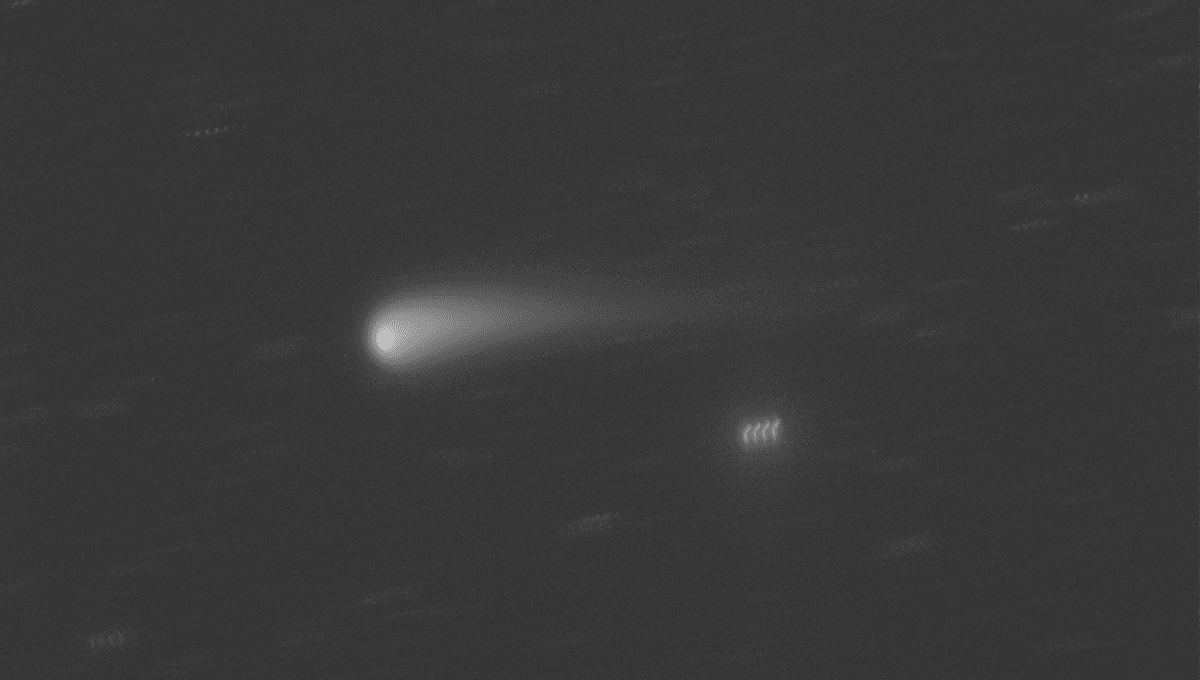
Back in May, we brought you the news that Comet C/2023 A3 (Tsuchinshan–ATLAS) would soon be visible in the night sky, as it made a close approach to the Earth.
With its closest approach to the Earth on October 12, at approximately 70.6 million kilometers (43.9 million miles), it was estimated by some that the object would be brighter even than Jupiter from Earth, and perhaps even visible at sunset.
But unfortunately – according to analysis by astronomer Zdenek Sekanina, which has not yet been peer reviewed – the comet is doomed to break apart before its close approach with Earth.
According to Sekanina, the comet shows signs of disintegrating as it heads towards its closest approach to the Sun on September 27, when it will be 58.6 million kilometers (36.4 million miles) from our star.
As comets approach the Sun and heat up, they outgas, losing gas and later (when they are even closer to the Sun) dust, which form their trail or coma. This outgassing acts like thrusters, slightly altering the trajectory, rotation, and speed of the comet. This is termed “non-gravitational acceleration”, in that it is acceleration not produced by falling into a gravity well of objects in the Solar System. While the comet has been observed to be accelerating beyond what we would expect from gravitational forces alone, it has not brightened in the way we would expect.
“The first issue, which was recently called attention to by I. Ferrin, is this Oort cloud comet’s failure to brighten at a heliocentric distance exceeding 2 AU, about 160 days preperihelion, accompanied by a sharp drop in the production of dust,” Sekanina writes in the paper.
As comets approach the Sun closer than 2 Astronomical Units (AU) – with 1 AU being the distance of the Earth to the Sun – plasma tails are rarely seen, so it is unsurprising that the comet’s trail is found to be dust. However, the tail is unusually thin, and unusually shaped, resembling tails of comets arriving from the Oort cloud. These objects do not fare well during close approaches to the Sun, which isn’t great news for Comet C/2023 A3 as it approaches at roughly the distance of Mercury.
“The comets of this class have a tendency to disintegrate if they are intrinsically faint and depleted in dust by the time they are near 1 AU from the Sun,” he adds. “Given the perihelion distance of 0.39 AU, I expect that the object will disappear and cease to exist as an active comet before perihelion.”
While disappointing for people who want to see the object with their own eyes, it could be good news for astronomers wanting to learn more about the fate of these objects. For Sekanina, the evidence suggests that the comet is emitting large grains fairly far from the Sun, causing its acceleration without an associated coma. The largest of these emitted “blobs” could, he suggests, look like interstellar visitor ‘Oumuamua.
“Most unusual is the continuing absence of an ordinary dust tail, which means that large amounts of dry, fractured solid material do not disintegrate into microscopic dust, but stay assembled in dark and highly porous bizarre bodies that I refer to above as blobs,” he concludes. “Once they disperse in space, they are nearly impossible to detect, yet they may be omnipresent though perhaps short lived.”
Astronomers will continue to track the comet on its journey. It is still possible that the object will not disintegrate and will light up the sky, but if not we will still learn something interesting.
The paper is posted to pre-print server arXiv.

Source Link: Comet Tsuchinshan-ATLAS Appears To Be Breaking Up Ahead Of Close Approach To Earth
