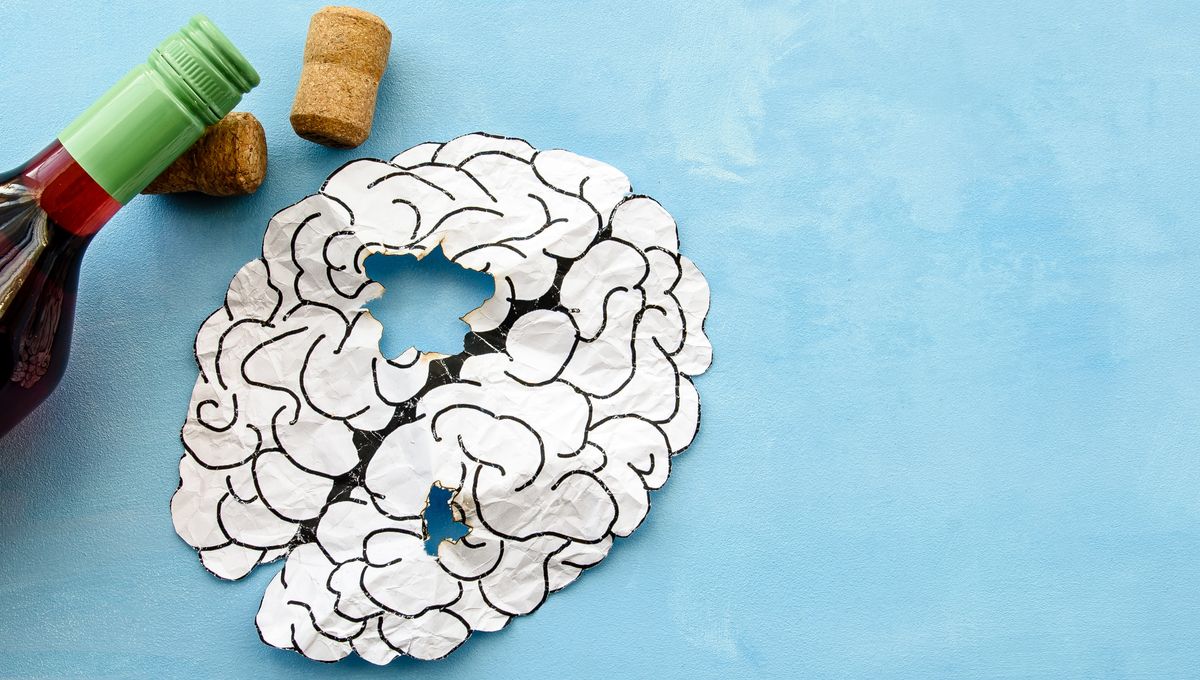
It’s a truth often played for laughs that alcohol messes with your brain function. That’s why the cops make you do stuff like walk in a straight line and touch your nose when they suspect you’ve been drinking: those are some of the first things to deteriorate after a heavy night at the bar.
But a new study has shown that frequent alcohol consumption may have some pretty gnarly effects long-term, too. “We looked at how alcohol affects the brain as people get older,” said Alberto Fernando Oliveira Justo, a postdoc at the University of Sao Paulo Medical School in Brazil and co-author of the paper, in a statement.
“We found heavy drinking is directly linked to signs of injury in the brain,” he explained, “and this can cause long-term effects on brain health, which may impact memory and thinking abilities.”
After analyzing nearly 1,800 brain autopsies from participants classified as either never, moderate, heavy, or former drinkers, Justo and his colleagues found that those who had consumed eight or more alcoholic drinks per week had 133 percent higher odds of developing a type of vascular brain legion known as hyaline arteriolosclerosis.
“Moderate, heavy, and former heavy alcohol consumptions were associated with hyaline arteriolosclerosis and neurofibrillary tangles,” the paper confirms. “The association between alcohol and cognitive abilities was fully mediated by hyaline arteriolosclerosis.”
The problem scaled with alcohol consumption: compared to non-drinkers, former heavy drinkers’ risk of having these lesions was increased by 89 percent, and moderate drinkers – defined as up to seven alcoholic drinks per week – had 60 percent higher odds. Heavy and former heavy drinkers also had significantly higher chances of developing tau tangles – an abnormal build-up of tau proteins inside neurons, known to be a primary biomarker of Alzheimer’s disease.
Further, “former heavy alcohol consumption was associated with reduced brain mass and cognitive abilities,” the authors note – though the same was not true for moderate or heavy drinkers.
And the kicker, literally: heavy drinkers died an average of 13 years earlier than their teetotal counterparts.
“Heavy alcohol consumption is a major global health concern,” Justo said of the findings, “[and is] linked to increased health problems and death.”
Now, as with any study of this type, it’s as important to know what this study doesn’t tell us as much as what it does. Crucially, this is a cross-sectional, not longitudinal, study, analyzing data from a single point in time – a limitation that the authors admit “restricts the interpretation of our findings.”
In short: the study can confirm that higher alcohol consumption seems to scale with brain damage – but whether the one causes the other, vice versa, or something completely different is going on, is not something we can conclude from the paper.
Nevertheless, it’s yet more evidence of alcohol’s deleterious effects on the brain – not only in the short term, but throughout your life.
“Our research shows that heavy alcohol consumption is damaging to the brain, which can lead to memory and thinking problems,” Justo said.
“Understanding these effects is crucial for public health awareness and continuing to implement preventive measures to reduce heavy drinking.”
The study is published in the journal Neurology.

Source Link: Consuming 8 Alcoholic Drinks A Week More Than Doubles Your Risk Of Brain Damage
