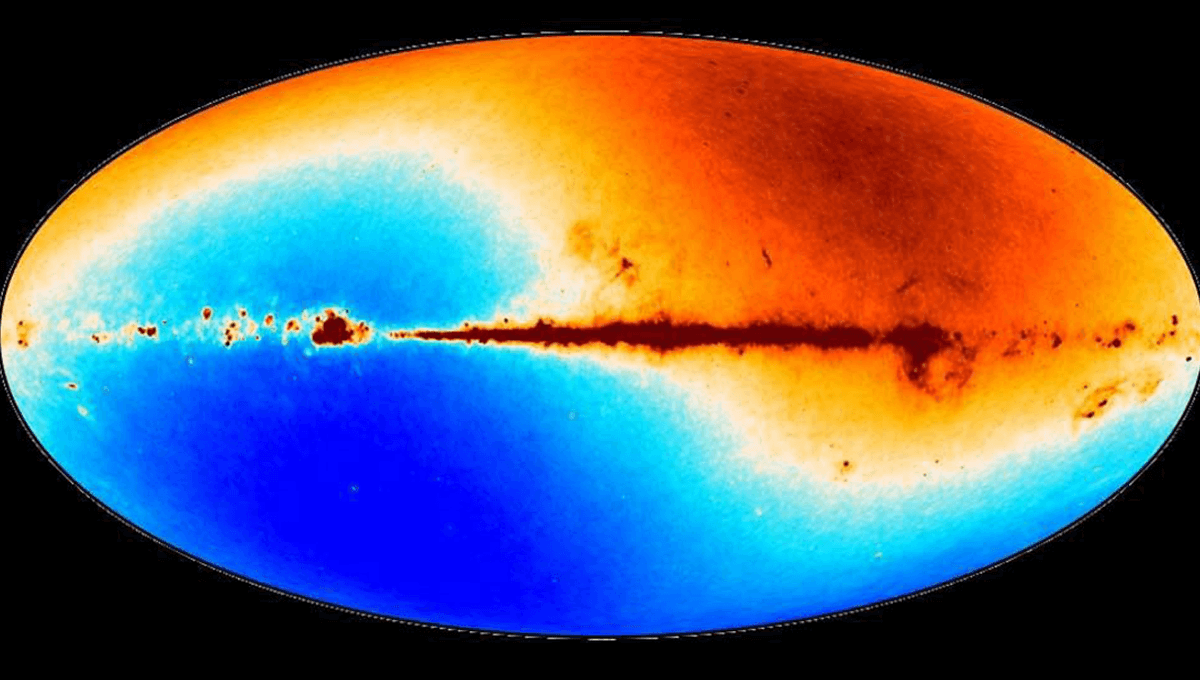
A new study from an international team of researchers suggests that the universe may be “lopsided”, and it could be a huge challenge to our current understanding of the cosmos.
The more we have learned about the world and the cosmos, the more we have had to let go of ideas of our own importance. We discovered that the world is not the center of the universe around which all objects rotate. Then we found that the Earth rotated around the Sun, and believed that that was the center of the universe instead.
Now we know that is not the case either. Abandoning ideas of our own importance, we now use the Copernican principle and its updated astronomical twin, the cosmological principle; that we on Earth are not at the center of the universe, nor occupy a privileged region within it. Though regions of space may differ – for instance, the Great Nothing – viewed at a large enough scale, the universe is isotropic and homogenous, or roughly the same wherever you are within it, if you “zoom out” far enough.
A violation of this principle would be huge. Not as big as if the laws of thermodynamics were broken, but still a big deal.
“The Copernican principle is a cornerstone of most of astronomy, it is assumed without question, and plays an important role in many statistical tests for the viability of cosmological models,” Albert Stebbins of Fermilab explained to Phys.org. “It is also a necessary consequence of the stronger assumption of the Cosmological Principle: namely, that not only do we not live in a special part of the universe, but there are no special parts of the universe – everything is the same everywhere (up to statistical variation).”
“It is a very handy principle, since it implies that here and now is the same as there and now, and here and then is the same as there and then. We do not have to look back in time at our current location to see how the universe was in our past – we can just look very far away, and given the large light travel time, we are looking at a distant part of the universe in the distant past. Given the Cosmological Principle, their past is the same as our past.”
But when studying the cosmic microwave background (CMB) – the leftover radiation from around 400,000 years after the universe began, that is faintly detectable and permeates all of the known universe – several teams have found challenges to this principle.
If the principle (and our current understanding of physics) holds, the first light that began its journey as the hot early universe cooled should be roughly the same temperature, bar for minor fluctuations in temperature.
“[NASA’s COBE and WMAP missions] measured the temperature of the CMB to be 2.726 Kelvin (approximately -270 degrees Celsius) almost everywhere on the sky,” the European Space Agency explains. “The ‘almost’ is the most important factor here, because tiny fluctuations in the temperature, by just a fraction of a degree, represent differences in densities of structure, on both small and large scales, that were present right after the Universe formed. They can be imagined as seeds for where galaxies would eventually grow.”
Dividing up the CMB into segments allows you to analyze the distributions of temperatures. When you divide up the CMB into smaller segments (dipole being two hemispheres, quadrupole being divided into fourths, etc.) and compare them, the temperature distribution in these regions should appear completely random, but this isn’t exactly the case, even after correcting it for the motion of the Earth, Solar System, and the Milky Way.
“Having established that the cosmic microwave background is symmetric on large scales, variations in this relic radiation from the big bang have been found,” Subir Sarkar, Emeritus Professor in the Department of Physics at the University of Oxford and an author of the new study, explains in an article for The Conversation.
“One of the most significant is called the CMB dipole anisotropy. This is the largest temperature difference in the CMB, where one side of the sky is hotter and the opposite side cooler – by about one part in a thousand.”
The dipole anomaly does not directly challenge our best model of the Big Bang universe, known as Lambda-CDM, with Lambda representing the cosmological constant and dark energy, and CDM referring to cold dark matter. However, Sarkar explains, we should find variations in other astronomical data that correspond to the variations seen in the CMB.
In the Lambda CDM model, more local astronomical variations in the distribution of radio galaxies or quasars would result in an odd “clustering dipole”. But in the more distant universe, if the universe is “symmetrical”, isotropic, and homogenous, then variations in the CMB should correspond to variations in the distribution of matter. This is because the CMB represents the relic radiation from around 380,000 years after the Big Bang, the initial conditions from which the universe evolved. This has become known as the “Ellis-Baldwin test”, after the team that first proposed it.
In more recent years, and with much more astronomical data, it has become a little easier to put this idea to the test, and that is what the current team attempted to do.
“The outcome is that the universe fails the Ellis-Baldwin test. The variation in matter does not match that in the CMB. Since the possible sources of error are quite different for telescopes and satellites, and for different wavelengths in the spectrum, it is reassuring that the same result is obtained with terrestrial radio telescopes and satellites observing at mid-infrared wavelengths,” Sarkar explains.
“The cosmic dipole anomaly has thus established itself as a major challenge to the standard cosmological model, even if the astronomical community has chosen to largely ignore it.”
While interesting, and certainly worthy of investigation, we’d be getting ahead of ourselves to declare Lambda CDM and the cosmological principle dead. More data is needed, the likes of which will hopefully be provided by the Vera Rubin Observatory and the Square Kilometre Array, and satellites including Euclid and SPHEREx. But if it holds, it may require a lot more rethinking of the Lambda CDM model, if not, according to Sarkar, abandonment of it. If that happens, it could be very interesting times indeed.
The study is published in Reviews of Modern Physics.

Source Link: "Cosmic Dipole Anomaly" Suggests That Our Universe May Be "Lopsided", Seriously Challenging Our Understanding Of The Cosmos
