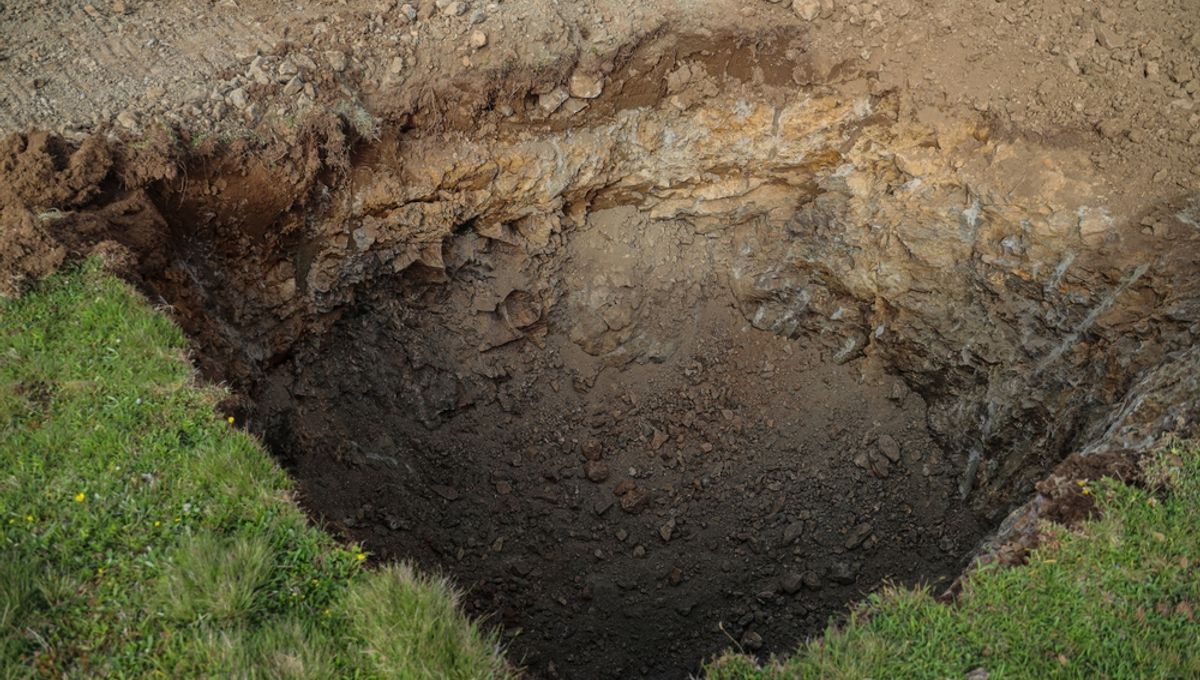
Eight years ago, a popular interactive map showed you where you would pop up if you were to dig your way right through the Earth.
It’s a bit of fun, even if for the vast majority the answer was “somewhere in an ocean”. But would it be possible to dig through the Earth and pop out the other side?
Various teams have attempted to dig down into the Earth before. China has recently begun digging a 10,000-meter (32,808-foot) hole into the Earth, the deepest ever attempted in the country. Digging down through 10 layers of rock, the team hopes to reach rocks from the Cretaceous Period, the layer known as the Cretaceous System, which dates back up to 145 million years.
The hole, while impressively deep, will not be the deepest human-made hole on Earth. That title goes to the Kola Superdeep Borehole, on the Kola Peninsula in northwestern Russia. The project, which spanned from May 24, 1970, to just after the collapse of the Soviet Union, saw the deepest branch of the hole reach 12,263 meters (40,230 feet) below the surface.
The team found that the rocks deep below the Earth were a lot wetter than they were expecting. Before the borehole found it, scientists had thought the water would not permeate the rock so deeply. They had also been expecting to find a layer of basalt beneath the continent’s granite, as this is what was found in the oceanic crust. Instead, they found that beneath the igneous granite was metamorphic granite. Since the continental crust was granite all the way down, this was evidence for plate tectonics, a theory that had only recently begun to be accepted when they began digging the borehole.
Though that sounds pretty deep, the Kola Superdeep Borehole team and the new team in China were nowhere near breaking through the Earth’s lithosphere (crust) to reach the mantle.
The Earth’s crust, on land, is variable. On average it is about 30 kilometers (19 miles) thick, though under mountain ranges it can reach as much as 100 kilometers (62 miles). Beneath the oceans, it doesn’t vary as much and is on average 6-7 kilometers (3.7-4.3 miles) thick. While there is less crust to dig through under the oceans, adding in factors like keeping the drill steady makes the process nightmarishly complicated.
If you’re going to attempt to drill through the Earth though, expect many more nightmarish complications, the main problems being the mole people intense pressure and heat.
Doug Wilson, a research geophysicist at the University of California, Santa Barbara, told Live Science that for every 3 meters (10 feet) you will add an extra atmosphere of pressure (as you are headed towards the core, not away from it, of course). Since you are digging about 6,370 kilometers (3,960 miles) into the very center of the Earth, that pressure is going to get intense: 1,179,423,669,639,374,797 hectoPascals (hPa) of pressure to be precise, where standard pressure at sea level is 1,013 hPa.
As pointed out in our article What Would Kill You First If You Jumped In A Hole Through The Earth?, at these pressures the air and you would likely become a superfluid, ending your days in the soup.
The temperature your drilling machinery will face will probably be insurmountable, with the inner core being 5,200 degrees Celsius (9,392 degrees Fahrenheit). Wilson suggested that continuously pumping water would help with (but likely not succeed at) cooling the bit, but as you get to the outer core it would be like drilling through a liquid.
The inner core meanwhile is solid, not due to lower temperatures but because of the intense pressure. Though your equipment has likely been soupified by this point, if you were able to get through this core of iron and nickel, you would briefly be rewarded with weightlessness, where the Earth’s mass pulls at you equally in all directions, before the long slog upwards to the other side.
An earlier version of this story was published in 2023.

Source Link: Could One Drill A Hole From One Side Of The Earth And Come Out The Other Side?
