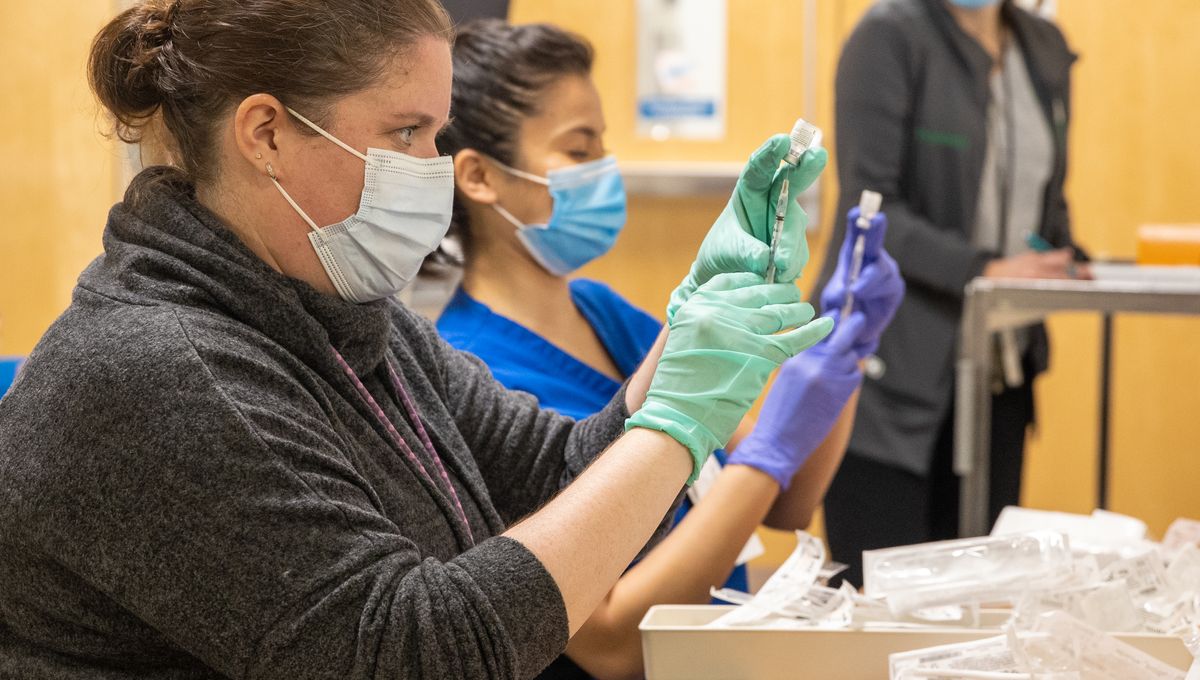
Science has shown us that COVID-19 vaccines had a transformative effect, saving lives, preventing illness, and altering the course of the pandemic for the better. But thanks to a new study, we can put some numbers to it. According to this analysis, 2.5 million lives were saved by COVID shots during 2020-24.
According to the team, led by scientists at the Università Cattolica del Sacro Cuore in Milan, Italy, that equates to 14.8 million years of life saved – one year for every 900 doses of vaccine administered around the world.
“To date, 13 billion COVID-19 vaccines have been administered,” writes Monica Gandhi, MD, MPH, from the University of California, San Francisco Center for AIDS Research, in an invited commentary on the new study. “67 percent of the total population [had] received a complete primary series of a COVID-19 vaccine by December 31, 2023.”
With the passage of time, it may be becoming easier to forget what it was like in the early months of the pandemic. Before vaccines, some research has suggested that 44 percent of COVID patients admitted to an intensive care unit died.
We know that excess deaths skyrocketed during 2020, and around 72 percent of those in the US were directly attributed to COVID-19. Across the world, it was estimated that the period between January 1, 2020, and December 31, 2021, saw 14.9 million excess deaths associated with the pandemic.
Recent analysis estimated that 16.8 million life years were lost in Europe between 2020 and 2022, based on data from 18 countries.
Against this backdrop, the race to formulate a vaccine began as soon as scientists had begun to understand the type of virus we were dealing with in SARS-CoV-2. The first successful candidates reached the clinic astonishingly quickly, thanks to a massive, coordinated international effort. It was clear that these were effective vaccines that were going to save lives and prevent hospitalizations, and the new study corroborates this with hard figures.
“Before ours, several studies tried to estimate lives saved by vaccines with different models and in different periods or parts of the world, but this one is the most comprehensive because it is based on worldwide data, it also covers the Omicron period, it also calculates the number of years of life that was saved, and it is based on fewer assumptions about the pandemic trend,” explained study authors Professor Stefania Boccia and Dr Angelo Maria Pezzullo in a statement.
The “challenging” legacy of COVID-19
According to their analysis, 82 percent of the lives saved by vaccines were in people who got their shots before they were exposed to the virus – for which, in many cases, it’s likely reasonable to thank lockdowns and other mitigation strategies. But while we know these measures prevented illness and death, we also know that they came with their own downsides.
Some 57 percent of the lives saved were during the Omicron period and 90 percent involved people aged 60 and over. The authors write, “The relative contribution of children, adolescents, and young adults to lives and life-years saved appears minimal.”
Addressing this finding, Gandhi writes that “both the importance of vaccines for older individuals and the fact that children were at low risk of severe complications of COVID-19 were facts that were known from very early on in the pandemic.”
“Vaccines save lives and the only way to get through this pandemic was always immunity; it is much safer to provide immunity to an older person through a vaccine than through natural infection. […] We should have focused our messaging more on older individuals to get vaccinated in the US”.
“If there is a future pandemic, models such as the one presented herein can help minimize the damage of widely restrictive policies and still allow for protection of those who need it the most,” Gandhi concludes.
The authors end their paper on a similarly mixed conclusion. While the success of the COVID vaccines should be celebrated, they express some concern over the pandemic’s legacy when it comes to vaccination programs more broadly.
They point to the fact that while the COVID-19 vaccines were “clearly a major achievement”, they don’t quite reach the heights of other widely used vaccines – for example, they claim that the life-years saved by the COVID vaccines were “more than 30-fold lower” than those saved by measles vaccination during the same period.
“Decrease in trust and increased hesitancy for these vaccines may be devastating,” they say. “The COVID-19 pandemic and pandemic response created a more challenging landscape on how to overcome general vaccine hesitancy.”
The study is published in JAMA Health Forum.

Source Link: COVID Vaccines Saved An Incredible 2.5 Million Lives In The First 4 Years Of The Pandemic
