• Email Us: [email protected]
  • Contact Us: +1 718 874 1545
  • Skip to main content
  • Skip to primary sidebar

Medical Market Report

  • Home
  • All Reports
  • About Us
  • Contact Us

Dark And Bright Spots Seen On Neptune From Earth For The First Time

September 5, 2023 by Deborah Bloomfield

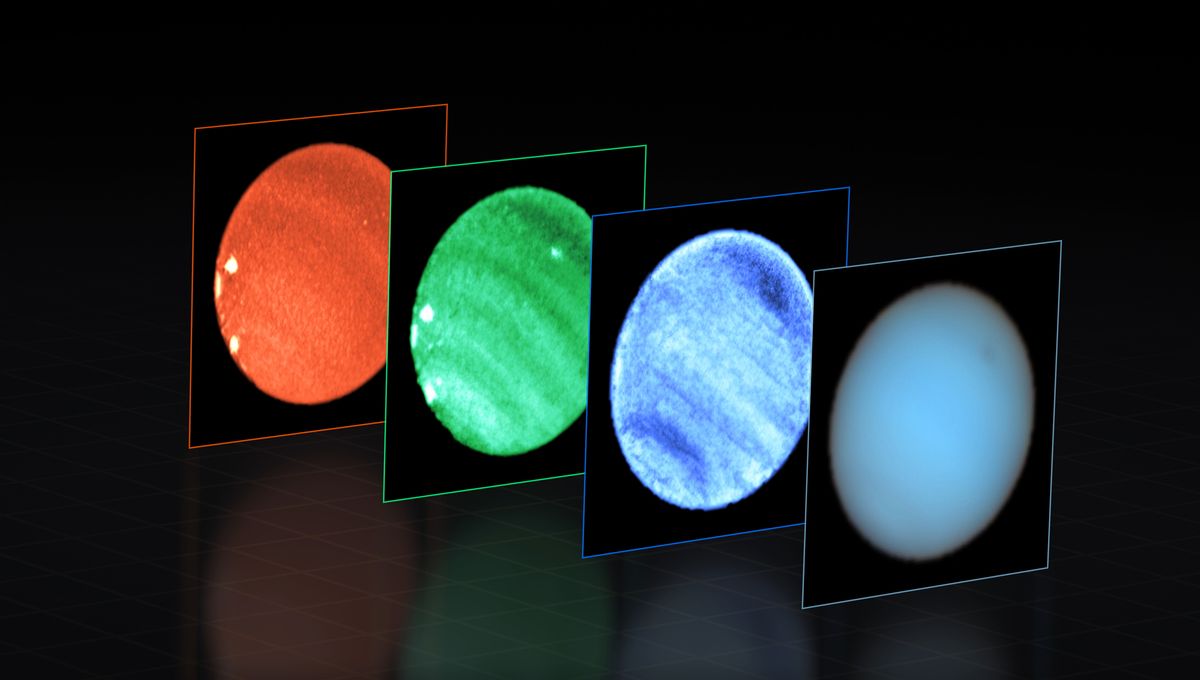
For the first time, astronomers have observed a dark spot on Neptune from the ground and also discovered a bright spot companion next to it. These features have no clear origin, but the work provides new insight into how these peculiar features come to form in the first place.

While spots like the Great Red Spot on Jupiter have been known for hundreds of years, it was only in 1989 that the flyby of Voyager 2 also revealed spots on Neptune. Spots on the big blue planet are short-lived, which is very different from the Great Red Spot. In 2018, Hubble saw new ones on Neptune, which were were followed up with the European Southern Observatory’s Very Large Telescope (VLT).

Advertisement

Thanks to the instruments on the VLT, astronomers were able to measure the sunlight reflected from Neptune at different depths in the atmosphere, giving them the ability to study these spots in three dimensions.

“I’m absolutely thrilled to have been able to not only make the first detection of a dark spot from the ground but also record for the very first time a reflection spectrum of such a feature,” Patrick Irwin, professor at the University of Oxford in the UK and lead researcher on the study, said in a statement. “Since the first discovery of a dark spot, I’ve always wondered what these short-lived and elusive dark features are.”

The team believes that the darkness of the spot is caused by the presence of a molecular structure that is less reflective. This could be caused by a dark material floating upwards from a deeper layer, or the condensation of hydrogen sulfide ice on the product of a light-induced chemical reaction. Both scenarios are very different from Jupiter’s Great Red Spot, which is a massive anticyclone.

“In the process we discovered a rare deep bright cloud type that had never been identified before, even from space,” explained study co-author Michael Wong, a researcher at the University of California, Berkeley, USA.

Advertisement

The bright cloud on Neptune is something completely different and, unlike other bright clouds observed, it appears right next to the dark spot at the same level in the atmosphere. There are still many unknowns about these structures, but the current study shows how much ground-based observatories have improved over the last several decades.  

“This is an astounding increase in humanity’s ability to observe the cosmos. At first, we could only detect these spots by sending a spacecraft there, like Voyager. Then we gained the ability to make them out remotely with Hubble. Finally, technology has advanced to enable this from the ground,” concluded Wong, before adding, jokingly: “This could put me out of work as a Hubble observer!”

The study is published in Nature Astronomy. 

Deborah Bloomfield
Deborah Bloomfield

Related posts:

  1. Paris ramps up security as jihadist attacks trial starts
  2. Cricket-‘Western bloc’ has let Pakistan down, board chief says
  3. Analysis-Diverse boards to pick the next Boston and Dallas Fed bank chiefs
  4. Ancient Bison Found In Permafrost Is So Well Preserved Scientists Want To Clone It

Source Link: Dark And Bright Spots Seen On Neptune From Earth For The First Time

Filed Under: News

Primary Sidebar

  • US Just Killed NASA’s Mars Sample Return Mission – So What Happens Now?
  • Art Sleuths May Have Recovered Traces Of Da Vinci’s DNA From One Of His Drawings
  • Countries With The Most Narcissists Identified By 45,000-Person Study, And The Results Might Surprise You
  • World’s Oldest Poison Arrows Were Used By Hunters 60,000 Years Ago
  • The Real Reason You Shouldn’t Eat (Most) Raw Cookie Dough
  • Antarctic Scientists Have Just Moved The South Pole – Literally
  • “What We Have Is A Very Good Candidate”: Has The Ancestor Of Homo Sapiens Finally Been Found In Africa?
  • Europe’s Missing Ceratopsian Dinosaurs Have Been Found And They’re Quite Diverse
  • Why Don’t Snorers Wake Themselves Up?
  • Endangered “Northern Native Cat” Captured On Camera For The First Time In 80 Years At Australian Sanctuary
  • Watch 25 Years Of A Supernova Expanding Into Space Squeezed Into This 40-Second NASA Video
  • “Diet Stacking” Trend Could Be Seriously Bad For Your Health
  • Meet The Psychedelic Earth Tiger, A Funky Addition To “10 Species To Watch” In 2026
  • The Weird Mystery Of The “Einstein Desert” In The Hunt For Rogue Planets
  • NASA Astronaut Charles Duke Left A Touching Photograph And Message On The Moon In 1972
  • How Multilingual Are You? This New Language Calculator Lets You Find Out In A Minute
  • Europa’s Seabed Might Be Too Quiet For Life: “The Energy Just Doesn’t Seem To Be There”
  • Amoebae: The Microscopic Health Threat Lurking In Our Water Supplies. Are We Taking Them Seriously?
  • The Last Dogs In Antarctica Were Kicked Out In April 1994 By An International Treaty
  • Interstellar Comet 3I/ATLAS Snapped By NASA’s Europa Mission: “We’re Still Scratching Our Heads About Some Of The Things We’re Seeing”
  • Business
  • Health
  • News
  • Science
  • Technology
  • +1 718 874 1545
  • +91 78878 22626
  • [email protected]
Office Address
Prudour Pvt. Ltd. 420 Lexington Avenue Suite 300 New York City, NY 10170.

Powered by Prudour Network

Copyrights © 2026 · Medical Market Report. All Rights Reserved.

Go to mobile version