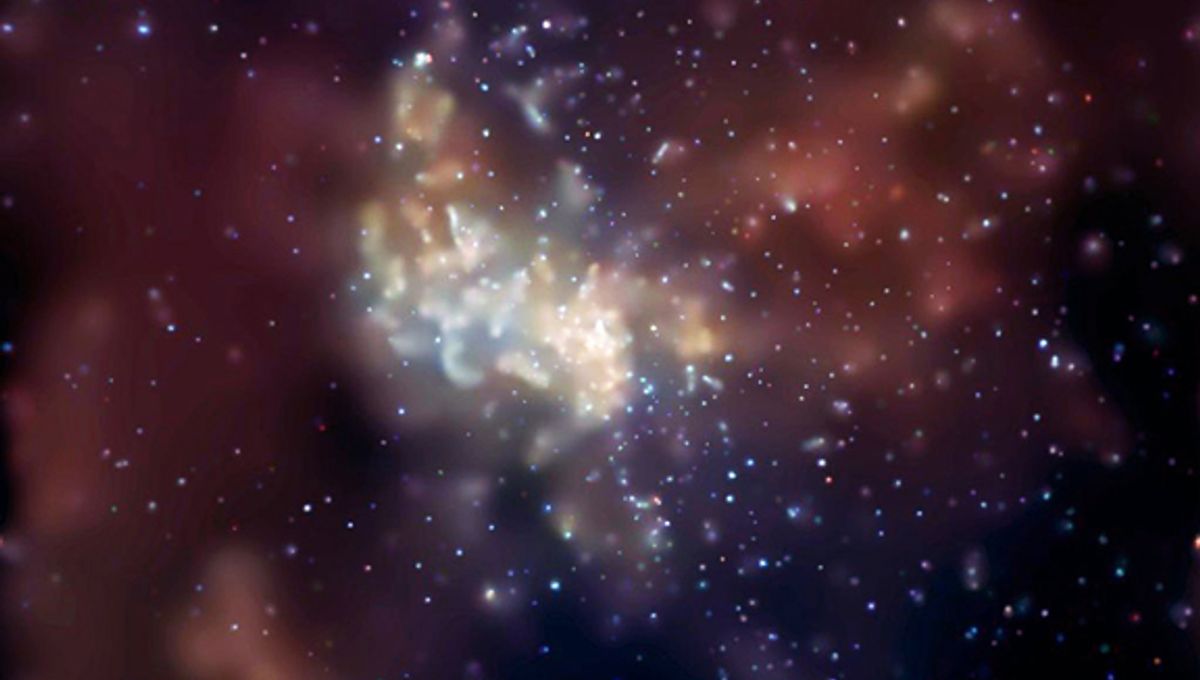
Sagittarius A* is the supermassive black hole sitting at the core of the Milky Way. It has a mass of 4.3 million times our Sun’s and a radius of 12 million kilometers (7.4 million miles). It is not alone at the center of our galaxy; it is orbited by multiple stars and other peculiar objects. It had been suggested that the odder objects were doomed to be destroyed by its incredible gravitational pull, but new evidence suggests that things are a lot calmer.
The rest of this article is behind a paywall. Please sign in or subscribe to access the full content.
Using the ERIS (Enhanced Resolution Imager and Spectrograph) at the Very Large Telescope (VLT), an international team was able to track the orbit of some of the most intriguing objects that orbit Sagittarius A*. A very famous one is called G2, thought for a while to be a cloud of just dust and gas. Supermassive black holes can rip stars apart, a process that starts with the dramatic stretching of objects.
It would not be a shock to see a large cloud of material orbiting a supermassive black hole. In fact, G2 is not unique – there is a whole class of these objects. The precursor, G1, was found in 2005, G2 in 2012, and several more in 2020. For G2 in particular, the new work provides a highly detailed orbit. It shows that it is on a stable orbit, suggesting that there’s likely a star inside the cloud, balancing out the gravitational pull somewhat.
The work also suggests that binary star system D9, which was discovered just one year ago, is also surprisingly stable. The system is believed to be young, maybe around 2.7 million years old, with one star about 2.8 times the mass of the Sun while the other is about 0.73 times the mass. They orbit each other in around 372 days and it seems that they do not really mind the presence of a supermassive black hole.
Modeling at the time of the discovery suggested that the two star were likely to merge into a single object within 1 million years, but the new ERIS data does not show this to be a certain scenario. D9 seems stable. Similarly, analysis of objects X3 and X7, whose exact nature is a mystery, does not provide any semblance of significant changes.
“The fact that these objects move in such a stable manner so close to a black hole is fascinating,” lead author Florian Peißker, from the University of Cologne, said in a statement. “Our results show that Sagittarius A* is less destructive than was previously thought. This makes the centre of our galaxy an ideal laboratory for studying the interactions between black holes and stars.”
The work adds valuable insight into what the environment around supermassive black holes is like. Many supermassive black holes in other galaxies are extremely active. Their brightness is key for us to study them at a distance, but things near them would be cooked by their intense processes. Sagittarius A* is quiet, a place that seems surprisingly stable.
“The supermassive black hole at the centre of the Milky Way has not only the capability to destroy stars but it can also stimulate their formation or the formation of pretty exotic dusty objects, most likely via mergers of stellar binaries,” added Michal Zajaček from Masaryk University in Brno, Czech Republic.
The study is published in the journal Astronomy & Astrophysics.

Source Link: Defiant Stars And Unusual Objects Survive Against The Milky Way’s Supermassive Black Hole
