


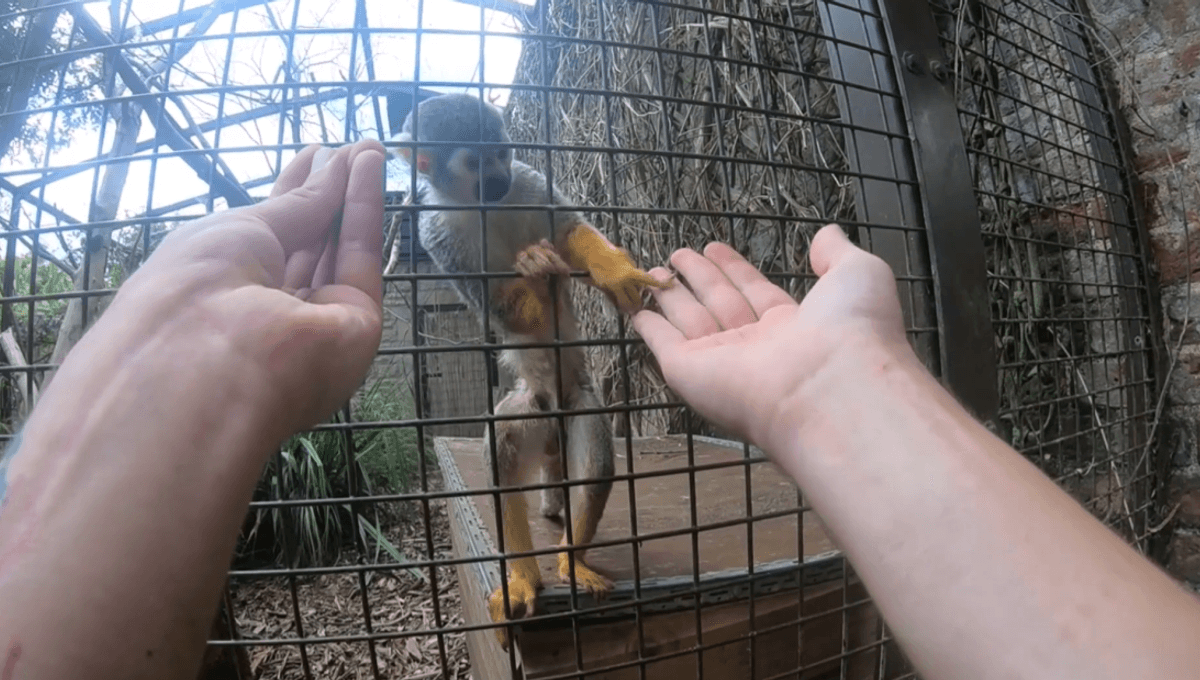
It’s got to be a great day as a scientist when you’re called upon to perform magic tricks for monkeys. That’s what the authors of a 2023 study found themselves doing when they used “The French Drop” as a tool for studying an animal’s capacity to anticipate another’s actions.
“Magicians use intricate techniques to mislead the observer into experiencing the impossible,” said Dr Elias Garcia-Pelegrin, a magician and assistant professor in comparative psychology at the National University of Singapore, in a statement. “It is a great way to study blind spots in attention and perception.”
“By investigating how species of primates experience magic, we can understand more about the evolutionary roots of cognitive shortcomings that leave us exposed to the cunning of magicians.”
(FYI – Director of the UK’s only MAGIC Lab, Dr Gustav Kuhn, will be at our next CURIOUS Live event on December 11 if you have any questions about how magic can be wielded as a tool for science.)
Garcia-Pelegrin was completing his PhD at Cambridge University when his team began performing magic for three species of monkey: common marmosets (Callithrix jacchus), Humboldt’s squirrel monkeys (Saimiri cassiquiarensis), and yellow-breasted capuchins (Sapajus xanthosternos).
The French drop is a classic sleight-of-hand trick where a magician appears to take an object from one hand using the other. As the “grabbing” hand closes, the object is secretly left in the original hand, but the audience’s attention follows the empty hand, creating the illusion of disappearance. So, how did the monkeys get on?

The team performed the French drop for 24 monkeys, replacing the coin you’d typically use for a human audience with each species’ snack of choice. Eight capuchins were after peanuts, eight squirrel monkeys wanted dried mealworms, and eight marmosets were hungry for *checks notes* marshmallows. Fair play.
The differences between the monkeys and how often they fell for the trick were pretty extreme, pointing to a trait shared by the most gullible species.
The biggest suckers were the squirrel monkeys, who fell for the trick 93 percent of the time. Meanwhile, capuchins also lost out 81 percent of the time. The marmosets, however, were chowing down on marshmallows, having only been caught out by the trick 6 percent of the time.
So, what do squirrel monkeys and capuchins have that marmosets don’t? Human-like hands.
“There is increasing evidence that the same parts of the nervous system used when we perform an action are also activated when we watch that action performed by others,” explained Prof Nicola Clayton FRS, senior author of the study from Cambridge’s Department of Psychology. “This mirroring in our neural motor system might explain why the French drop worked for the capuchins and squirrel monkeys but not for marmosets.”
“It’s about the embodiment of knowledge. How one’s fingers and thumbs move helps to shape the way we think, and the assumptions we make about the world – as well as what others might see, remember and anticipate, based on their expectations.”
“Our work raises the intriguing possibility that an individual’s inherent physical capability heavily influences their perception, their memory of what they think they saw, and their ability to predict manual movements of those around them.”
The study is published in the journal Current Biology.


Source Link: Do Animals Fall For Magic Tricks? Watch A Devastated Squirrel Monkey Prove That Yes, They Do