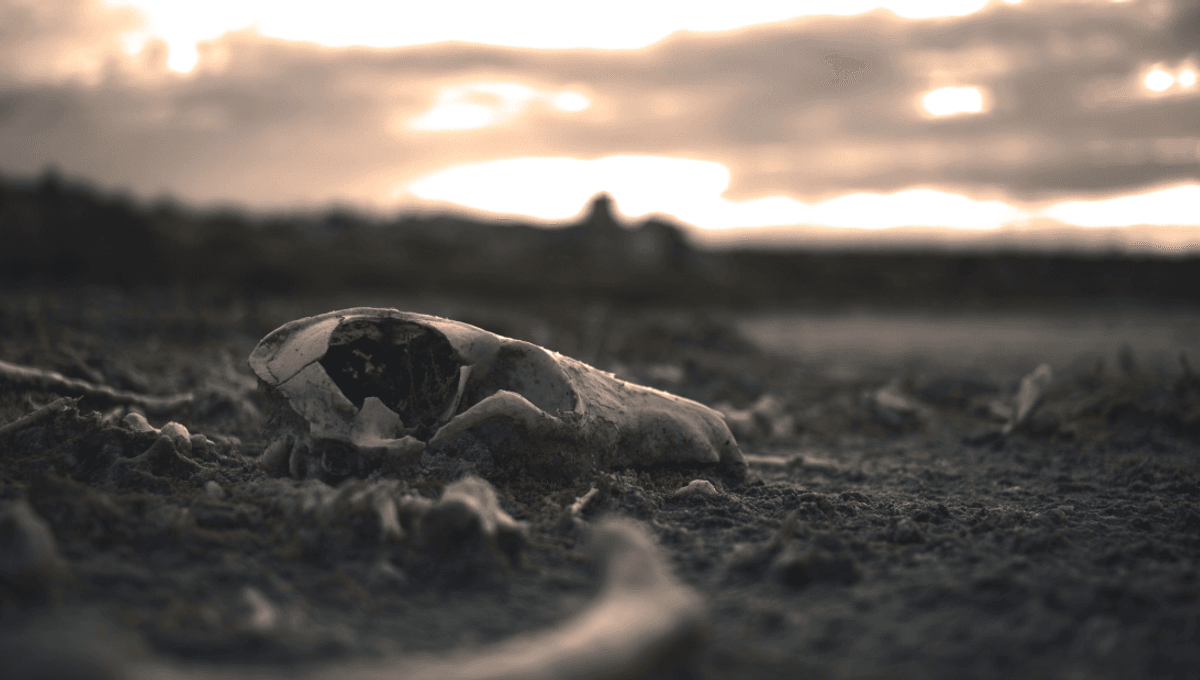
The decomposition of a corpse until there’s nothing left but bone is a process known as skeletonization, and it can take anywhere from a couple of weeks to a few years. The rate of decomposition depends heavily on the environmental conditions, but what about that skeleton that’s left behind? If bones don’t decompose, how come we’re not walking on skeletons everywhere we go?
Do bones decay?
Yes, bones decay, albeit sometimes very, very slowly. The process that helps our bones to achieve that coveted “dust to dust” status is known as diagenesis and it encompasses microbial, chemical, and mechanical changes. It can take anywhere from a few days, to a few thousand years, to a few million.
Once a poorly understood area of science, we’re getting to know more about how bones break down in the short-term thanks to studies such as this 2022 paper that buried the ribs of six humans for 12 months to see what changes they underwent.
Bones are made up of minerals and collagen, a protein that holds bones together. The researchers found that hydrolysis fragmented the collagen’s bonds, weakening it over time, while the minerals undergo dissolution and recrystallization.
Without collagen acting as glue, the remaining skeletal material is exposed and fragile. Anything from extreme temperatures and moisture to carnivores and wind can turn what remains to dust. As for those special bones we find seemingly still intact millions of years after the animal died, that all comes down to the quirks of mineralization, which is just one of several fossilization processes.
That bones hang around longer than the rest of us is something that forensic taphonomists have figured out how to use to our benefit. As it turns out, skeletal remains can help us to reconstruct a deceased person’s identity.
“It involves creating what we call the osteobiographical profile, and typically comprises an estimation of biological sex, age at death, stature, potential trauma that might have occurred either before or around the time of, or after, death,” explained forensic expert Dr Devin Finaughty to IFLScience as part of an interview that first appeared in our digital magazine CURIOUS.
“There’s also a lot of information you can pull up about a person’s lifestyle from their skeleton. I like to say that our life stories are written into our bones; the types of activities that we do, the level of physical activity that we do, history of disease processes.
Even when we’ve stopped growing, it doesn’t mean that your bones just stop doing what they do.
Dr Devin Finaughty
If you get really sick with something, that is often reflected in the bones, Finaughty pointed out. “Ongoing disease processes – if they’re quite systemic, or maybe sometimes very localized – can affect bone as well. Histories of surgeries, the insertion of prostheses, repairs.
“We can reconstruct a person’s diet at different stages of their lives depending on where we source the tissue from. Even when we’ve stopped growing, it doesn’t mean that your bones just stop doing what they do. Your body continues to turn over that, and it’s pulling in material from your diet as it does that. This means we can use stable isotope analysis to generate information based on your diet. Everything from the type of water you were drinking to the type of food that you were eating, all of that is written in bones.”
And as for what happens to all the squishy stuff? Well, we have the decomposition ecosystem to thank for that.

Source Link: Do Bones Decay? Welcome To The Gaunt World Of Diagenesis
