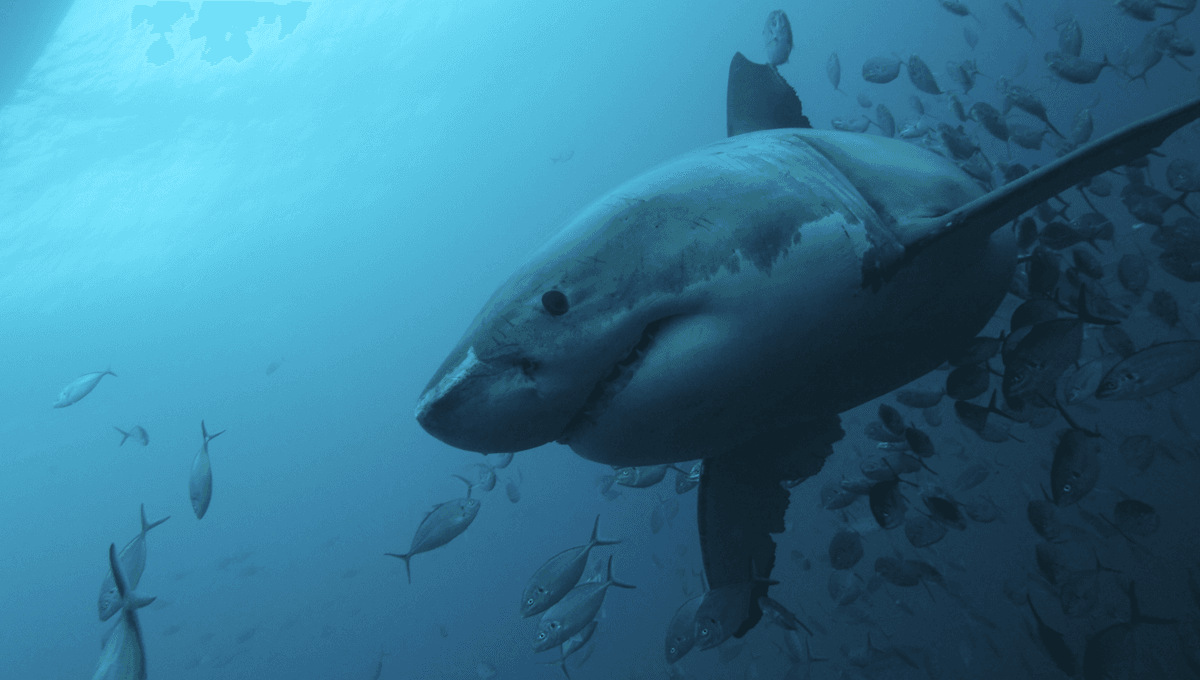
No, sharks do not have bones. Their skeletons are made of cartilage, the same flexible, “rubbery” material found in human ears and noses.
Unlike bone, which is a rigid, mineralized tissue rich in calcium phosphate, cartilage is made mostly of water and protein collagen, making it lighter, flexible, and less rigid.
Bonelessness is a defining characteristic of sharks. They belonged to a group known as cartilaginous fishes, along the likes of rays, skates, sawfish, and chimaeras (better known as ghost sharks). As a family, they are among the oldest living groups of jawed vertebrates on the planet.
Do sharks have bones in their jaw?
Sharks don’t even have jawbones in the classic sense. However, some species of shark have jaws that are given extra bite thanks to reinforced cartilage that’s partially calcified and hardened.
What are shark teeth made of?
Speaking of their infamous chomping abilities, the only part of a shark’s skeleton not made from cartilage is its teeth, which are made of a hard inner core of dentin, covered by an even tougher outer layer called enameloid.
Since cartilage doesn’t fossilize as easily as bone, most of the physical evidence of early sharks is teeth, which preserve much better.
In fact, scientists primarily estimate the size of megalodon and other extinct shark species by measuring their enormous teeth. Megalodon teeth can be as big as a human hand, suggesting they must have been significantly longer than their living descendants.
Sharks continuously shed and regrow their teeth, leaving tens of thousands behind over a lifetime. It’s not uncommon for lucky beachcombers to stumble upon these prehistoric treasures washed up on sandy shores.
Why don’t sharks have bones?
Acting like sturdy scaffolding, bones do an excellent job of supporting the structure of animal bodies. Why, then, did sharks not evolve this extremely useful feature?
The simple answer is that cartilage is lighter and more flexible, allowing sharks to swim faster with nimble agility.
Unlike other bony fish, sharks don’t have swim bladders, a gas-filled organ that controls buoyancy. Instead, they possess a chunky liver filled with low-density oils that help them float. Their lighter framework also aids them with this feat.
A study in 2014 highlighted another key insight into why sharks never evolved bones. Scientists at San Francisco State University studied the DNA of elephant sharks (Callorhinchus milii), a cartilaginous fish with a peculiar trunk-like snout, and found their genome doesn’t have the genes needed to convert cartilage into bone.
Instead of evolving these genes, their genomes have stayed mostly unchanged for hundreds of millions of years, so cartilage remains their main skeletal material. It might be a similar case for true sharks and other cartilaginous fishes.
How many “bones” do sharks have?
Once again, sharks don’t have bones, as in fully rigid skeletal structures made of calcium phosphate and other chemicals. However, most sharks reportedly have about 200 to 400 structures made of cartilage that act as supporting structures for their bodies.
By comparison, humans have 206 true bones in our bodies. We’re actually born with approximately 275 to 300 bones, but that number is slashed by almost 100 by the time we reach adulthood, as some of them fuse together.

Source Link: Do Sharks Have Bones?
