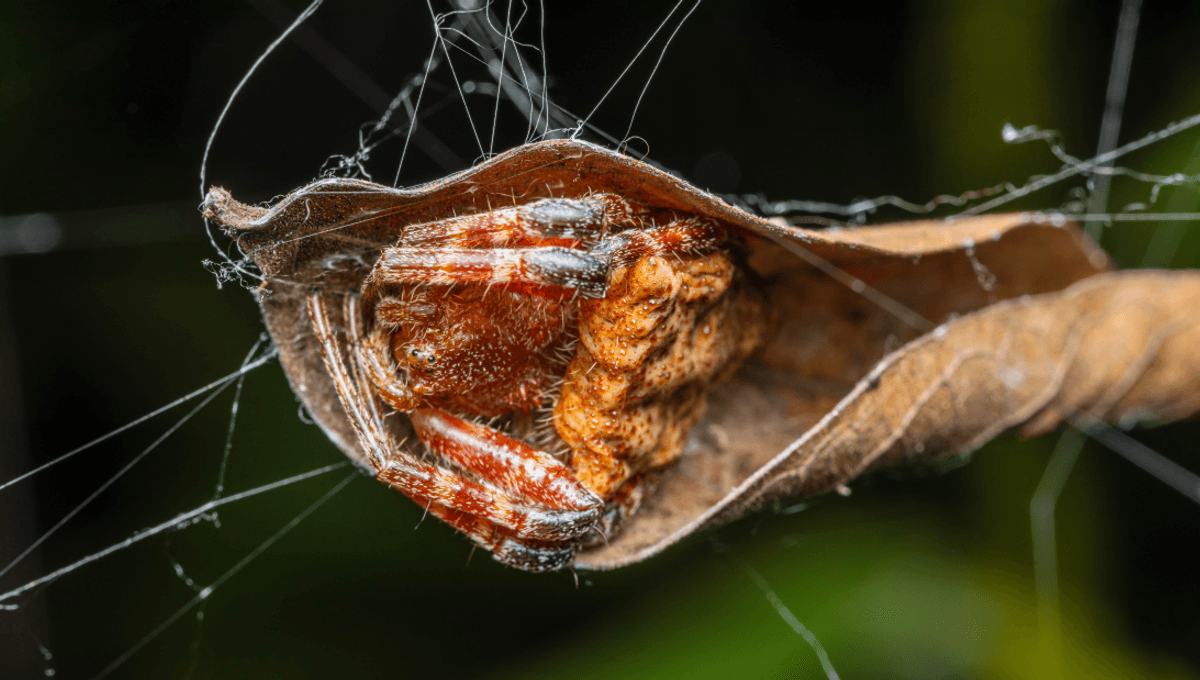
Do spiders dream? It’s strange to imagine, but there is evidence to suggest that at least some species might.
We know that spiders enter a sleep-like state. This deep rest state enables them to keep healthy, and despite being all eight legs and lots of eyes, they share a surprising number of similarities to human sleep.
So, does that include dreaming? A 2022 study that tracked the movement of jumping spiders’ retinal tubes while snoozing revealed activity similar to that seen in rapid eye movement (REM) sleep – the stage of sleep associated with dreaming.
The study looked specifically at European jumping spiders (Evarcha arcuata). This species typically rests at night by hanging from a thread and tucking in its limbs (though there were recorded examples of spiders sleeping standing on a surface). By all accounts, it sounds pretty cute.
“A usual night starts with the spider finding a good spot to drop down from,” study author Dr Daniela Rößler of the Max Planck Institute of Animal Behavior told IFLScience. “They will build little silk anchors in a zig-zag fashion, and then drop down attached by a silk thread which they hold with one of the back legs.”
“They often first start cleaning themselves (brushing their legs against each other, cleaning their eyes etc.), sometimes they even have a little snack while suspended. Eventually, they become motionless. Then, in quite regular intervals we can observe what looks like active phases but with uncoordinated movements, these can be either periods with noticeable twitches of the abdomen, spinnerets or single legs, or more extreme with some or all legs curled up resembling a dead spider.”
The study was able to capitalize on the translucent exoskeletons of jumping spider juveniles to get a good look at what was going on while they were resting. Jumping spiders can’t move their eye lenses like humans can, but they do have retinal tubes that can move to adjust their gaze. It was this movement that the researchers were able to look out for in nighttime footage of 34 juvenile jumping spiders as they snoozed on camera.
The footage revealed that the juvenile spiders’ retinal tubes moved at regular intervals. These intervals increased the longer the nap went on, and each one was associated with leg twitches (two things observed in REM for other animals, too).
The researchers also observed sleeping adult jumping spiders, and their leg twitching appeared to reflect similar intervals to the eye-twitching phases for the juvenile spiders. The discovery marked the first direct evidence for REM sleep in a terrestrial invertebrate, but does that mean they dream?
“Personally, after watching hundreds of spiders, there is no doubt in my mind that they experience dreams, just like no one would doubt that when watching a cat or a dog dream,” said Rößler. “Whether we will be able to scientifically prove that this is the case… we will have to see.”
And on the topic of things spiders do and don’t do, ever wondered if they get caught in their own webs?

Source Link: Do Spiders Dream? “After Watching Hundreds Of Spiders, There Is No Doubt In My Mind”
