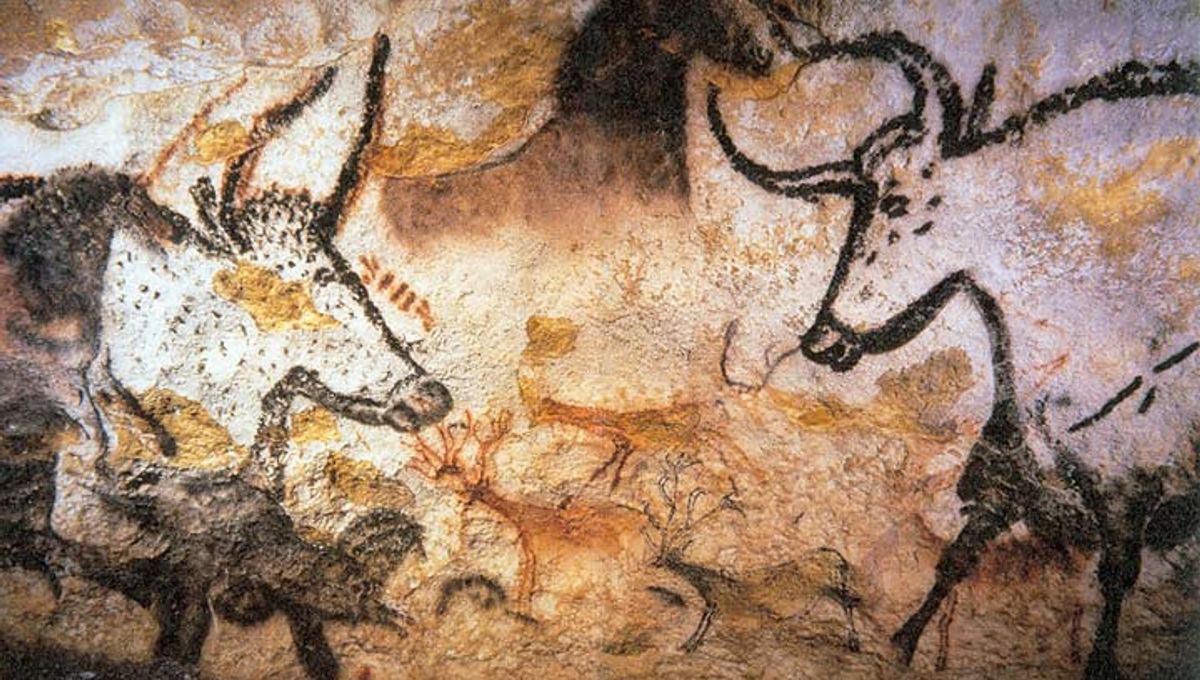
Breathtaking prehistoric paintings have been discovered on the walls of caves across Europe, Africa and Australasia, yet the meanings and functions of these Stone-Age masterpieces remain a topic of fierce debate. Recently, a team of researchers proposed that some of the most iconic examples of rupestral art are in fact lunar calendars, marked out by the world’s earliest known writing system, although a new study has challenged these remarkable claims.
Put forward in January 2023, the hypothesis focuses on European rock art from the Upper Paleolithic, most of which was created between 45,000 and 12,000 years ago. Noting that these designs typically feature animals accompanied by abstract marks like dots or vertical lines, the first team of researchers proposed that these symbols represent days or months in the lunar calendar.
To back up this claim, they pointed out that the total number of notations never exceeds 13, which is the number of lunar months in a year. They therefore suggest that these sequences mark out the annual cycles of certain prey species, with a ‘Y’ shape denoting the month in which a specific animal typically gives birth.
However, according to the authors of the new critique, there are in fact several examples of sequences of lines and dots that exceed 13, thus undermining the entire concept of the cave art lunar calendar. They go on to say that these cases were deliberately excluded from the original analysis so as to not wreck the whole idea.
Pouring further skepticism on the theory, the authors point out that all of the species present in these paintings give birth in the first or second month of spring, and that ancient hunter-gatherers would hardly have needed to devise an artistic or semantic system just to keep track of this. “Why would Palaeolithic people need a calendar to record or predict the mundane fact that all their major herbivores give birth one or two months after the snow melts?” they ask rhetorically.
Noting these substantial holes in the theory, the researchers strongly argue against the conclusion drawn by the earlier study – namely that the “Y” symbol present in many ancient paintings functioned as the earliest known written word. Specifically, the proponents of the hypothesis had stated that the letter represented a noun and carried the meaning “to give birth”.
Compiling a lengthy list of arguments, the authors conclude that there is no solid evidence to suggest that these prehistoric artworks document lunar calendars or archaic writing systems. Seeking out alternative possibilities in ethnographic studies of more recent rock art, they suggest that abstract symbols like dots are more likely to represent such elements as “bees, seeds, stars, raindrops, huts, fires, tracks or blood.”
The study is published in the Cambridge Archaeological Journal.

Source Link: Does Stone Age Cave Art Contain The World’s Earliest Writing And Lunar Calendars?
