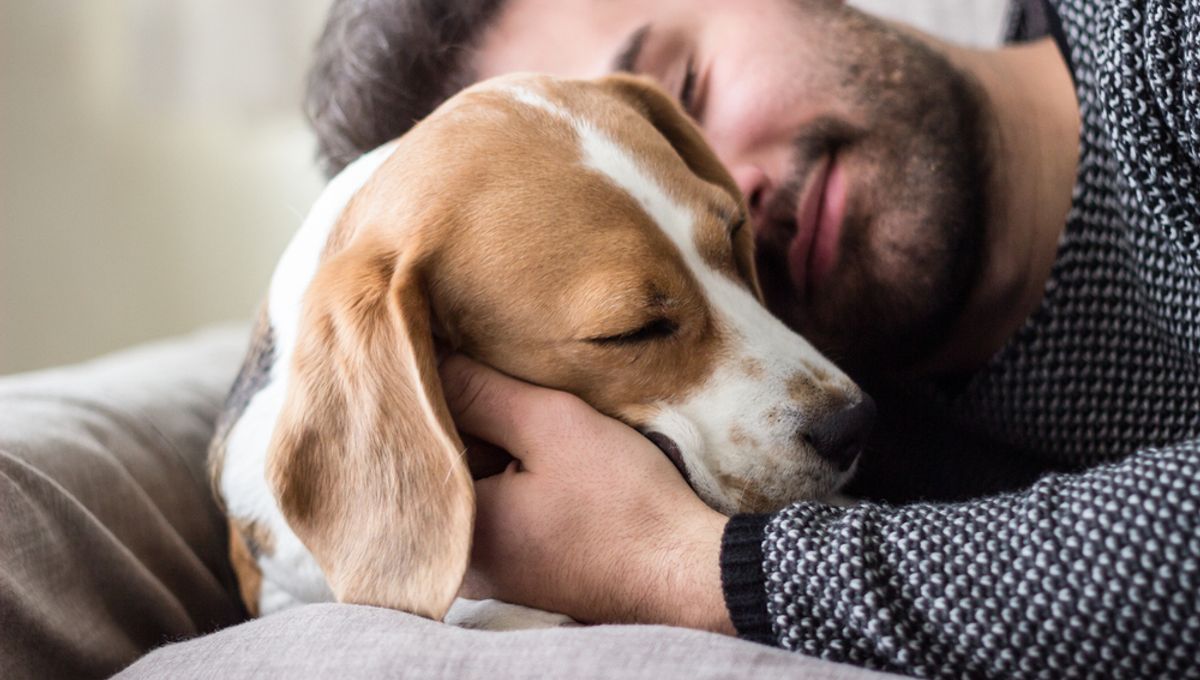
Few things are as joyful as returning home to the affection of a pet dog, and new research indicates that the happiness of being reunited with an owner can reduce a pooch to tears. Describing their findings in the journal Current Biology, the study authors explain that dogs’ emotional response to seeing their favorite human is all designed to tug on our heartstrings and inspire us to be better owners.
“Unlike any other animal, dogs have evolved or have been domesticated through communication with humans and have gained high-level communication abilities with humans using eye contact,” write the researchers. “Through this process, their tears might play a role in eliciting protective behavior or nurturing behavior from their owners, resulting in the deepening of mutual relationships and leading to interspecies bonding.”
In contrast to us weepy humans, however, blubbering dogs don’t produce the kind of tears that roll down the cheeks and soak the pillow. Instead, they simply well up and become teary-eyed, producing an irresistible puppy-dog eye effect.
Rather than counting teardrops, therefore, the study authors measured the volume of tears in dogs’ eyes when at home with their owner and then again when reunited with owners after five to seven hours apart. Results indicated that tear volume increased significantly during reunions with owners, but not when dogs were reintroduced to familiar humans who weren’t their owner.
Previous research has indicated that interactions between dogs and humans trigger the release of the so-called “love hormone” oxytocin in both species. Because oxytocin plays a central role in social bonding and emotional responses, the study authors speculated that dogs’ soppy behavior may be triggered by this neuropeptide.
To investigate, they administered oxytocin to dogs’ eyes, and found that this caused an increase in tear volume. The fact that no such reaction was observed when a different peptide solution was added to the animals’ eyes confirms that the tears were not produced due to irritation.
“We found that dogs shed tears associated with positive emotions,” explained study author Takefumi Kikusui in a statement. “We also made the discovery of oxytocin as a possible mechanism underlying it.”
Finally, the study authors showed people photographs of dogs’ faces with and without tears, and asked them to rate the degree to which they wanted to look after the animals depicted. Overall, participants expressed a greater urge to care for dewy-eyed dogs, indicating that the production of tears may serve to play on our emotions and heighten our desire to protect.
“Dogs have become a partner of humans, and we can form bonds,” said Kikusui. “In this process, it is possible that the dogs that show teary eyes during interaction with the owner would be cared for by the owner more.”
While the results of these experiments indicate that dogs well up in response to happy encounters with humans, it is not known if they also produce tears when they are sad. Furthermore, the researchers are unable to say whether or not tears have any function in mediating social interaction between dogs, or if puppy-dog eyes exist for the sole purpose of making humans go all mushy.

Source Link: Dogs "Cry" When Reunited With Their Favorite Human, Study Finds
