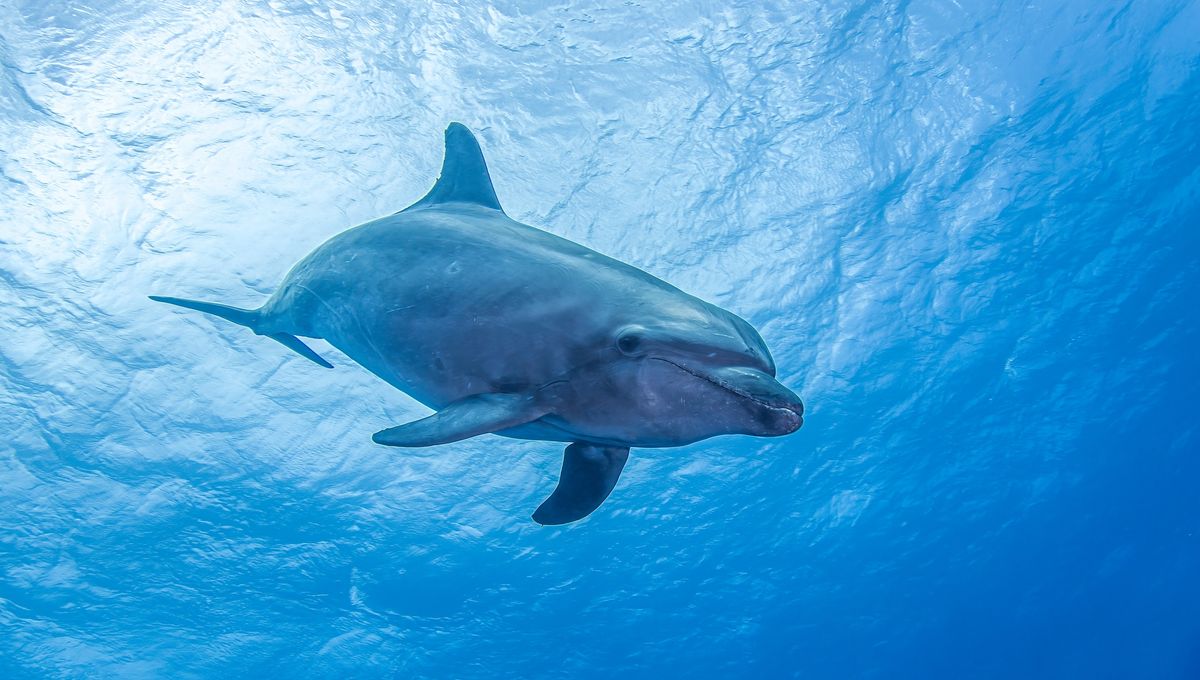
According to a new study, we may have been thinking about dolphins’ echolocation all wrong. Rather than using it to “see” the world around them, as in constructing a picture of their environment from the way sound bounces off objects, the animals may in fact be “feeling” their surroundings instead.
Echolocation is the ability to navigate the environment by detecting objects using sound, emitting it and then listening for echoes. It is an incredible adaptation used by various animals, such as bats, dolphins, some species of birds, and even some very cool humans. It is particularly valuable when hunting at night or when moving through locations where visibility is poor, such as in dark caves or murky water.
Traditionally, we have thought about this process as a way of “seeing” the world with sound, whereby the echoes help create a mental picture of objects and spaces. In this respect, echolocation is similar to sonar, where sonic waves are translated into visual representations. The idea was further supported by rather invasive and ethically dubious (by today’s standards) experiments in the 1970s and 1980s, where scientists probed dolphin and porpoise brains. They found that the animals’ brains showed activity in their visual cortices when hearing sounds. This is not dissimilar to how human brains function when using echolocation.
But is this really an accurate way to think about this ability in cetaceans? For one thing, this interpretation is based on limited research with older technologies. At the same time, the authors behind the new study point out that there is clear evidence that different suborders of Cetacea have evolved different ways to use sound – not just for echolocation, but also for communication, foraging, hunting, and navigating, to greater or lesser extents.
In recent years, technology has developed that could allow scientists to explore this question in greater detail, at the neuroanatomical and cellular levels, but doing so in ethical and non-invasive ways still remains an issue.
In their latest study, researchers wanted to explore the neural mechanisms behind echolocation in dolphins. They did so by comparing the preserved brains of three species of dolphins that use echolocation with the brain of a sei whale. This species of whale is closely related to the three dolphin species, but does not use echolocation.
The brains were imaged and analyzed at high resolution using a technique called diffusion tractography, which essentially measured the movement of water molecules along the brain’s nerve fibers. This allowed the team to follow the path of auditory information through the brain, seeing which parts were connected in processing it.
Rather than the visual cortex being involved, the team instead observed a neural pathway that linked the inferior colliculus – an auditory nucleus involved in analyzing frequency, sound intensity, and location – and the cerebellum – part of the brain that helps us coordinate movement and balance, among other things.
Importantly, this same pathway was not present in the sei whale brain.
The results suggest that echolocation in these dolphins operates similarly to how we use touch to explore the world. This tactile alternative relies on a feedback loop for motor control whereby sensations and motion send signals to the cerebellum, which then fine-tunes the dolphins’ movements so that they are more precise.
In this context, dolphins using their echolocation to explore the world would be similar to us trying to navigate our homes at night without turning on the lights – only they’re more skilled at it.
The paper is published in PLOS One.

Source Link: Dolphins May Not "See" With Echolocation, But Instead "Feel" With It
