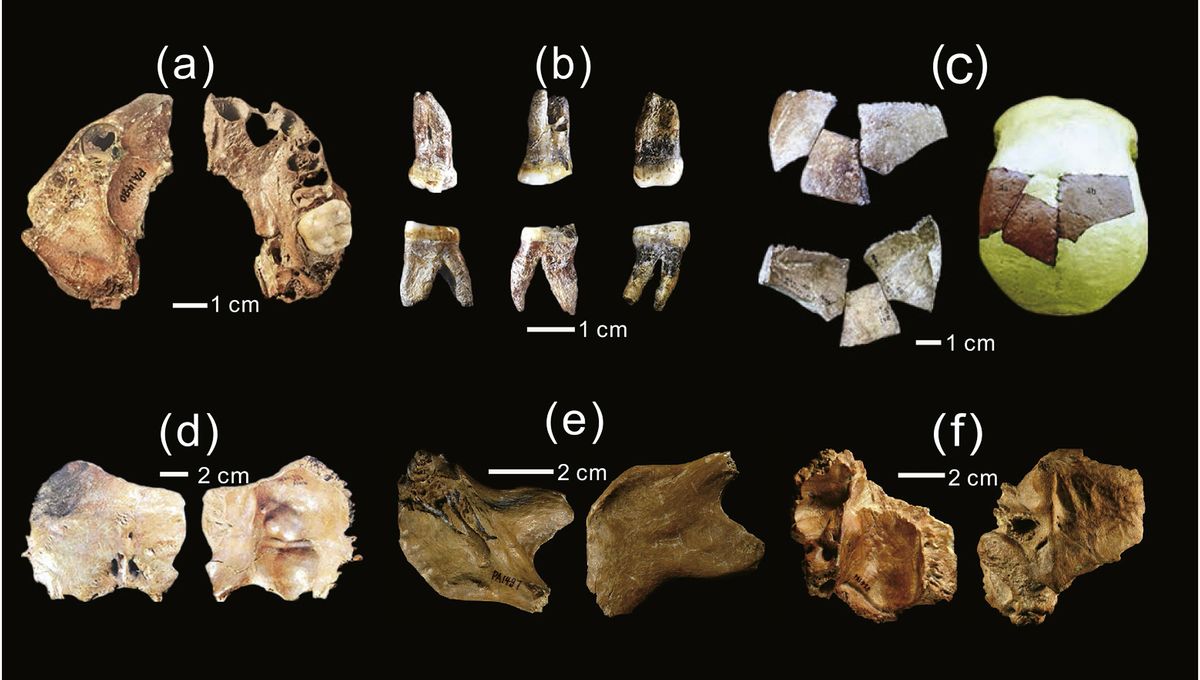
The most recent addition to the human family tree – named after its unusually fat head – roamed northern China at the same time as the Denisovans. According to uranium-series dating, Homo juluensis existed between about 140,000 and 230,000 years ago, making it a contemporary of Homo longi – which literally means “Dragon Man”.
The rest of this article is behind a paywall. Please sign in or subscribe to access the full content.
The Middle Pleistocene was an interesting time to be in China, and the fossil record from this period is populated with a mishmash of human remains that have yet to be classified as belonging to any particular species. This hazy melting pot of ambiguous hominins is often referred to as the “muddle in the middle”, and is one of these least well-defined eras in human evolution.
Among the enigmatic specimens that populated the region at this time was H. juluensis – meaning “Large-Headed Man” – which was unearthed in Hebei Province in the 1970s but only named in 2024, when researchers suggested it may represent a new human species. In the decades since its discovery, old Big Head has been subjected to a number of dating attempts, all of which have produced wildly contrasting results.
For instance, magnetostratigraphic dating of minerals in the sediment layer in which the fossils were found suggested that they were around half a million years old. Conversely, however, infrared stimulated luminescence dating of these sediments has yielded an age of just 69,000 years.
To clear up the confusion, the authors of a new study conducted uranium-series dating on five of the H. juluensis fossils, as well as the bones of other mammals – including horses – that were found in the same layer as the prehistoric hominin. According to the researchers, this study “demonstrates clearly” that the species was present at the site some time between 138,000 and 228,000 years ago.
What’s particularly interesting about this finding is that it suggests that H. juluensis lived at the same time as Dragon Man, which occupied northern China around 150,000 years ago. “These results indicate that at least two morphologically distinct hominin taxa (H. juluensis and H. longi) likely coexisted in northern China,” write the study authors.
Exactly how closely related these two hominins were is unclear, although there is strong evidence to suggest that they may both belong to a sister lineage of modern humans. H. longi, for instance, was recently confirmed to be of Denisovan heritage, while H. juluensis is also suspected to form part of this same branch of the human family tree.
For instance, similarities between this large-domed specimen and another Denisovan fossil found at the bottom of the Taiwan Strait have been interpreted as evidence for a close familial link between these two hominins. However, until more H. juluensis specimens are found and analyzed, we won’t know for sure if it falls within the ever-expanding catalog of Denisovan fossils.
The study has been published in the journal Quaternary Science Reviews.

Source Link: "Dragon Man" And "Big-Headed Man" Co-Existed In Prehistoric China 150,000 Years Ago, New Dating Reveals
