• Email Us: [email protected]
  • Contact Us: +1 718 874 1545
  • Skip to main content
  • Skip to primary sidebar

Medical Market Report

  • Home
  • All Reports
  • About Us
  • Contact Us

Earliest Detailed Observations Of A Star Exploding Show True Shape Of A Supernova

November 18, 2025 by Deborah Bloomfield

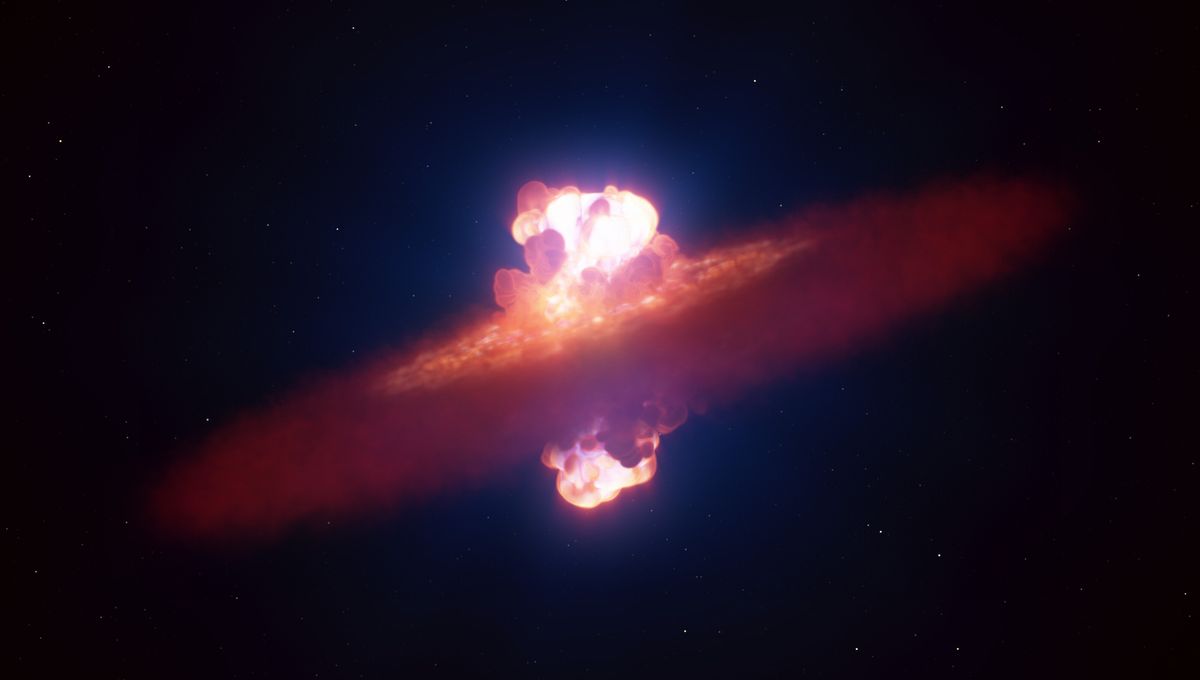
Astronomers have been able to catch the earliest phases of supernova explosions with one of the most powerful observatories on Earth. These incredible observations have provided our first look at what the shape of a supernova is. It turns out, they are not really spherical.

The rest of this article is behind a paywall. Please sign in or subscribe to access the full content.

The European Southern Observatory’s Very Large Telescope (ESO’s VLT) looked at Supernova SN 2024ggi just 26 hours after it was discovered on April 10, 2024. Yi Yang, an assistant professor at Tsinghua University in Beijing, had detected it, and he was the one to send a proposal to ESO to immediately point the VLT at this event.

The quick turnaround meant that for the first time, we could have a detailed view of the short-lived stage of a supernova. It turns out that as SN 2024ggi began to explode, it was not shaped like a ball but more like an olive. The true shape of a supernova is an ellipsoid.

“The first VLT observations captured the phase during which matter accelerated by the explosion near the centre of the star shot through the star’s surface. For a few hours, the geometry of the star and its explosion could be, and were, observed together,” co-author Dietrich Baade, an ESO astronomer in Germany, said in a statement.


Stars with a mass over eight times that of our Sun end their lives in a supernova. Eventually, their cores are no longer fusing elements, and without the energy release pushing material out, the star collapses on itself. The collapse releases an enormous amount of energy, which causes the supernova. The exact details are uncertain; this is why the observations of SN 2024ggi are so valuable.

“The geometry of a supernova explosion provides fundamental information on stellar evolution and the physical processes leading to these cosmic fireworks,” lead author Yang explained. “These findings suggest a common physical mechanism that drives the explosion of many massive stars, which manifests a well-defined axial symmetry and acts on large scales.”

Knowing that the explosion is not spherical has allowed us to rule out some possible models of supernova formation. It is also improving some other possible models. A better understanding of how massive stars end their lives is at hand.

“This discovery not only reshapes our understanding of stellar explosions, but also demonstrates what can be achieved when science transcends borders,” says co-author and ESO astronomer Ferdinando Patat. “It’s a powerful reminder that curiosity, collaboration, and swift action can unlock profound insights into the physics shaping our Universe.”

The study is published in the journal Science Advances. 

Deborah Bloomfield
Deborah Bloomfield

Related posts:

  1. Bolivian president calls for global debt relief for poor countries
  2. 4,000-Year-Old Tablet Shows Teachers Have Reached For The Red Pen For Centuries
  3. New Google Game Is A Fun Way To Learn About The Lunar Cycle
  4. When You Hack A Shark, You’re Exploiting A Glitch Billions Of Years In The Making

Source Link: Earliest Detailed Observations Of A Star Exploding Show True Shape Of A Supernova

Filed Under: News

Primary Sidebar

  • 25-Year-Old Paper On Controversial Glyphosate Weedkiller Retracted, After It Turns Out Monsanto Staff Helped Write It
  • Gravitational Lenses Confirm That Something Is Still Broken In The Universe
  • Adorable Camera Trap Footage Of Moms And Cubs Heralds Conservation Win For Sunda Tigers
  • Exercise VS Sleep: Which Is More Important When You Don’t Have Time For Both?
  • A Deep-Sea Mining Test Carved Up The Seabed. Two Years On, We’re Seeing Devastating Impacts
  • Enormous New Study Finds COVID-19 mRNA Shots Associated With 25 Percent Lower Risk Of Death From Any Cause
  • What Is The Best Movie Set In Space? We Asked Real-Life Astronauts To Find Out
  • Chernobyl’s Protective Shield Is Broken After A Drone Strike, Warns UN Nuclear Watchdog
  • Isaac Newton Was Born On Christmas Day – And January 4th
  • Why Is December The 12th Month Of The Year When Its Name Means 10?
  • Poor Sauropod Was Limping When It Made Curious 360° Looping Dinosaur Track
  • Inhaling “Laughing Gas” Could Treat Severe Depression, Live Seven-Arm Octopus Spotted In The Deep Sea, And Much More This Week
  • People Are Surprised To Learn That The Closest Planet To Neptune Turns Out To Be Mercury
  • The Age-Old “Grandmother Rule” Of Washing Is Backed By Science
  • How Hero Of Alexandria Used Ancient Science To Make “Magical Acts Of The Gods” 2,000 Years Ago
  • This 120-Million-Year-Old Bird Choked To Death On Over 800 Stones. Why? Nobody Knows
  • Radiation Fog: A 643-Kilometer Belt Of Mist Lingers Over California’s Central Valley
  • New Images Of Comet 3I/ATLAS From 4 Different Missions Reveal A Peculiar Little World
  • Neanderthals Used Reindeer Bones To Skin Animals And Make Leather Clothes
  • Why Do Power Lines Have Those Big Colorful Balls On Them?
  • Business
  • Health
  • News
  • Science
  • Technology
  • +1 718 874 1545
  • +91 78878 22626
  • [email protected]
Office Address
Prudour Pvt. Ltd. 420 Lexington Avenue Suite 300 New York City, NY 10170.

Powered by Prudour Network

Copyrights © 2025 · Medical Market Report. All Rights Reserved.

Go to mobile version