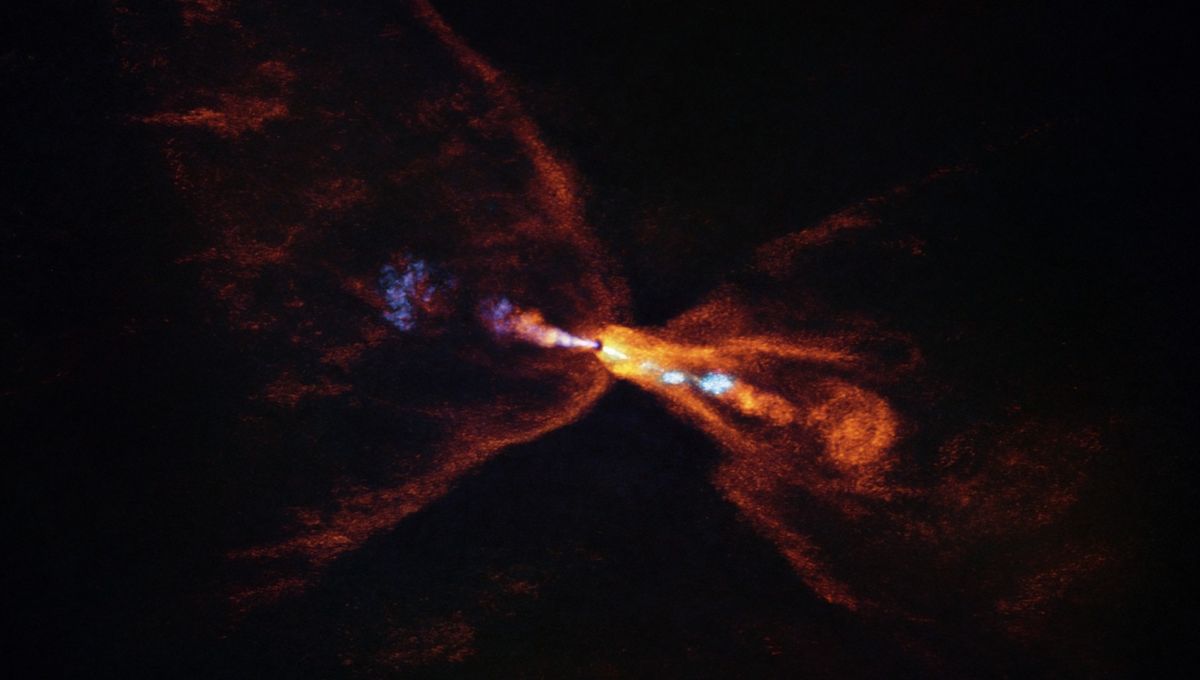
The formation of planetary systems is not fully understood. There are many steps that require further observations, modeling, and theories. Stars form from clouds of gas and dust, and following star formation, that dust will crystallize into minerals, which will become pebbles, which might end up growing into planets. For the first time, researchers have observed the crystallization process.
Using the incredible Atacama Large Millimeter Array (ALMA) and JWST, astronomers observed hot minerals beginning to solidify around HOPS-315, a proto-star located 1,300 light-years away. They determined that the system has silicon monoxide in gaseous form, often found in these hot protoplanetary environments. However, the system also has silicon monoxide in crystalline form.
“For the first time, we have identified the earliest moment when planet formation is initiated around a star other than our Sun,” lead author Melissa McClure, a professor at Leiden University in the Netherlands, said in a statement.
Co-author Merel van ‘t Hoff, a professor at Purdue University, added that “we’re seeing a system that looks like what our Solar System looked like when it was just beginning to form.”
The existence of silicon monoxide in interstellar space has been known since the early 1970s. It has been used to track shocked gas in the outflows from protostars. The fact that the Earth’s crust is mostly made of silicon and oxygen minerals was not lost on scientists, but it is one thing to know that the hot gas will have to solidify, and another to catch it in the act. In the case of HOPS-315, it is truly at the beginning of that crystallization process.
“This process has never been seen before in a protoplanetary disc — or anywhere outside our Solar System,” explained co-author Edwin Bergin, a professor at the University of Michigan.
The team determined that the crystallization is taking place at a particular distance from the star – and it is impossible not to make a comparison to the Solar System.
“We’re really seeing these minerals at the same location in this extrasolar system as where we see them in asteroids in the Solar System,” said co-author Logan Francis, a postdoctoral researcher at Leiden University.
The discovery of the minerals came from JWST, but it was ALMA that was needed to work out where exactly these crystals were forming. ALMA has been a powerhouse when it comes to studying the very early stages of planetary formation.
ESO astronomer and European ALMA Programme Manager Elizabeth Humphreys, who did not take part in the study, said: “I was really impressed by this study, which reveals a very early stage of planet formation. It suggests that HOPS-315 can be used to understand how our own Solar System formed. This result highlights the combined strength of JWST and ALMA for exploring protoplanetary discs.”
The study is published in the journal Nature.

Source Link: “Earliest Moment” Of Planet Formation Spotted For First Time Around Star 1,300 Light-Years Away
