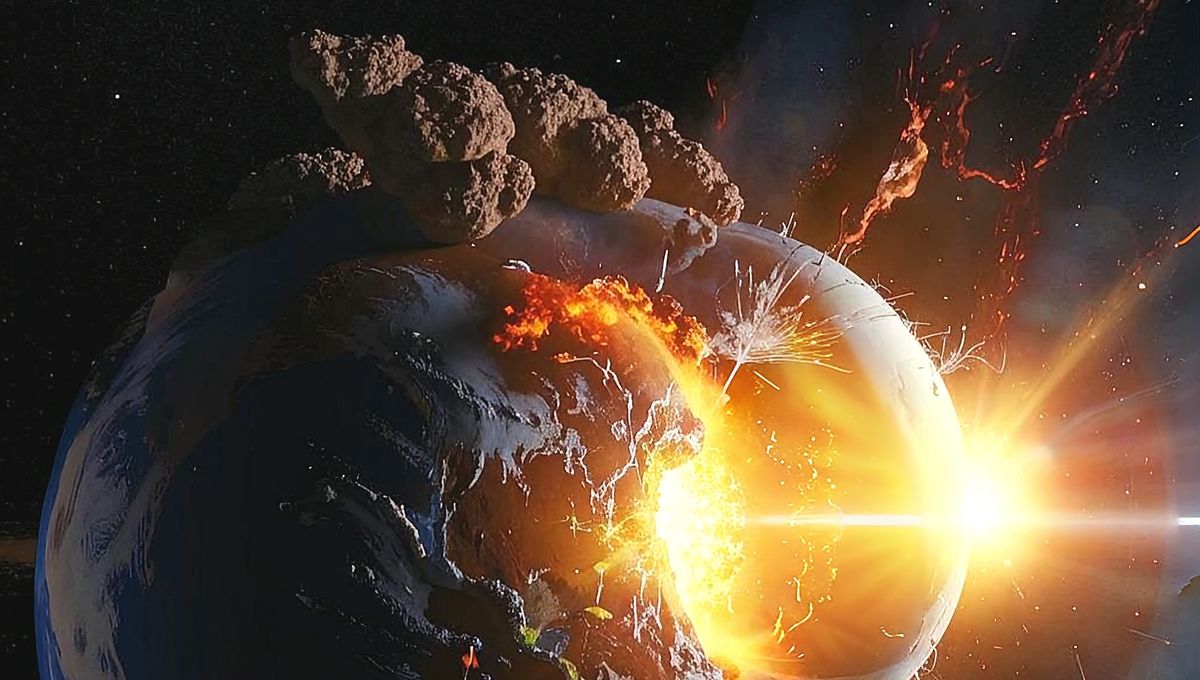
A new take on the origins of Earth’s water claims to reveal the composition of the Earth in the first few million years after it formed. This theory proposes the planet was dry before the collision that formed the Moon, which would make habitable Earth-like planets very much the exception, not the norm.
The source for Earth’s vast oceans has been a matter of debate for at least 400 years. Newton proposed that they are the product of comets, and in recent years, plenty of evidence has been presented for and against that proposition. We know that the early Earth was hot enough to turn water to steam, much of which should have escaped. Water could not have survived at the surface, but must have either been trapped deep within, or delivered later from space.
A fresh perspective on Earth’s formation attributes the water less to a steady stream of comets, which other planets would also experience, and more to a single freak event that also created the Moon.
The authors note that Mercury, Venus, and Mars have very few volatile elements – those that turn to gas easily – such as hydrogen, carbon, and sulfur. Given that two of those are considered essential for life, that absence is telling. The jury may still be out as to whether Mars ever had life, but anything it might have had could not have been anything remotely as widespread as on Earth, given the shortage of hydrogen and carbon.
This raises the question of why Earth is different. Volatile elements had no problem condensing further from the Sun, as testified by comets and icy moons.
No one has found a way to measure the presence of the most important volatiles on the early Earth, but Universität Bern’s Dr Pascal Kruttasch and Professor Klaus Mezger have used manganese as a proxy, despite it condensing at much higher temperatures.
By comparing isotopes of manganese and chromium from asteroids and Earth rocks, they concluded that the proto-Earth took at most three million years to form after the Solar System began. However, this original version of the Earth was as low in volatiles as the other inner planets, they say.
The authors find evidence that the Earth’s chemistry changed during a narrow period of time, dated to 4,561 million years ago.
“A high-precision time measurement system based on the radioactive decay of manganese-53 was used to determine the precise age,” Kruttasch said in a statement. “This isotope was present in the early Solar System and decayed to chromium-53 with a half-life of around 3.8 million years.”
Earth’s current abundances, the authors argue, are consistent with the volatiles being delivered in a single package, rather than a steady rain of comets that must have lasted much longer. Given that it is generally accepted that an object the size of Mars smashed into the Earth around that time, throwing enough material into orbit to form the Moon, the connection is hard to ignore.
If Theia, the name given to the impacting object, formed beyond the Solar System’s snowline, it could have brought with it plenty of volatiles. No doubt many of these would have boiled off in the staggering heat released by the collision, but enough would have been left behind to turn the Earth wet.
The modern planet is probably around 90 percent made up of material from the proto-Earth pre-collision, 10 percent Theia, and 0.4 percent material that arrived afterwards, the team concludes.
“Thanks to our results, we know that the proto-Earth was initially a dry rocky planet. It can therefore be assumed that it was only the collision with Theia that brought volatile elements to Earth and ultimately made life possible there,” Kruttasch said.
If Kruttasch and Mezger are right, then the odds against a habitable planet were exceptionally long. The team are not the first to conclude that the presence of a moon as large as ours is essential to advanced life, and that this might require the unusual event of an enormous collision early in the planet’s formation. Requiring the impactor to have formed so far out makes the scenario even more improbable. “The chances of anything coming from [beyond] Mars are a million to one,” you might say.
If so, a vanishingly tiny proportion of other rocky planets within stars’ habitable zones would have got the same treatment. Life, in this case, may or may not be common in the universe, but would almost always consist of simple organisms scavenging for the tiny traces of carbon and water their planets hold. Meanwhile, planets and moons with plenty of both might be abundant, but only in the frozen wastelands far from their stars.
“This makes it clear that life-friendliness in the universe is anything but a matter of course,” said Mezger.
No need then to evoke dubious assumptions to explain the Fermi Paradox; we might really be alone.
If this depresses you, the study is published open access in Science Advances to try to find a flaw in their reasoning.

Source Link: Earth Was Uninhabitable Until Collision That Created The Moon "Ultimately Made Life Possible"
