• Email Us: [email protected]
  • Contact Us: +1 718 874 1545
  • Skip to main content
  • Skip to primary sidebar

Medical Market Report

  • Home
  • All Reports
  • About Us
  • Contact Us

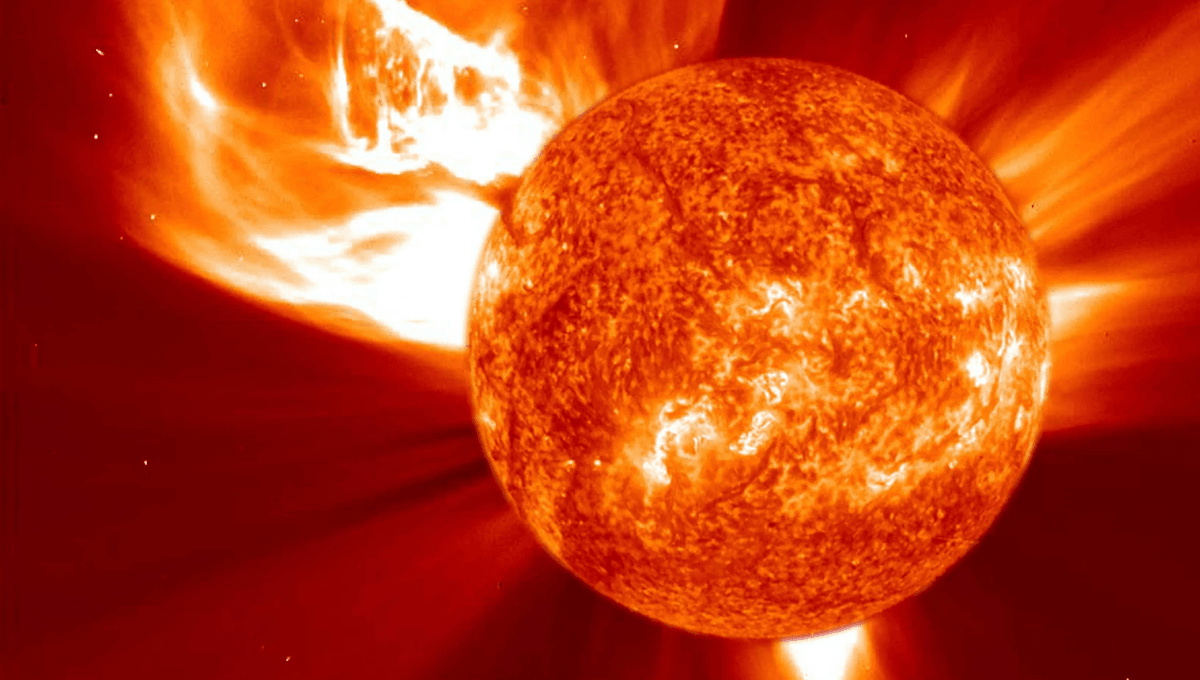
Earth’s Strongest Solar Storm Ever Hit In 12350 BCE – Could It Have Been A Fabled Super Solar Storm?

May 16, 2025 by Deborah Bloomfield

Solar storms can be scary. They have the ability to disrupt our tech, cause blackouts, and even impact us directly. Still, nothing directly observed nor in living memory might quite compare with new findings from researchers – a peak of radiation, consistent with an extreme solar particle event (ESPE) more intense than anything previously known on record.

The most intense event on record is the January 20, 2005, solar storm. If you were on a plane over the southern polar regions (which received a good chunk of that radiation), you’d have received the typical annual cosmic radiation dosage at sea level in just one hour. If you were on a plane in 12350 BCE, you’d have received the annual dosage of radiation in less than 8 seconds.

“Compared to the largest event of the modern satellite era — the 2005 particle storm — the ancient 12350 BC event was over 500 times more intense, according to our estimates,” lead author Dr Kseniia Golubenko, from the University of Oulu in Finland, said in a statement.

The famous Carrington event, the most powerful on record, was not accompanied by a solar particle storm, so it is difficult to compare the two. There is a different comparison that was fundamental for this work: the 775 CE event, which was also very powerful.

The evidence for both comes from tree rings, but for this older event, researchers had to contend with the complexity of estimating tree rings under glacial conditions. To do this, they developed a new climate chemistry model, SOCOL:14C-Ex, and validated it with other known events. With this model, they estimated that the 12350 BCE event was 18 percent more intense than the 775 CE event.

“The ancient event in 12350 BC is the only known extreme solar particle event outside of the Holocene epoch, the past ~12,000 years of stable warm climate,” added Golubenko. “Our new model lifts the existing limitation to the Holocene and extends our ability to analyse radiocarbon data even for glacial climate conditions.”

It is possible for the Sun to create a superflare event, some simplistic early models suggest, based on other sun-like stars, with a possible occurrence rate of maybe one every 6,000 years. Could those two events be the measured effects of a superflare? More work is needed to find out.

“This event establishes a new worst-case scenario,” Golubenko noted. “Understanding its scale is critical for evaluating the risks posed by future solar storms to modern infrastructure like satellites, power grids, and communication systems.”

The study is published in the journal Earth and Planetary Science Letters.

Deborah Bloomfield
Deborah Bloomfield

Related posts:

  1. Russia moves Sukhoi Su-30 fighter jets to Belarus to patrol borders, Minsk says
  2. French senators to visit Taiwan amid soaring China tensions
  3. Thought Unicorns Don’t Exist? Turns Out They Live In A Chinese Cave
  4. Man Finds Three Mammoth Skeletons In His Wine Cellar

Source Link: Earth’s Strongest Solar Storm Ever Hit In 12350 BCE – Could It Have Been A Fabled Super Solar Storm?

Filed Under: News

Primary Sidebar

  • First Hubble View Of The Crab Nebula In 24 Years Is A Thing Of Beauty… With Mysterious “Knots”
  • “Orbital House Of Cards”: One Solar Storm And 2.8 Days Could End In Disaster For Earth And Its Satellites
  • Astronomical Winter Vs. Meteorological Winter: What’s The Difference?
  • Do Any Animal Species Actively Hunt Humans As Prey?
  • “What The Heck Is This?”: JWST Reveals Bizarre Exoplanet With Inexplicable Composition
  • The Animal With The Strongest Bite Chomps Down With A Force Of Over 16,000 Newtons
  • The Eschatian Hypothesis: Why Our First Contact From Aliens May Be Particularly Bleak, And Nothing Like The Movies
  • The Great Mountain Meltdown Is Coming: We Could Reach “Peak Glacier Extinction” By 2041
  • Comet 3I/ATLAS Is Experiencing A Non-Gravitational Acceleration – What Does That Mean?
  • The First Human Ancestor To Leave Africa Wasn’t Who We Thought It Was
  • Why Do Warm Hugs Make Us Feel So Good? Here’s The Science
  • “Unidentified Human Relative”: Little Foot, One Of Most Complete Early Hominin Fossils, May Be New Species
  • Thought Arctic Foxes Only Came In White? Think Again – They Come In Beautiful Blue Too
  • COVID Shots In Pregnancy Are Safe And Effective, Cutting Risk Of Hospitalization By 60 Percent
  • Ramanujan’s Unexpected Formulas Are Still Unraveling The Mysteries Of The Universe
  • First-Ever Footage of A Squid Disguising Itself On Seafloor 4,100 Meters Below Surface
  • Your Daily Coffee Might Be Keeping You Young – Especially If You Have Poor Mental Health
  • Why Do Cats And Dogs Eat Grass?
  • What Did Carl Sagan Actually Mean When He Said “We Are All Made Of Star Stuff”?
  • Lonesome George: The Giant Tortoise Who Was The Very Last Of His Kind
  • Business
  • Health
  • News
  • Science
  • Technology
  • +1 718 874 1545
  • +91 78878 22626
  • [email protected]
Office Address
Prudour Pvt. Ltd. 420 Lexington Avenue Suite 300 New York City, NY 10170.

Powered by Prudour Network

Copyrights © 2025 · Medical Market Report. All Rights Reserved.

Go to mobile version