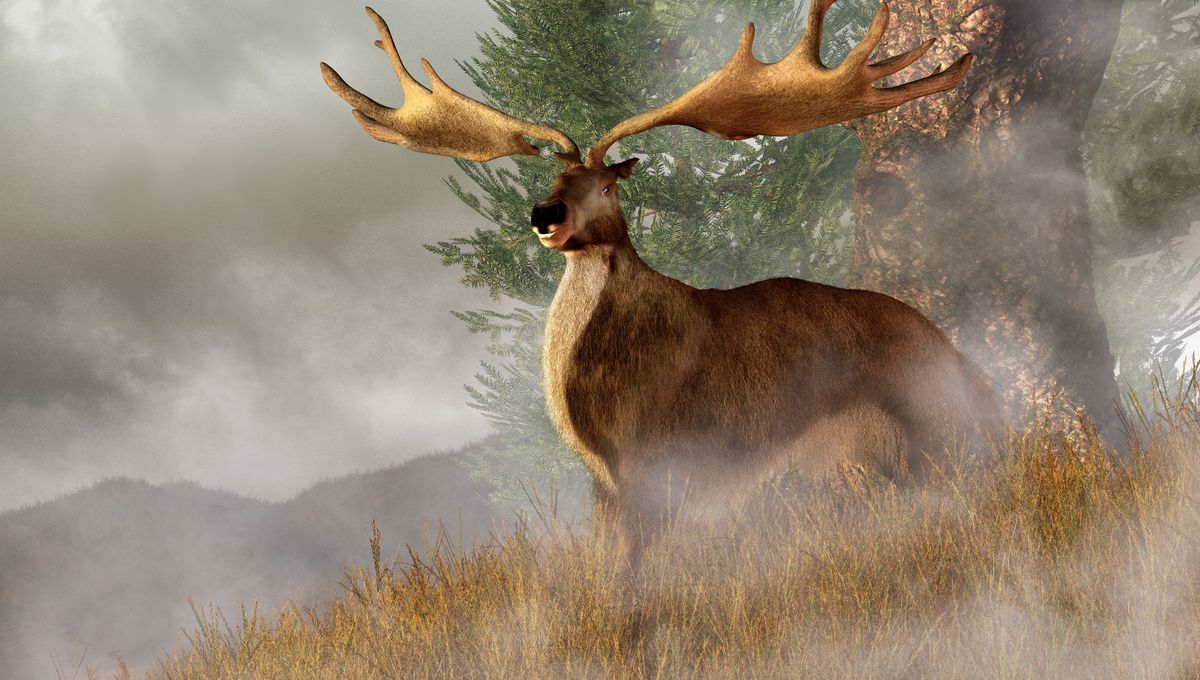
Meet the Irish elk: an enormous extinct deer with a pair of comically large antlers to boot. The ancient behemoth’s unusual appendages, which measure a whopping 3.5 meters (11.5 feet) from tip to tip, may look impressive but we’re not exactly sure why they’re quite so big. According to one new study, their size doesn’t make much sense at all.
The Irish elk (Megaloceros giganteus), also called giant deer for obvious reasons, was Europe’s biggest ever deer, and one of the largest deer to exist period, measuring around 2 meters (6.5 feet) tall at the shoulder. Its range extended across Eurasia during the Pleistocene, from Ireland to Lake Baikal in Siberia, before it went extinct around 8,000 years ago.
“The huge antlers of the extinct Irish elk have invited evolutionary speculation since Darwin,” the researchers write in their study. In the 1970s, biologist Stephen Jay Gould proposed an explanation for their size, concluding that they were linked to the size of the deer and the result of “positive allometry”, with bigger deer having proportionally even bigger antlers.
However, the authors of the new study have revisited Gould’s conclusions and run additional analyses, finding something contradictory.
“We found no evidence for allometric constraints as an explanation for the large antlers of the Irish elk,” they conclude.
While Gould compared the shoulder height and antler length of “cervine” deer, the team chose to focus on antler volume instead. Using Gould’s positive allometry, they predicted Irish elk would have had an antler volume of 17.5 liters, when in reality the average observed antler volume is around 25.5 liters.
“I wouldn’t say Gould was entirely wrong,” study author Thomas Hansen at the University of Oslo told New Scientist. “Allometry still plays an important role.” However, Hansen’s research suggests that other factors are likely behind the evolution of the deer’s enormous antlers.
And what are those factors, you ask? Well, we don’t know for sure. Professor Adrian Lister, an expert on extinct megafauna at London’s Natural History Museum, argued that the answer is sexual selection. Fallow deer, the closest living relative of the giant deer, form a “lek” during the mating season, where males compete by roaring, parading, and locking antlers.
“In this display of strength, bigger antlers were probably more intimidating to other males and more desirable to the females, who would wander into the lek to choose their mate,” he explained. But having been extinct for several millennia, it’s impossible to study Irish elk’s behavior to know if they did the same.
Their diets and habitats could also have helped, Hansen speculated.
Despite previous suggestions that the Irish elk’s insanely big antlers may have had something to do with its extinction – the pressure of finding enough food to grow them can’t have made it easy to adapt and survive – the new study concludes that there is no evidence to support this.
The study is published in Evolutionary Biology.
[H/T: New Scientist]

Source Link: Enormous Extinct Deer Had Even More Enormous Antlers – But We Don't Know Why
