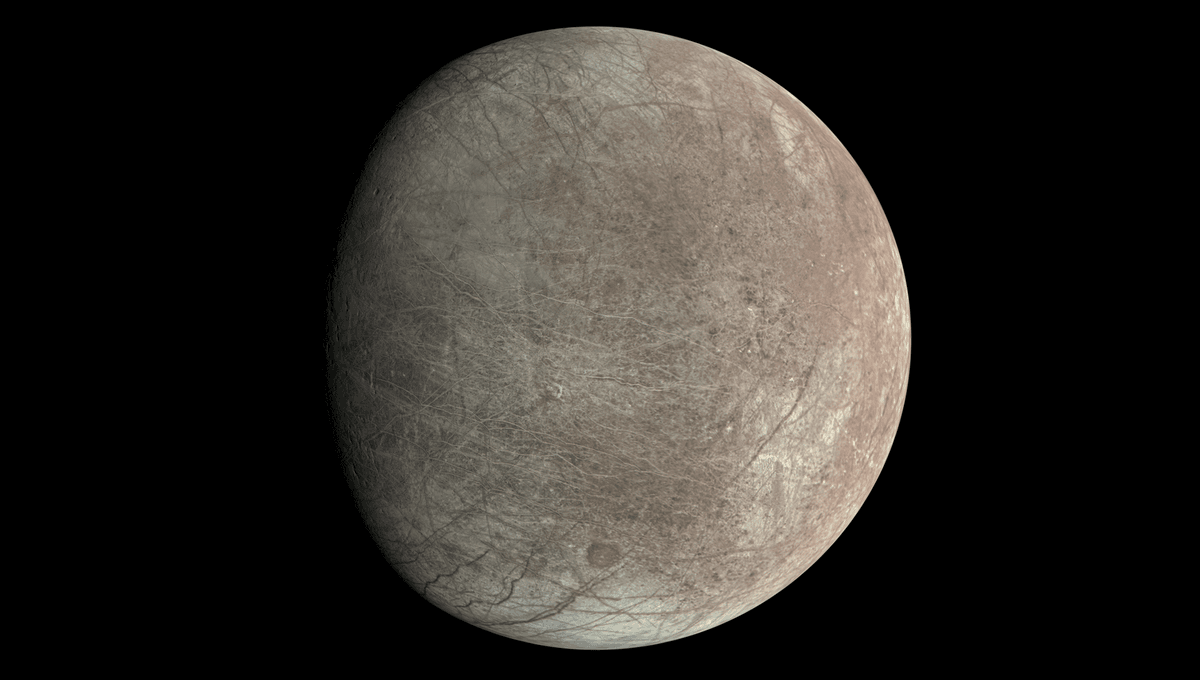
Europa is one of the four largest moons of Jupiter. It has an icy surface that hides a deep ocean, containing maybe two to three times as much water as there is on Earth. These characteristics made this world a prime candidate for hosting life. A new study, though, suggests that the possibility of a habitable ocean might have to be revised.
The rest of this article is behind a paywall. Please sign in or subscribe to access the full content.
The paper looked specifically at what might be happening on the moon in terms of geology. As far as we can tell, Europa has an icy crust 15 to 25 kilometers (10 to 15 miles) thick, sitting over an ocean 60 to 150 kilometers (40 to 100 miles) deep. At the bottom of the ocean, there’s a rocky mantle surrounding a metal core.
The interface between the ocean and the mantle is the moon’s seafloor. The presence of volcanoes, like those on neighboring moon Io, or hydrothermal vents, like those expected to be found on Saturn’s icy moon Enceladus, was considered a strong possibility. The new work instead suggests that there is not enough energy to create much geology there. And without energy, the support for life there today might not exist.
“If we could explore that ocean with a remote-control submarine, we predict we wouldn’t see any new fractures, active volcanoes, or plumes of hot water on the seafloor,” lead author Paul Byrne, an associate professor of Earth, environmental, and planetary sciences at Washington University in St. Louis, said in a statement. “Geologically, there’s not a lot happening down there. Everything would be quiet.”
The four Galilean moons – Io, Europa, Ganymede, and Callisto – are not only affected by Jupiter’s portentous gravity; they also affect each other. The gravitational tug of war creates tidal heating,
“Europa likely has some tidal heating, which is why it’s not completely frozen,” Byrne said. “And it may have had a lot more heating in the distant past. But we don’t see any volcanoes shooting out of the ice today like we see on Io, and our calculations suggest that the tides aren’t strong enough to drive any sort of significant geologic activity at the seafloor.”
“The energy just doesn’t seem to be there to support life, at least today.”
We will know more about Europa in the coming years. NASA has a mission specifically to this moon called Europa Clipper, and the European Space Agency has a mission, called Juice, that will study Europa, Callisto, and focus mainly on Ganymede. If there is a chance for habitability on these moons, we will find it in the coming decades.
“I’m not upset if we don’t find life on this particular moon,” Byrne explained. “I’m confident that there is life out there somewhere, even if it’s 100 light-years away. That’s why we explore – to see what’s out there.”
The study is published in the journal Nature Communications.

Source Link: Europa’s Seabed Might Be Too Quiet For Life: “The Energy Just Doesn’t Seem To Be There”
