Contrary to previous suspicions, Europe probably had many species of ceratopsian dinosaurs, a clade of large herbivores whose most famous member is Triceratops. Ceratopsian fossils are common across North America and Asia, but their relative absence from Europe had puzzled palaeontologists. A new study provides an answer: as well as settling a debate as to whether one species is ceratopsian after all.
The oldest ceratopsians come from Asia, but they flourished in North America, and there is evidence they reached the continent in several expansions, not just one. The location of the continents in the Late Jurassic and Cretaceous make it more likely they would have got to North America through Europe, rather than across the Bering Strait, so a presence there would make sense.
That has made the shortage of ceratopsian fossils in Europe a puzzle. Ajkaceratops kozmai was thought to be the best candidate, but for a long time all we had was a snout. Some palaeontologists argued the species described from this specimen had been miscategorized, and it actually belongs to the same clade as Iguanadon.
A new specimen led Professor Susannah Maidment of London’s Natural History Museum to reinvestigate the question, and in the process she and co-authors have decided Ajkaceratops is actually a legitimate holder of the -ceratops name. They also argue that it isn’t the only case of mistaken identity, and it had company in other misdescribed species.
“While Iguanodon and Triceratops look very different, the groups they are part of both evolved from a common ancestor, meaning they’ve both inherited certain characteristics,” Maidment said in an emailed statement. “They also independently evolved four-leggedness, complex chewing mechanisms and a large body size.”
“This means that their teeth and limbs look quite similar, both because of their shared history and way of life. So, when we only have small parts of the skeleton to look at, it can be quite difficult to tell what’s what.”
In circumstances like this, controversies are often not settled to everyone’s satisfaction. However, Maidment and co-authors have the advantage not only of a new and more complete Ajkaceratops skull but also CT scans that provide new perspectives.
Now, armed with a better idea of what Ajkaceratops looked like, the team realized a specimen that had previously been described as a separate species, Mochlodon vorosi, was instead another Ajkaceratops.
Mochlodon vorosi had previously been categorized as a rhabdodontid, which were thought to be an early breakaway from the iguanadontians, leading to them having unusually shaped teeth and other body parts. Having found that one rhabdodontid was a ceratopsid, the authors were naturally keen to investigate the others.
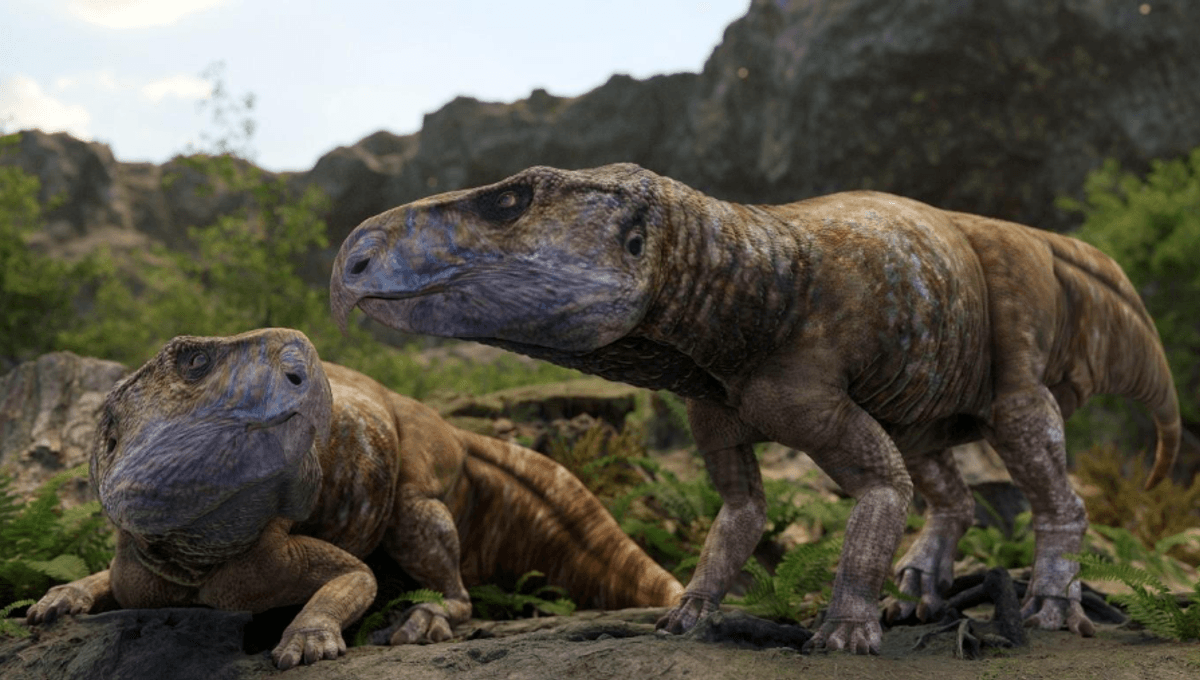
They conclude another supposedly rhabdodontid species, previously known as Zalmoxes shqiperorum, was also a ceratopsid and should be renamed to Ferenceratops shqiperorum. The other member of the Zalmoxes genus may also be a ceratopsian, they argue, but that is less certain.
With sea levels higher than today, and the collision with Africa that pushed up parts of Europe, what is now a continent was then a set of intermittently connected islands, which would have encouraged species diversity. Consequently, it would not be surprising if many ceratopsians thrived on different islands at the time.
If the two supposed Zalmoxes species aren’t closely related at all, it may be necessary to break the genus up, just three years after it’s starring role on Prehistoric Planet. Having lost two of their members, the rhabdodontids themselves may be due a systematic reconsideration, the authors add, but they leave that to another project.
“Horned dinosaurs like Triceratops are some of the most iconic dinosaurs, but most of them are from North America, and now we’ve found them in Europe, hiding in plain sight because they’ve been misidentified for decades as other types of dinosaurs,” said Professor Steve Brusatte of the University of Edinburgh.
The study is published in Nature.

Source Link: Europe's Missing Ceratopsian Dinosaurs Have Been Found And They're Quite Diverse
