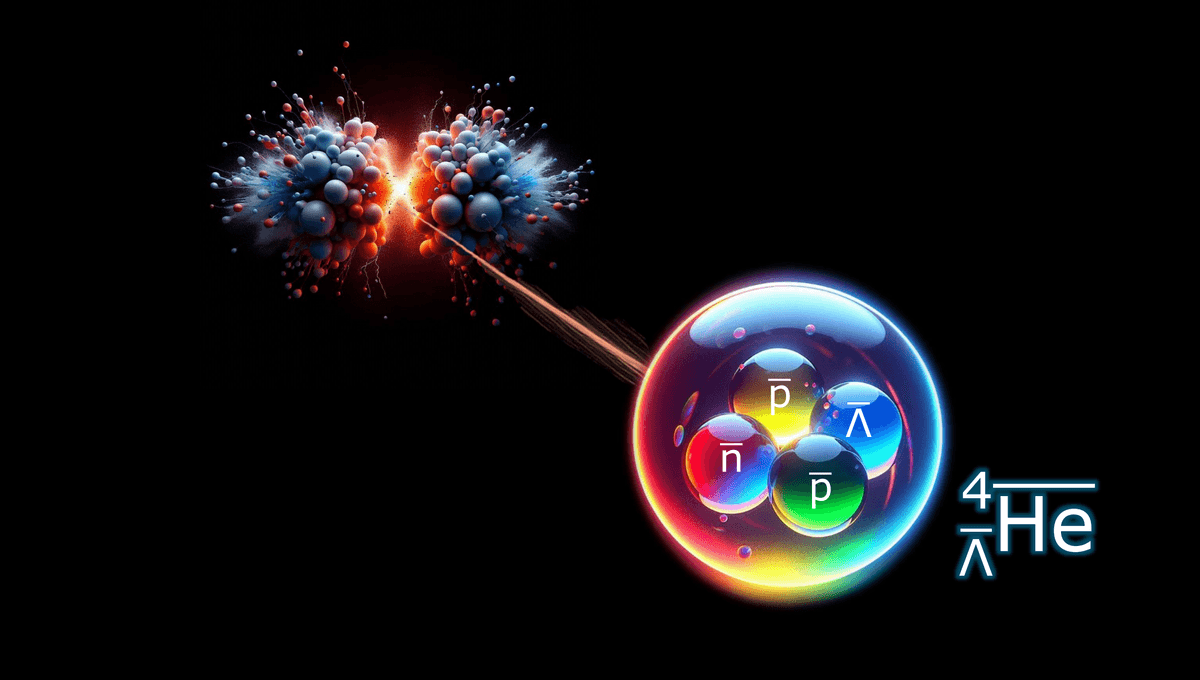
In the Large Hadron Collider at CERN, collisions occur where, for a fraction of a second, the conditions that existed right after the Big Bang happen once more. In the deluge of particles that form during those moments, physicists are keen to find the most peculiar, as they help probe the limits of our physics. Now, researchers with A Large Ion Collider Experiment (ALICE) have just announced a really weird one.
A new paper that has yet to be peer-reviewed has announced evidence of antihyperhelium-4 – which, as names go, could be something found in your favorite science fiction series rather than a lab. Let’s start from the end: Helium is the second lightest and second most abundant element in the universe, with a nucleus containing two protons and two neutrons surrounded by two electrons.
Electrons are fundamental particles – meaning they aren’t composed of other, smaller particles. Protons and neutrons are not, each being made of three quarks. Protons have two up quarks and one down quark, and neutrons are made of one up and two downs.
However, four other types of quarks exist. One of them is called the strange quark, which is like a heavier version of the down quark. When you put a strange quark with two other quarks you end up with a hyperon, a particle similar to the neutron or proton but heavier.
These hyperons are unstable, but they can live long enough to join protons and neutrons. Hyperhelium-4 would be made by two protons, one neutron, and one hyperon known as the lambda (which is made of one up quark, one down quark, and one strange quark)
If all of this was not complicated enough, what researchers have actually found evidence of in the experiment is not hyperhelium-4 but rather its antimatter counterpart, antihyperhelium-4, which is made up of two antiprotons, an antineutron, and an antilambda. They observed the decay products of antihyperhelium-4 – namely, an antihelium-3 nucleus, an antiproton, and a charged pion. This is the first evidence of the heaviest antimatter hypernucleus yet at the LHC.
Last year, the LHC announced the discovery of the lightest hypernucleus, hypertriton, and its antimatter partner antihypertriton. Earlier this year the STAR collaboration at the Relativistic Heavy Ion Collider (RHIC) produced antihyperhydrogen-4 – an antiproton, two antineutrons, and an antilambda – just slightly lighter than the antihyperhelium-4. ALICE found evidence of antihyperhydrogen-4 as well among the rest.
The goal of this kind of research is to answer some fundamental questions about the nature of the Universe. According to the laws of physics, matter and antimatter are equal and only opposite in electric charge – and yet, the universe is made of matter. Something must have preferred it to its counterpart.
The data from these particles have not yet shown a deviation from the expected behaviors of matter and antimatter, so the search continues.
The paper has been submitted to Physical Review Letters and is available before peer review on the ALICE site for Physics Publications and Article Submissions.

Source Link: Evidence Of Bizarre Antimatter Particle Seen At CERN For The First Time
