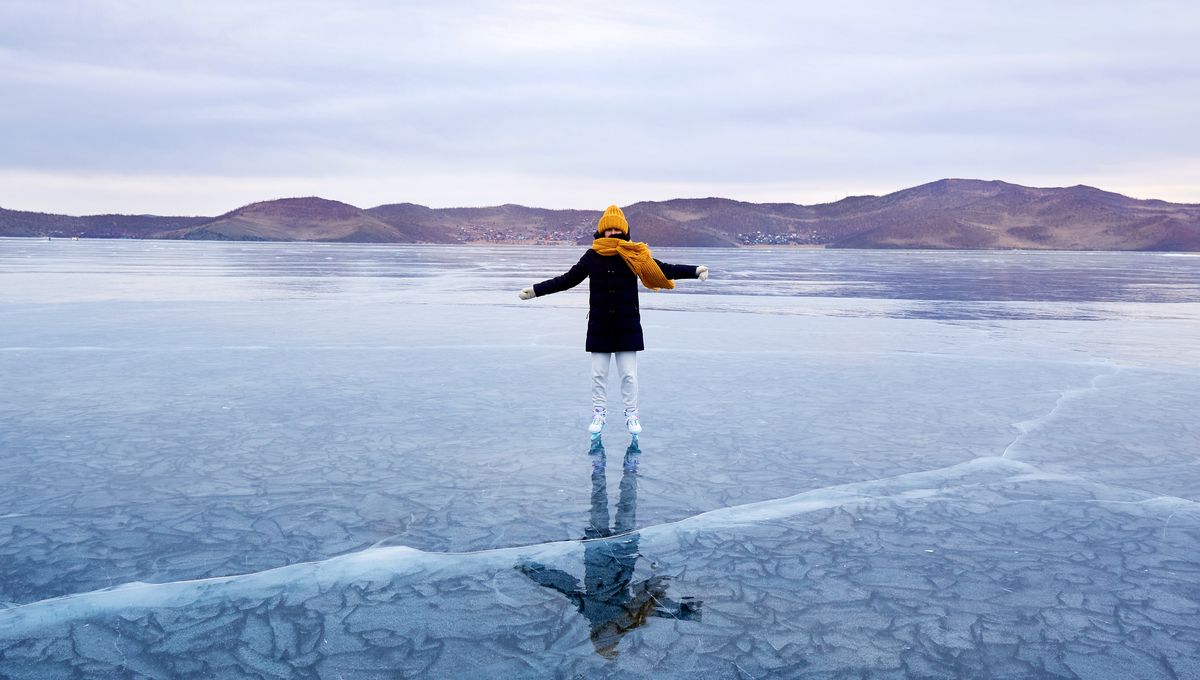
Water can be liquid at temperatures far below freezing under several conditions; perhaps the most surprising is as a thin layer on the surface of ice. The discovery of this fact dates at least to 1859, but there have only been partial explanations, until now.
Don’t you hate it when there is a well-documented phenomenon important to many areas of science that no one can explain? Fortunately, there is now one fewer example of such anomalies out there to bother scientists.
Michael Faraday, more famous for revolutionizing our understanding of electricity and light, noted in 1842 that the surface of ice can have a thin layer of water even at sub-zero temperatures, publishing 17 years later. Although probably not the first to see this, Faraday observed this can cause separate ice blocks to freeze together and said it explained why snowballs hold together.
Faraday called the phenomenon “premelting”. The name is somewhat misleading, since the layer forms even without warming that will eventually cause the whole body of ice to melt, but it stuck, and the phenomenon is observed in other crystals as well.
Although physicists have used many methods to confirm the existence of this liquid layer between ice and air, the explanations provided have been partial or not uniformly accepted. A team of researchers, mostly based at Peking University, think they can change that. They have announced the discovery of an additional layer that forms at temperatures as low as -153°C (-244°F).
Although Faraday called what he observed a liquid layer, it is now considered quasiliquid. In contrast, the new discovery is an amorphous ice layer (AIL) – in other words the molecules are not moving around like in a liquid, but they lack the regular placement of a crystal. The team used a machine learning framework to make predictions of what the structure of the ice should look like and compared them to the observations made with atomic force microscopy (AFM) to test the molecules’ arrangement.
The authors propose that at -152°C (-242°F) disorder among the protons at the surface and the boundaries between tiny domains encourage the formation of vacancies, which reduce the strength of binding between molecules within the ice. This weakness triggers a disordering of the structure, which turns a sliver of the regular crystal into an AIL.
“Although developed in the context of ice, the proposed framework is broadly applicable to a wide range of nanostructure and disordered interfaces,” the paper notes. However, the authors add that “deeply-buried” defects may also be important, and are beyond the reach of the techniques they used.
Premelting is part of the reason snowflakes are occasionally triangular, rather than hexagonal, but it is much more than a curiosity. It contributes to cloud formation, and is one of several competing explanations for why it is possible to skate on ice. The paper’s authors also claim it is important for preserving materials in frozen form, presumably including organs and tissue for transplant.
Faraday had quite the eye for phenomena with the potential to be useful, but electricity took much less time to understand. The authors attribute the long delay to the difficulty of studying surface structures, which are not susceptible to crystallography. Techniques developed to explore the outermost layers of a material, like low-energy electron diffraction, “suffer from limited spatial resolution and intrinsic averaging effects,” they note, so they have left big question unanswered.
The study is published open access in Physical Review X.
[H/T: Phys.org]

Source Link: Faraday’s Enigma Of Premelted Ice Finally Explained After 166 Years
