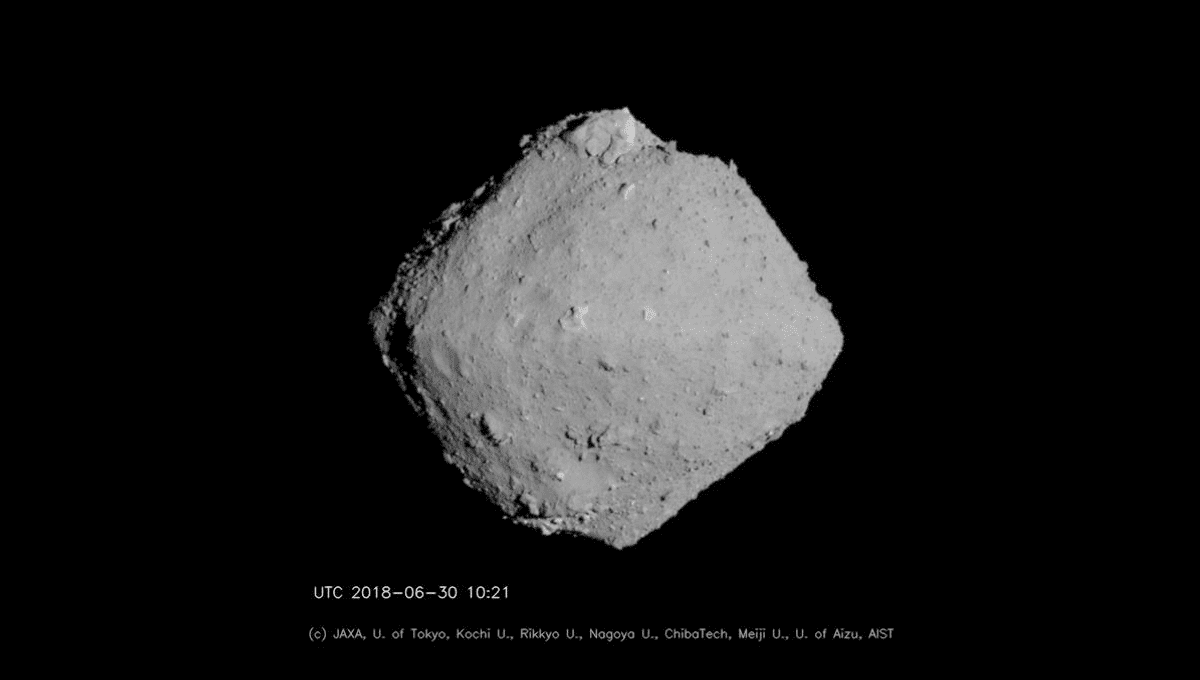
Scientists recently had the first-ever opportunity to study gases freshly grabbed from a moving asteroid. These unbelievably rare samples are the subject of a bunch of new studies published this week and have revealed that the space rock, asteroid Ryugu, was once a child of the Solar System’s iciest depths.
Asteroids can prove to be an invaluable tool for astronomers looking into the early history of the Solar System. Since it’s believed that the building blocks of life on Earth were seeded by meteorites from elsewhere, understanding the composition of an asteroid could even increase our understanding of how life emerged on Earth and where we might find it elsewhere in the universe.
The meteorites that have crashed into Earth’s surface can be useful, but their descent into our planet has meant the material has become somewhat contaminated. Instead, it’s better to get the samples directly from the source.
This is exactly what the Japanese Space Agency’s (JAXA) Hayabusa 2 spacecraft achieved. In 2018, the spacecraft made contact with the near-Earth asteroid Ryugu, scooped up some samples, and carried it back to Earth. First discovered in 1999, this asteroid measures 1,004 by 876 meters (3,293 by 2874 feet) and has a foggy past.
Previous research has closely looked at the 5.5 grams – about a teaspoonful – of solid dust scooped from the asteroid by Hayabusa 2, revealing all kinds of insights into the Solar System’s distant past. For one, it suggested that Ryugu formed from the debris left over from the cosmic collision between its parent bodies, which likely occurred deep on the fringes of our Solar System. Even more incredibly, the samples contained evidence of amino acids and the historic presence of water, which could have implications in the search for extraterrestrial life.
This latest research has studied the pristine gases that were captured in what researchers have called the “treasure box from Ryugu.” It tells us that this asteroid is loaded with noble gases and nitrogen. Importantly, astronomers were able to chronicle the history of Ryugu by looking at how the gases have interacted with solar winds and cosmic rays throughout the asteroid’s life.
Ryugu is made of material dating back to the formation of the Solar System 4.5 billion years ago. However, the gases revealed that the grains from the sample were dated to 5 million years ago, indicating that Ryugu shifted to its current orbit and left the main asteroid belt just beyond Mars at least several million years ago.
Furthermore, analysis of the gas confirmed that the asteroid was most likely born in the outer Solar System, beyond the orbits of Jupiter and Saturn, before being whirled into the asteroid belt near Mars.
“All studies indicate that Ryugu, like the carbonaceous chondrites, is a child of the outer Solar System,” Timo Hopp first author from the University of Chicago, said in a statement.
Two of the studies are published in Science Advances (here and here) and a third is published in the journal Science.

Source Link: First Asteroid Gas Brought To Earth Reveals Ryugu Is A Child Of The Outer Solar System
