Two teams of astronomers have found direct evidence that when a star goes supernova, it leaves behind a neutron star or a black hole. These are compact objects of extreme density; a teaspoon of neutron star material has the weight of a mountain, and nothing can escape a black hole. Their formation has long been linked with supernovae, but this is the first time that direct evidence has been seen linking the dramatic explosions and the extreme objects.
Supernovae are extremely bright, and the objects they create are tiny, smaller than a city. Their nature is often assessed long after the supernova has faded. So, while we have found black holes and neutron stars where supernovae used to be and we have observed many supernovae right after they happened, humans had yet to see this direct link.
In May 2022, South African amateur astronomer Berto Monard discovered the supernova SN 2022jli. Its light came from a spiral galaxy NGC 157, 75 million light-years away. Two teams immediately started studying the event and reported that as the brightness of the supernova began to decline, as it was expected to, it showed a periodic 12-day brightening and fading. Something quite unique.
“In SN 2022jli’s data we see a repeating sequence of brightening and fading. This is the first time that repeated periodic oscillations, over many cycles, have been detected in a supernova light curve,” lead author of one of the papers, Thomas Moore from Queen’s University Belfast, said in a statement.
The periodic behavior was the tell-tale sign that the supernova had left something behind. Well, two things. The exploded star had a companion, which survived the explosive demise of its partner. That companion continued to orbit what was left over from the supernova. Moore’s team couldn’t pinpoint what behavior was causing this, but a second team led by Ping Chen from the Weizmann Institute of Science spotted periodic movement of hydrogen gas and gamma rays from the system.
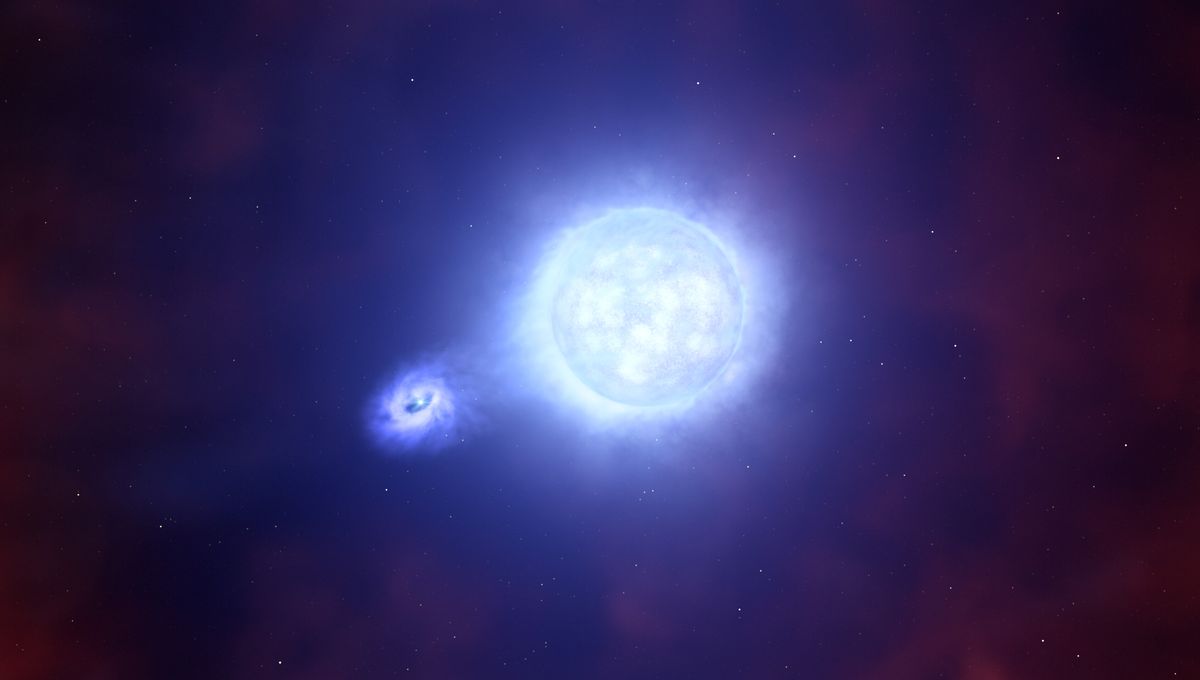
This was enough to paint a cosmic picture and reveal the compact object. The companion star has been interacting with the material ejected by the supernova, which made the companion puffier. Now, the compact object left behind by the supernova orbits through this puffy atmosphere. Whenever it does that, it steals matter, leading to a lot of energy being released. This can only be caused by a neutron star or black hole being left over from the supernova.
“Our research is like solving a puzzle by gathering all possible evidence,” Chen explained. “All these pieces lining up lead to the truth.”
Moore’s paper was published a few months ago in The Astrophysical Journal. Chen’s paper is published today in the journal Nature and will be presented at the 243rd American Astronomical Society meeting in New Orleans.

Source Link: First Direct Evidence In Real Time That Supernovas Create Black Holes And Neutron Stars
