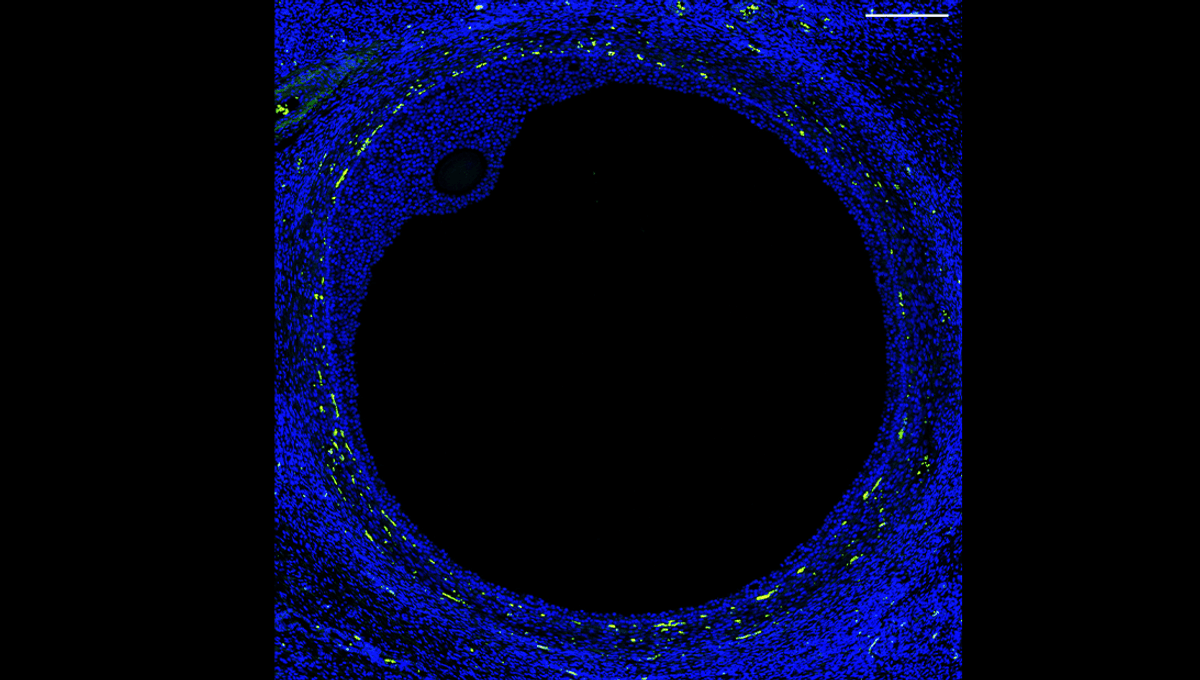
In the latest addition to the ambitious Human Cell Atlas project, launched in 2016, scientists have created the first-ever spatial map of all the different cell types that make up a human ovary. It’s already giving us a detailed look at how these organs function, and could help pave the way for the development of artificial ovaries in the future.
Since the Human Cell Atlas project kicked off, we’ve seen some incredible results – from the unprecedented inner complexity of the human brain, to the chance to watch how fingers and toes grow.
This new atlas is giving scientists a detailed window on how the ovaries work, and how things can go wrong. This deeper understanding is an essential step on the road to hopefully creating artificial ovaries that could provide a solution to some types of infertility.
It’s often said that human females are born with all of the eggs they will ever have. This is true, but it’s also true that the majority of the egg-producing structures – called follicles – contained within an ovary never actually go on to produce an egg.
Until now, the reasons behind this have been a bit of a mystery. Most follicles lie dormant in the ovary’s outer layer, with only a small subset periodically migrating inside. An even smaller group of these produce the hormones necessary to prod immature eggs, called oocytes, down the path to maturity and eventual release into a fallopian tube.
Being able to analyze ovarian tissue down to the level of a single cell has allowed a team at the University of Michigan to zero in on the egg-producing follicles, and look at the patterns of gene expression that allow them to succeed where so many others do not.
Using a technique called spatial transcriptomics, the scientists leverage strands of RNA present in tissue samples to infer which genes are being expressed. For these experiments, the team used ovaries from five human donors, targeting the follicles and oocytes in a first-of-its-kind investigation.
“Now that we know which genes are expressed in the oocytes, we can test whether affecting these genes could result in creating a functional follicle. This can be used to create an artificial ovary that could eventually be transplanted back into the body,” said co-corresponding author Ariella Shikanov in a statement.
A version of this procedure already exists, but it’s far from perfect. Ovarian tissues that have been frozen to protect them from medical treatments like radiotherapy can be reimplanted later to temporarily restore egg production. But it doesn’t work for very long, because most of the follicles don’t survive the process. Creating true artificial ovaries could offer a vast improvement.
And it’s not just about fertility – functioning ovaries also provide the hormones estrogen and progesterone, without which people with a female reproductive system will rapidly enter menopause.
Given the confluence of the well-documented male bias that has existed in medical research and education, the difficulties many report in accessing high-quality female healthcare, and the prevalence of infertility worldwide, the new insights into the reproductive system that this cell atlas will provide are welcome.
Shikanov summarized, “This new data allows us to start building our understanding of what makes a good egg – what determines which follicle is going to grow, ovulate, be fertilized and become a baby.”
The study is published in Science Advances.

Source Link: First-Ever Cell Atlas Of The Human Ovary Brings Artificial Ovaries A Step Closer To Reality
