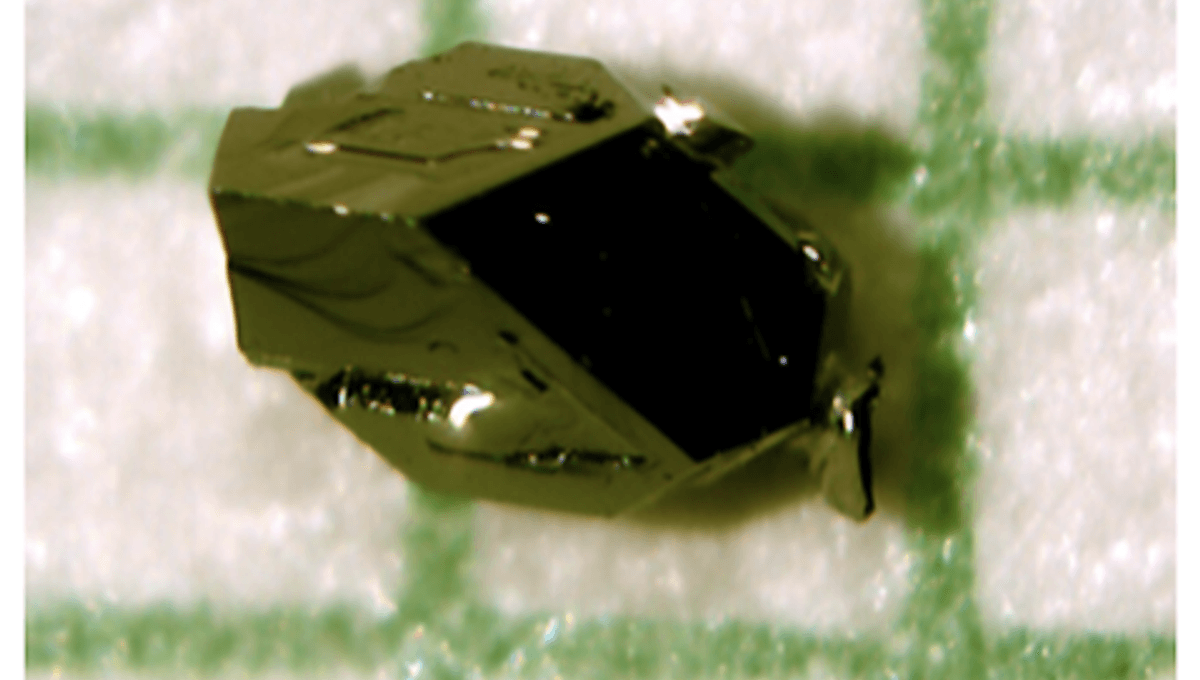
Scientists have found the first unconventional superconductor whose chemical composition is also found in nature. The mineral in question is called miassite, a truly peculiar substance. There are only three other natural superconductors but they follow the rules of Bardeen–Cooper–Schrieffer theory, the first microscopic theory of superconductivity. Lab-grown miassite is different.
Superconductivity means the ability to have no electrical resistance (so transmitting electricity with no waste of energy) while pushing magnetic fields outside the material. This happens below a certain critical temperature. In conventional superconductors, this is due to the formation of electron pairs bonding in a state. They are known as cooper pairs. Unconventional superconductors instead show the same macroscopic characteristics but something different is causing this state.
There is another difference between conventional and unconventional superconductors. The former tends to have a critical temperature much closer to absolute zero, while the latter can sport high-temperature superconductivity. Now, when we talk about high temperature we mean above 77 Kelvin, still far from the holy grail of room-temperature superconductivity, but at least on the way.
This is where miassite comes in. Despite its low critical temperature of -267.75°C (-449.95°F), it shares the unconventional properties of superconductors with a higher critical temperature and researchers hope to use it to better understand the origin of unconventional superconductivity. The mineral has a complex chemical formula with 17 atoms of rhodium and 15 of sulfur (Rh17S15).
“Intuitively, you think that this is something which is produced deliberately during a focused search, and it cannot possibly exist in nature,” senior author Ruslan Prozorov, from Ames National Laboratory, said in a statement. “But it turns out it does.”
Miassite in nature was found near the Miass River in Chelyabinsk Oblast, Russia. The elements that make it tend to react with oxygen so it is pretty rare. It also doesn’t grow into well-formed crystals so it is only through lab growth that its properties could be assessed.
Researchers were looking at rhodium-sulfur systems as a place where interesting superconductors might exist. Prozorov’s group kept the material just a little over absolute zero (-273.1°C/-460°F ) and once the superconductivity was established they tested how conventional it was.
One test is called the “London penetration depth”. In a conventional superconductor, a weak magnetic field can penetrate the bulk of the material at a constant length. In an unconventional one, this changes with the temperature.
Another approach was to hit the material with high-energy electrons causing defects. Unconventional superconductors are highly sensitive to these defects. And miassite behaved like an unconventional superconductor.
“It’s like finding a hidden fishing hole that is full of big fat fish. In the Rh-S system we discovered three new superconductors. And, through Ruslan’s detailed measurements, we discovered that the miassite is an unconventional superconductor,” added Professor Paul Canfield, from Iowa State University and Ames Lab. Canfield synthesized the miassite for this project.
A paper describing the results is published in the journal Communications Materials.

Source Link: First Ever Unconventional Superconductor Found In Nature
