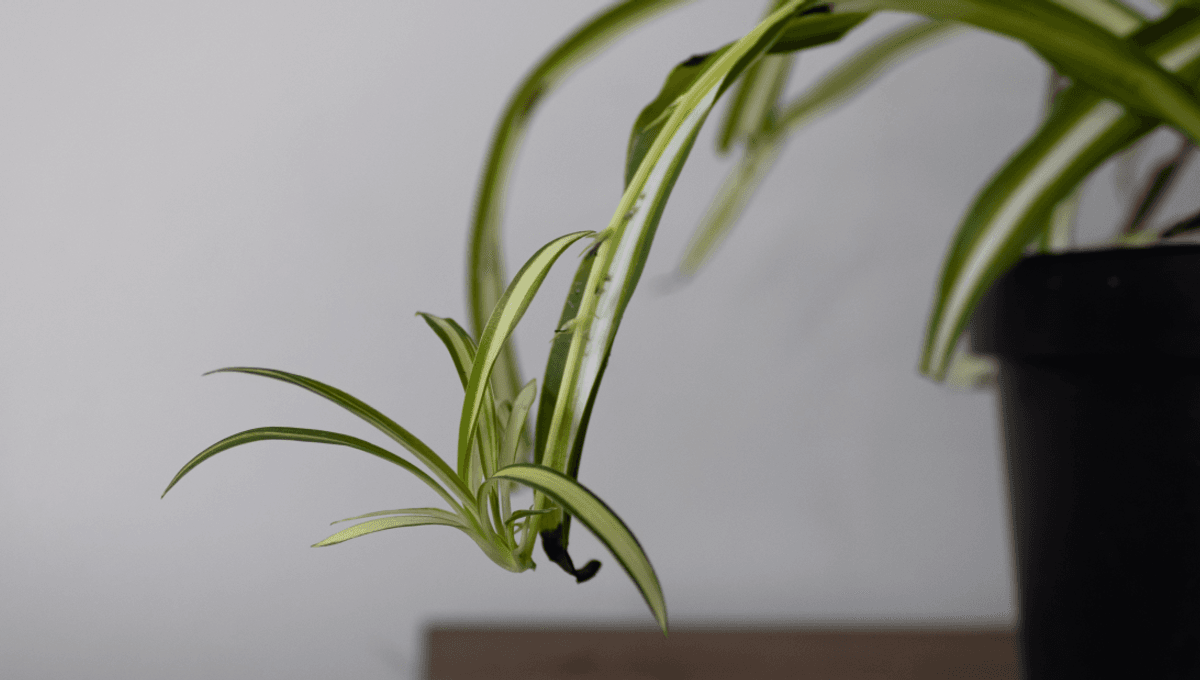
If you’ve ever owned a spider plant, you’ll know they love making babies. They do it with pride, presenting their offspring on the end of a long structure called a stolon. New research suggests that this stolon may be a vital lifeline equivalent to a mammalian placenta that provides dynamic care during a spider plant’s infancy.
In a preprint that has not yet undergone peer review, scientists revealed that in experimental conditions, severing the stolon almost always results in the death of a developing plant. So is it functionally analogous to a placenta? If so, it could mark the first evidence of maternal care in the plant kingdom.
Parental care is common among the animal kingdom, but we know less about if – or how – plants protect their offspring. There are types of cacti that retain seeds (something known as serotiny) to give them a better chance of survival, but until now, we’d never found anything that clearly constituted a kind of maternal care post-seed development.
The spider plant Chlorophytum comosum is an obvious candidate as a model system for investigating parental care in plants. It produces daughter ramets (or spiderettes) through asexual reproduction on the ends of long stems known as runners or stolons.
They tend to produce more when they’re stressed due to unfavorable conditions, which is why you might notice your houseplants sprouting more babies if you go away or forget to water them. The good news? You’ve not got a whole new plant that just needs a home.
Scientists wanted to investigate how significant a role these stolons played in sustaining attached offspring, and for how long. They also wanted to explore if the conditions an attached spiderette was exposed to altered how long nutrients were provided. If so, could this constitute maternal care from a physiological perspective?
They studied mother plants with daughters attached and took a close look at their biochemistry, anatomy, and how their activity was altered by different factors. These included severing the stolon, preventing root growth, and exposing the spiderettes to drought.
Their investigations revealed that spiderettes develop by first establishing their ability to photosynthesize, then working on their roots. During this time, support is provided via the stolon in a way comparable to the human placenta and umbilical cord. If the stolon was severed, most spiderettes died.
The connection between the mother and daughter plant naturally dies back when the new plant is established. However, this natural severance can be delayed if the spiderette can’t establish roots or is stressed due to unfavorable conditions such as drought.
“This study provides compelling evidence that stolon-mediated integration in Chlorophytum comosum functions as a plant analogue of maternal care, ensuring the survival and metabolic stability of developing daughter ramets,” conclude the authors from Mohanlal Sukhadia University in India.
“Anatomical, biochemical, and physiological analyses collectively demonstrate that stolons serve as transient physiological lifelines—facilitating nutrient, water, and signal transport until the [spiderettes] attain metabolic autonomy.”
The authors believe it to be the first experimental evidence of maternal care behavior in plants. However, further research is needed to understand if this process is influenced by the fact that spiderettes are clonally propagated, and whether or not maternal care exists between mothers and offspring made from sexual reproduction and seed-grown species. After all, if it’s a clone you’re raising, is that maternal care or self-care?
So, spare a thought for your spider plant the next time you walk by to find she’s got a new spiderette or five on the go. She’s got her work cut out.
The study is available on the preprint server bioRxiv.

Source Link: First Evidence For Maternal Care In Plants Reveals Placenta-Like Structure That Sustains Their Offspring
