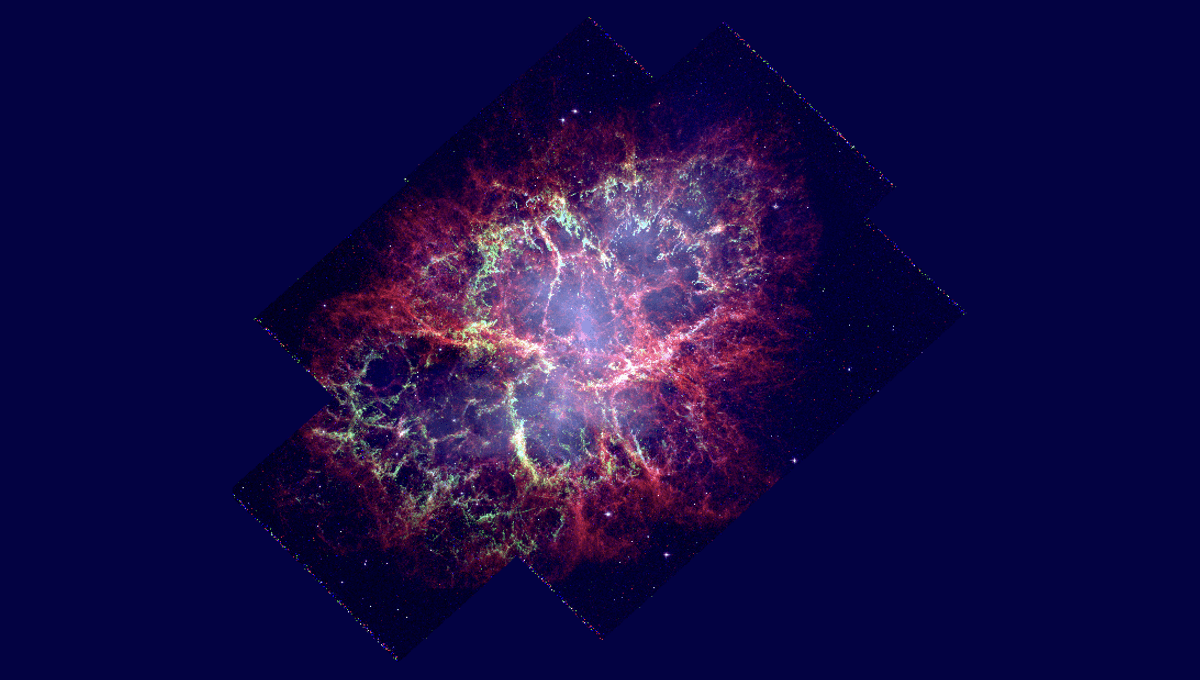
In 1054 CE, humans saw a new star appear in the sky. It was so bright that for 23 days it was visible during the day and for almost two years at night. At its peak, it was four times brighter than Venus, usually the brightest thing in the night sky. A phenomenal spectacle witnessed around the world, it was a supernova, and the remains of that spectacular event are still being studied today. Now, we call it the Crab Nebula.
The rest of this article is behind a paywall. Please sign in or subscribe to access the full content.
Almost a thousand years since its formation, the Crab Nebula sports complex shells of plasma, filled with tendrils, filaments, and knots. At its center sits a pulsar, a pulsating type of neutron star, a possible end product of a star exploding. It is one of the most studied objects in the sky, across all wavelengths of light.
The Hubble Space Telescope conducted high-resolution observations of this supernova remnant between 1999 and 2000, with a spectacular image published in 2005, and analysis that continued for a decade. Recently, researchers thought it was worth revisiting this object. Supernova remnants like the Crab or Cassiopeia A and others are very dynamic, with changes that we can see year-on-year with our telescopes.
“The main reason was that on a detailed scale, the nebula is expanding, so that over time the knots and filaments move in position on the sky. As more recent data [from other telescopes] are obtained, it is hard to compare directly,” lead author of a new study, Professor William Blair from Johns Hopkins University, told IFLScience.
“Secondly, again over 24 years, one might have expected some features to get brighter or fade, as has been seen for knots and filaments in Cassiopeia A and Kepler’s supernova remnant, which are seen to change over roughly a decade.”
The main purpose of the new paper is to get the images and observations into the public domain. These will serve as a new baseline to conduct new studies of the Crab Nebula. Still, many interesting insights are possible. The team found that the nebula’s expansion is easily seen after 24 years. This would be visible to ground-based telescopes, but Hubble showcases the effect of the expansion on a much finer scale.
In terms of brightness, the team does not report particular changes, and no major shift in position for the nebula itself beyond the expansion. Little change might seem a disappointing result, but it is not. The Crab Nebula has not been observed in such detail in visible light for almost two and a half decades, so even no changes tell a story. And anyway, there are some surprises.
“Our new observations have revealed two groupings of knots that ‘stand out from the crowd,’ so to speak,” Professor Blair told IFLScience. “They are present in earlier data if one looks carefully, but they jump out in the way our data are displayed. These two filament groupings are similar to each other in their characteristics, and are nearly diametrically opposed to the pulsar position.”
What are these enigmatic knots? We do not know… yet – they wouldn’t be enigmatic otherwise. But they provide a new avenue to explore, and the team expects that follow-up observations measuring their motion and composition will reveal their true nature.
A paper describing the new observations is accepted for publication in The Astrophysical Journal and is available on the ArXiv.

Source Link: First Hubble View Of The Crab Nebula In 24 Years Is A Thing Of Beauty… With Mysterious "Knots"
