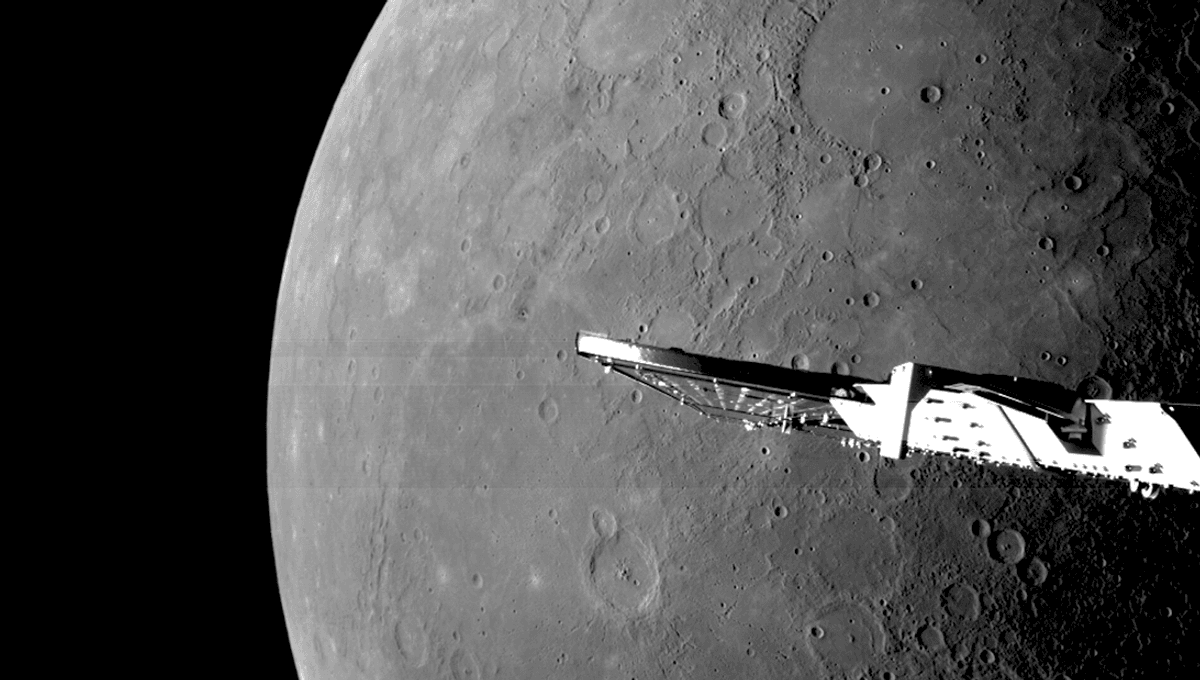
Pieces of Mercury may have been found on Earth, potentially allowing scientists to study the Solar System’s innermost planet.
While we have sent two spacecraft to Mercury – Mariner 10 and MESSENGER – we have not sent any probe down to the planet’s surface, other than in a controlled impact. A mission to do so would be as complex as it is expensive, taking an average of seven years to get there.
“Despite being much closer to Earth than Jupiter and Saturn, Mercury is actually more difficult to reach,” the European Space Agency (ESA) explains. “According to some estimates, it would take less energy to get to the dwarf planet Pluto than it takes to get to Mercury. The reason for that is Mercury’s closeness to the Sun. A spacecraft aiming to not only fly past Mercury while in orbit around the Sun but to enter into orbit around the planet directly, has to constantly brake against the gravitational pull of the star.”
“There are two ways how to accomplish this braking,” Johannes Benkhoff, ESA’s Project Scientist for the BepiColombo mission, added. “You either need a huge spacecraft that carries a lot of fuel, or you can use the gravity of other planets to slow you down along the way. To reach Mercury, you need to perform multiple such planetary flybys and so the journey takes a long time.”
As well as this, the heat is a problem, reaching temperatures hot enough to melt lead. As such, it would be really, really useful to have a chunk of Mercury make its way to us instead. Just like we have observed from Mars and the Moon, asteroids impacting Mercury sometimes kick debris from the planet’s surface into space, forming a new asteroid.
Mercury is covered in craters thought to be created by meteor and comet impacts, making it resemble the Moon. And yet, we have never found a meteorite confirmed to be from the planet, which the authors of a new study describe as a “longstanding mystery”.
Probes sent to the planet have studied Mercury’s surface composition from orbit, helping us to identify whether a meteorite originated from there, but candidate space rocks have always been found to have a composition that doesn’t fit the planet’s profile. Potentially, until now.
“Our latest study investigated the properties of two unusual meteorites, Ksar Ghilane 022 and Northwest Africa 15915. We found that the two samples appear to be related, probably originating from the same parent body,” Ben Rider-Stokes, Post Doctoral Researcher in Achondrite Meteorites at The Open University, explained in a piece for The Conversation. “Their mineralogy and surface composition also exhibit intriguing similarities to Mercury’s crust. So this has prompted us to speculate about a possible Mercurian origin.”
Both of the meteorites contain olivine and pyroxene, as well as minor albitic plagioclase and oldhamite, which the team explains is consistent with predictions for the composition of Mercury’s surface. However, there are also reasons to be cautious, or new mysteries to solve.
“Both meteorites contain only trace amounts of plagioclase, in contrast to Mercury’s surface, which is estimated to contain over 37 percent,” Rider-Stokes explained, adding that their samples were dated to 4.528 billion years old. This is also odd, as estimates of Mercury’s surface age based on crater counting and calculating how many meteor impacts the planet receives over time place the surface’s age at 4-4.1 billion years old.
“If the oldest surface visible on Mercury is 4 billion or 4.1 billion years old, then that would imply that the first perhaps 500 million or 400 million years of the planet have been erased,” Simone Marchi, a NASA Lunar Science Institute planetary scientist, explained to Space.com in 2013. “They are gone. There is no record of the oldest surface of Mercury, and we expect that Mercury pretty much formed like the Earth or the Moon around 4.5 billion years ago.”
According to the new team, that doesn’t necessarily rule out that the rocks came from the planet.
“If these meteorites do originate from Mercury, they may represent early material that is no longer preserved in the planet’s current surface geology,” Rider-Stokes explained.
Until we get a better look at Mercury, we won’t be able to make further judgments of whether these are really pieces of the planet. But thankfully, we won’t have to wait too long for more clues.
“[The] BepiColombo space mission approaches orbit around Mercury in 2026, resulting in a higher spatial resolution analysis of surface composition,” the team writes in their study. “A better determination of the regional-scale mineralogy of Mercury may then be able to identify a parental source for meteorites such as NWA 15915 and KG 022.”
The study is published in Icarus.

Source Link: First Pieces Of The Planet Mercury May Have Been Found On Earth After "Longstanding Mystery"
