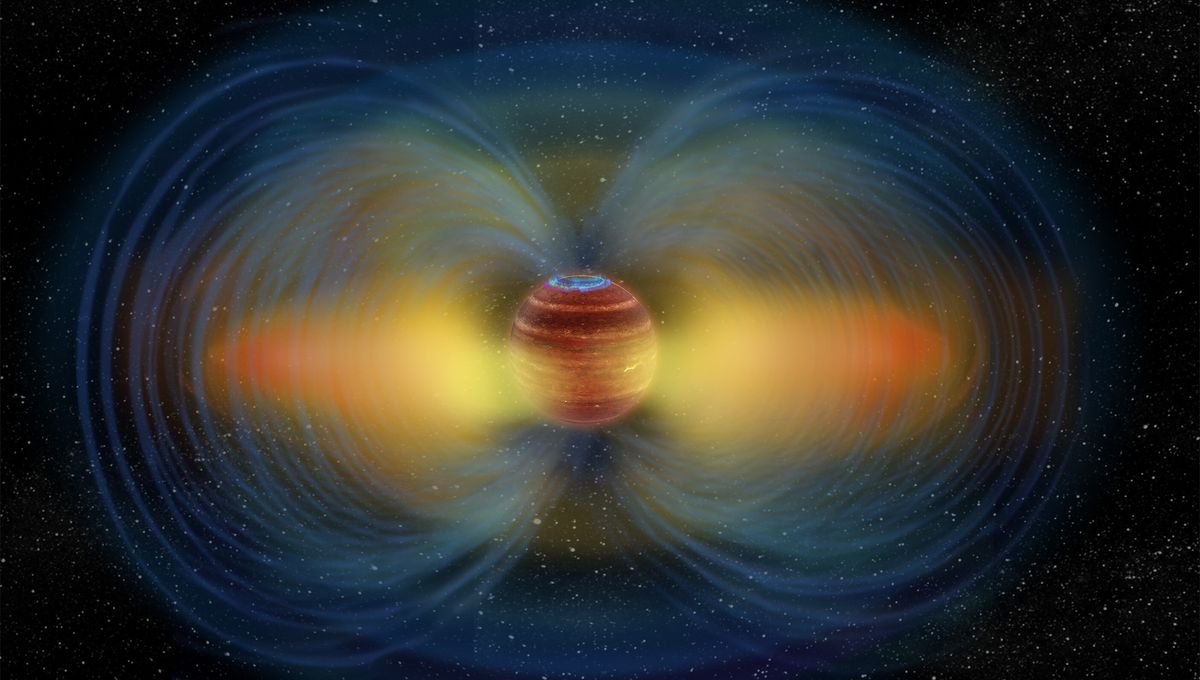
When celestial objects have a strong magnetic dipolar field, as the Earth does, you end up with bands of electrically charged particles captured and held by said magnetic field. Jupiter and Saturn too have radiation belts such as this. The Sun gets them temporarily. And now astronomers have discovered the first example of radiation belts beyond the Solar System.
The object in question is LSR J1835+3259, an ultra-cool dwarf that straddles the blurry limit between the smallest stellar object – AKA brown dwarfs – and the largest gas giant planets. It is 51 times the mass of Jupiter and it has already been talked about for producing the strongest known aurorae, southern and northern lights.
The presence of aurorae sent astronomers looking for the other characteristics found in objects with strong magnetospheres. One they could track was the radiation belt. Imagine large donuts of charged particles circling this dwarf – and they are bright, even when compared to the incredible ones around Jupiter. LSR J1835+3259 would be 10,000 times brighter than the one found around the largest planet in the Solar System.
“We are actually imaging the magnetosphere of our target by observing the radio-emitting plasma – its radiation belt – in the magnetosphere. That has never been done before for something the size of a gas giant planet outside of our solar system,” Dr Melodie Kao, a postdoctoral fellow at UC Santa Cruz, said in a statement.
The source of the magnetic field on Earth is its molten iron core. On Jupiter, it is believed that hydrogen is so compressed in its interior that it begins to act like a liquid metal, producing a magnetic field 20,000 times stronger than Earth’s own. Brown dwarfs’ magnetic fields are believed to be similarly powered.
The team used the High Sensitivity Array, consisting of 39 radio dishes from Hawai’i to Germany. Astronomers were able to snap high-resolution images that allowed them to distinguish between the aurorae and the radiation belts of this object from 18 light-years away. It would be like reading the top row of an eye chart in California from Washington D.C.
“Auroras can be used to measure the strength of the magnetic field, but not the shape. We designed this experiment to showcase a method for assessing the shapes of magnetic fields on brown dwarfs and eventually exoplanets,” Kao said.
“This is a critical first step in finding many more such objects and honing our skills to search for smaller and smaller magnetospheres, eventually enabling us to study those of potentially habitable, Earth-size planets,” added co-author Evgenya Shkolnik at Arizona State University.
Understanding magnetic fields around brown dwarfs and giant exoplanets will provide more insight into the inner workings of these objects. But studying magnetic fields around smaller worlds has another important aspect. Life on Earth has benefited greatly from the protection offered by our planet’s magnetic field. So, finding an Earth-size planet with a strong magnetic field might tell us something about its habitability.
The study is published in Nature.

Source Link: First Radiation Belt Discovered Beyond The Solar System
