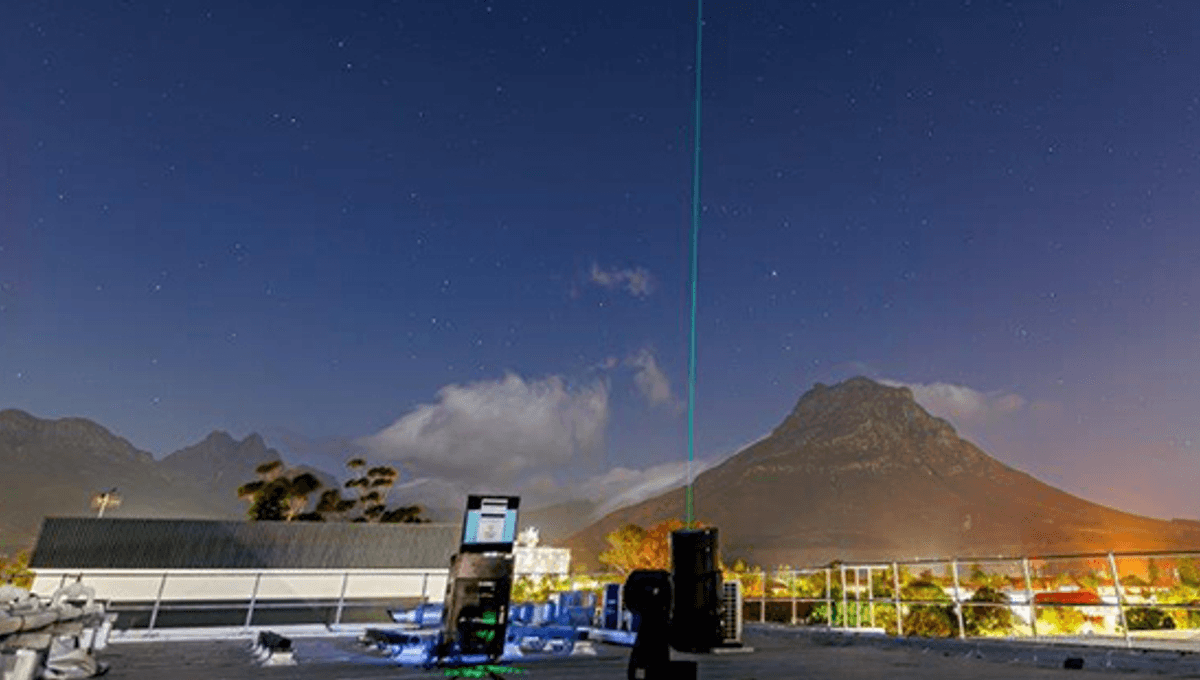
Images have been securely transmitted by satellite using Quantum Key Distribution (QKD) between ground stations in China and South Africa, a record-breaking distance of 12,900 kilometers (8,000 miles). More important than the distance is the drastic reduction in weight, and therefore ultimately of cost, in the transmission and reception technology.
ADVERTISEMENT
The weirdness of quantum mechanics can be harnessed to allow the secure transmission of data, at least in theory. Doing it at scale and over large distances has proven much slower than boosters anticipated. Nevertheless, progress has been made, marked now by the first quantum satellite communication link to include the Southern Hemisphere. However, the favorable conditions required suggest it may be some way off being universally available.
A demonstration of satellite quantum encryption was performed using stations at Stellenbosch University, South Africa, and the University of Science and Technology of China. In between was the microsatellite Jinan-1, specifically designed to allow quantum encryption of information between places not connected by cables.
In the space of one pass by Jinan-1 overhead, 1.07 million bits were securely transmitted. However, the researchers acknowledge the speed of this was made possible by the climatic conditions at Stellenbosch, which has very little cloud or humidity during the southern winter. Cloud (the rain-carrying sort, not where data is stored) forces a switch to auxiliary systems that will be slower.
QKD relies on the capacity of single photons to encode and transmit keys, which can be used to decode the substance of a message. A key feature of quantum mechanics is that intercepting, or even measuring, a single photon changes it, thus interfering with its use as a key. The intended recipient message would be alerted to any attempt at bugging.
China has established 2,000 kilometers (1,200 miles) of fiber for the transmission of quantum-encrypted signals between 32 locations in major cities. Such links could be made intercontinental, just as most ordinary Internet communication crosses oceans by cables, not satellites. However, that’s a lot of infrastructure to establish for something that may only be used in limited cases.
China’s first quantum satellite, Micius demonstrated the potential of using space instead by transmitting signals between China and Austria, but Jinan-1 reveals the technology has advanced further. Among other things, Jinan-1 is more than 10 times lighter than Micius, while at 100 kilograms (220 pounds) the ground stations were closer to a hundred times lighter. The team demonstrated the potential implications of this for portability, moving the Chinese ground station to different locations within several cities, and then into the mountains of Nanshan.
ADVERTISEMENT
The keys were transmitted using pulses from a near-infrared laser.
Stellenbosch is establishing its own Center for Quantum Science and Technology, and team leader there, Dr Yaseera Ismail, said in a statement: “International and national collaborations are essential to drive cutting-edge research and push scientific boundaries.”
The study is published in Nature.

Source Link: First World-Spanning Ultra-Secure Quantum Satellite Link Joins South Africa And China
