• Email Us: [email protected]
  • Contact Us: +1 718 874 1545
  • Skip to main content
  • Skip to primary sidebar

Medical Market Report

  • Home
  • All Reports
  • About Us
  • Contact Us

First X-Ray Image Of Comet 3I/ATLAS Reveals Signature Unseen In Other Interstellar Objects

December 10, 2025 by Deborah Bloomfield

The emission of X-rays is usually the domain of the energetic events of the universe: hot stars, supermassive black holes, and the like. However, since 1996, with Comet Hyakutake, we have learned that even comets can emit X-rays. But despite efforts, no such signal was ever seen for an interstellar object. Enter this year’s superstar Comet 3I/ATLAS, breaking yet another record.

The rest of this article is behind a paywall. Please sign in or subscribe to access the full content.

Interstellar object 3I/ATLAS is different from its predecessors, 1I/’Oumuamua, discovered in 2017, and Comet 2I/Borisov in 2019. It’s faster, it’s older, more active, and estimated to be larger. Now, observations from the X-ray telescope XRISM suggest that it is also the first interstellar object with an X-ray signature.

Before the conspiracy theorists claim that this is some sort of engine signature or a weapon charging up, let’s stress that it is perfectly normal for comets to emit X-rays. This emission comes from specific interactions between the plasma released at high speed by the Sun and the coma, the atmosphere of the comet. This is gas and dust released as the comet gets near the Sun.

The plasma slams into the gas of the coma, and it can rip electrons from the gas’s atoms. The electrons are pushed away with such energy that they begin to emit X-rays. It doesn’t matter that comets are among the coldest objects in the universe. This plasma interaction produces electrons with a temperature of millions of degrees.
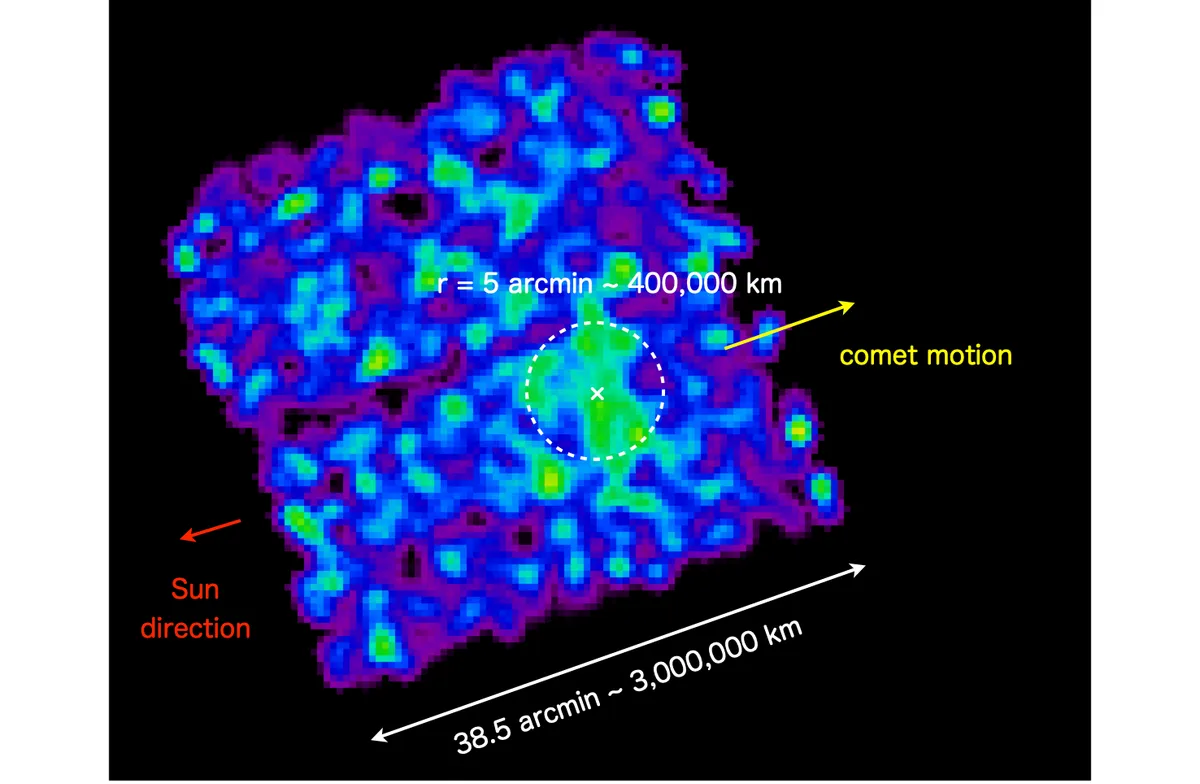
a square made of little bright and dark blobs and near the middle a very long structure blob, that can't be explained as just random noise.

It might look like a blob, but a very interesting blob!

Image credit: JAXA

The data was collected from 23:20 on November 26 to 20:38 on November 28, 2025, with an effective exposure of 17 hours. The primary analysis is consistent with a faint X-ray glow spanning 400,000 kilometers (250,000 miles). The team believes that it would be difficult to explain this signal just with noise from the detector.

While more work is necessary, the team has other preliminary evidence. The X-ray signatures of carbon, nitrogen, and oxygen appeared in the data in a way that couldn’t happen if there was a different source, such as the galaxy at large or even from our own atmosphere.


You might wonder, if looking for an X-ray emission was so important, why did it take so long for astronomers to search for it? Comet 3I/ATLAS was discovered on July 1, after all. The problem was its position in the sky. For most of the last several months, it appeared too close in the sky to the Sun for X-ray observatories to safely observe it. The researchers scheduled the observations for a moment when it appeared far enough away from the Sun to do it safely.

Other X-ray observatories can now safely observe it, so we might be getting further X-ray insights in the coming weeks, as we approach the closest distance between the comet and Earth.

Deborah Bloomfield
Deborah Bloomfield

Related posts:

  1. Exclusive-BOJ likely to warn of hit from Asia bottlenecks on exports, output – sources
  2. TWIS: Musk Reveals His Big Plans For Twitter, Nose Picking Aye-Ayes Will Give You Nightmares, And Much More This Week
  3. Amazing Life-Sized Camel Rock Carvings Discovered In Saudi Arabia – But Who Carved Them?
  4. Why Can’t We See Dark Matter?

Source Link: First X-Ray Image Of Comet 3I/ATLAS Reveals Signature Unseen In Other Interstellar Objects

Filed Under: News

Primary Sidebar

  • Could This Weirdly Moving Comet Have Been The Real “Star Of Bethlehem”?
  • How Monogamous Are Humans Vs. Other Mammals? Somewhere Between Beavers And Meerkats, Apparently
  • A 4,900-Year-Old Tree Called Prometheus Was Once The World’s Oldest. Then, A Scientist Cut It Down
  • Descartes Thought The Pineal Gland Was “The Seat Of The Soul” – And Some People Still Do
  • Want To Know What The Last 2 Minutes Before Being Swallowed By A Volcanic Eruption Look Like? Now You Can
  • The Three Norths Are Moving On: A Once-In-A-Lifetime Alignment Shifts This Weekend
  • Spectacular Photo Captures Two Rare Atmospheric Phenomena At The Same Time
  • How America’s Aerospace Defense Came To Track Santa Claus For 70 Years
  • 3200 Phaethon: Parent Body Of Geminids Meteor Shower Is One Of The Strangest Objects We Know Of
  • Does Sleeping On A Problem Actually Help? Yes – It’s Science-Approved
  • Scientists Find A “Unique Group” Of Polar Bears Evolving To Survive The Modern World
  • Politics May Have Just Killed Our Chances To See A Tom Cruise Movie Actually Shot In Space
  • Why Is The Head On Beer Often White, When Beer Itself Isn’t?
  • Fabric Painted With Dye Made From Bacteria Could Protect Astronauts From Radiation On Moon
  • There Used To Be 27 Letters In The English Alphabet, Until One Mysteriously Vanished
  • Why You Need To Stop Chucking That “Liquid Gold” Down Your Kitchen Sink
  • Youngest Mammoth Fossils Ever Found Turn Out To Be Whales… 400 Kilometers From The Coast
  • The First Wheelchair User To Travel To Space Is About To Make History
  • “It Was Bigger Than A Killer Whale”: 66 Million-Year-Old Tooth Suggests Mosasaurs Were Hunting In Rivers, Not Just Seas
  • Killer Whales And Dolphins Team Up In First-Ever Footage Of Cooperative Hunting
  • Business
  • Health
  • News
  • Science
  • Technology
  • +1 718 874 1545
  • +91 78878 22626
  • [email protected]
Office Address
Prudour Pvt. Ltd. 420 Lexington Avenue Suite 300 New York City, NY 10170.

Powered by Prudour Network

Copyrights © 2025 · Medical Market Report. All Rights Reserved.

Go to mobile version