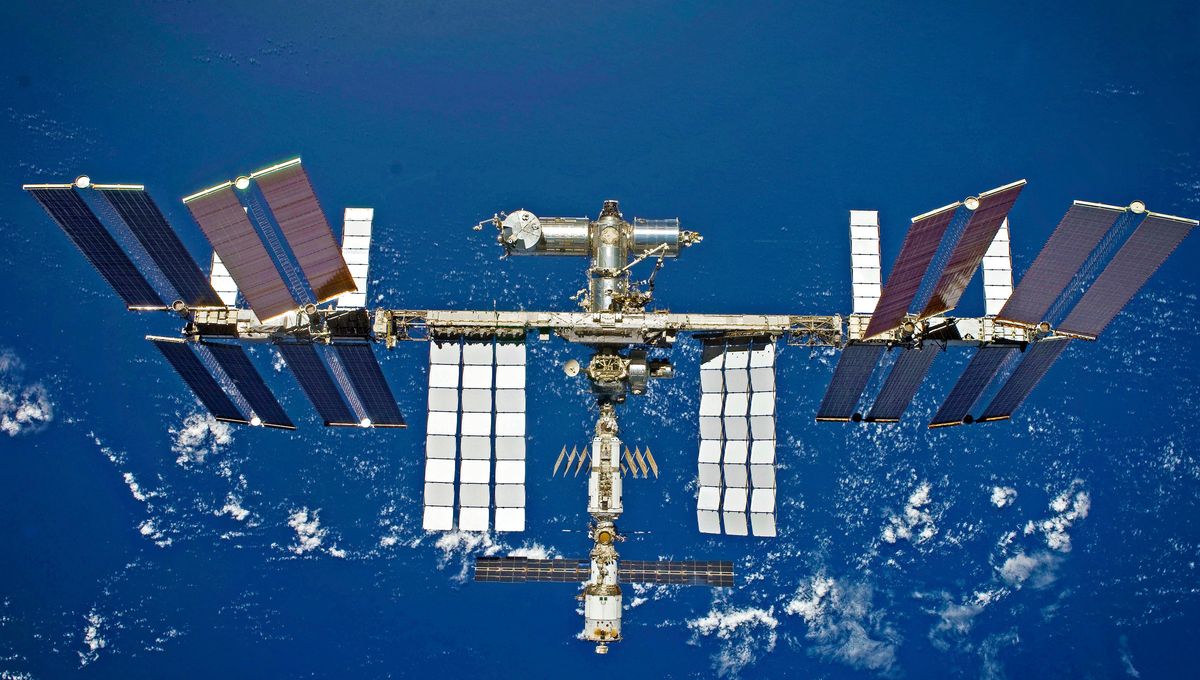
On November 2, 2000, astronaut Bill Shepherd and cosmonauts Yuri Gidzenko and Sergei Krikalev entered the International Space Station (ISS). That means that for the last 25 years, there have always been some humans in space – a quarter of a century in which a few members of our species have not been on the planet where we have all come from.
The ISS has been revolutionary. Over 250 people from 26 countries have visited the ISS, conducting several thousand scientific investigations on behalf of researchers from over 100 countries. There are hundreds of experiments going on every day. Their scope spreads from medicine to fundamental physics.
It had been true to its name of being international, as it was the collaborative endeavor of 15 countries that brought it together. It took 42 assembly space flights to build, 37 of which were with the now-retired Space Shuttle program. The final and current size of the ISS is impressive. Its truss length measures 109 meters (357.6 feet) and its mass is 419,725 kilograms (925,335 pounds).
The spacecraft is located at an altitude of about 410 kilometers (255 miles) from the ground, although it requires adjusting – something that has been politically fraught over the last several years (more on that later). At that altitude, the gravitational pull of the Earth is about 90 percent of what we experience on the ground.
So how do astronauts and cosmonauts float? That’s due to the orbital speed. The space station is in freefall, but it moves at 7.66 kilometers per second (17,100 miles per hour) around the Earth. This allows stuff and people to float as the motion creates what is known as microgravity.
How will the International Space Station be retired?
The Russian invasion of Ukraine and the subsequent sanctions against the country had some repercussions in space. Russia made multiple threats against the long-term survival of the ISS. It is the Soyuz and its powerful engines that keep the station in the right orbit, so Roscosmos, the Russian Space Agency, holds important cards.
For this reason, NASA tested the SpaceX Dragon capsule’s ability to do the same job in September. The test was very successful, but now a different kind of political problem might be emerging, as SpaceX CEO Elon Musk has recently been publicly fighting with Trump’s Transportation Secretary and Acting Head of NASA, Sean Duffy.
While the immediate future of the ISS doesn’t seem to be in jeopardy so far, the medium term gets us to the retirement of this incredible mission. The ISS is old, and it is not getting any new modules or substantial upgrades. Its mission has been extended through 2030, and it will be retired the following year.
Just like with Skylab and Mir before, the spacecraft will fly into the atmosphere and fall, in a controlled re-entry into the Pacific Ocean. The specific area is known as Point Nemo, the furthest spot from land on planet Earth, with the nearest land being around 2,700 kilometers (1,678 miles) away. Being so far away makes it ideal for deorbiting missions, and it has become famous as the place where spacecraft go to die.
Will humans still stay in space once the International Space Station comes burning down?
Even without the ISS, some humans will stay off planet for the foreseeable future. There is no plan to stop the continuous habitation of space. The spiritual successor of the ISS will likely be China’s Tiangong Space Station, the only other permanently orbiting space base currently in operation.
It is about one-third of the volume of the ISS, and it has been orbiting for several years with a decade-long lifetime. If a strict 10-year plan happens, it will still bring us into the early 2030s, but it is unlikely that the Chinese space agency will just shut it down like that.
Roscosmos has put forward claims that it will build its own space station. India too is planning the Bharatiya Antariksh Station, expected to fly in 2035. For NASA, the goal is to have private space companies build a space station in low-Earth orbit. One of them, Axiom Station, is expected to launch no earlier than 2028.
For NASA, the original plan was to take space habitation ambitions to the Moon. First, with the construction of the Lunar Gateway, a new international space station placed in lunar orbit as a “gateway” to the Moon, then a base on the surface of our natural satellite. The Trump administration plans to cut the gateway, among many other NASA missions, but the European Space Agency appears to be happy to keep building it by itself.
Humanity will continue to be in space, and maybe once the ISS is no more, we’ll miss it so much that we will build another.

Source Link: For 25 Years, People Have Been Living Continuously In Space – But What Happens Next?
