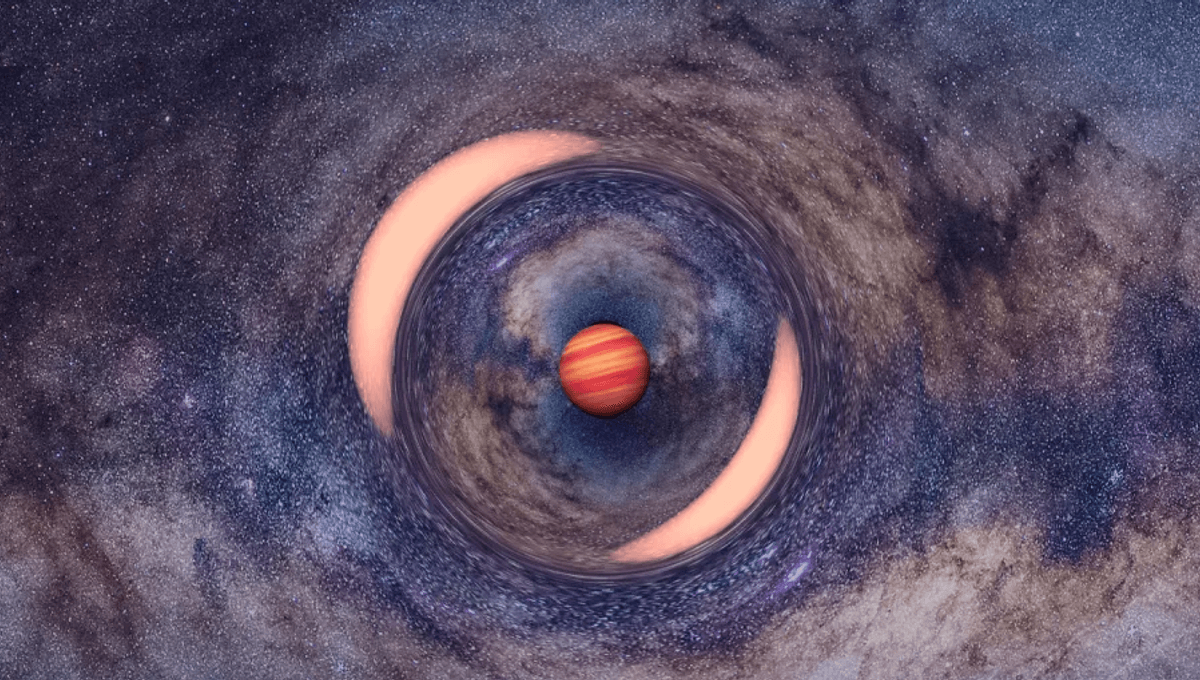
The galaxy is expected to be home to billions of free-floating, or “rogue”, planets that have no stellar companion. These worlds have been kicked out of the system where they formed, and they travel cold and alone around the Milky Way. They are found serendipitously, their properties hard to estimate, but a new approach and a lucky encounter has allowed the first mass and distance measurement of a solitary rogue planet.
The rest of this article is behind a paywall. Please sign in or subscribe to access the full content.
These worlds are too cold to be discovered directly, and they do not shine in visible light. The only way to spot them is when they produce a microlensing event. The planet passes in front of a much more distant star, briefly magnifying its light. These kinds of events will be particularly important with next-generation telescopes that can capture larger areas of the sky, so they have a better chance of catching a planet in such an act.
There is a problem with microlensing when it comes to estimating the properties of the free-floating planet, though. It is known as the mass-distance degeneracy. Basically, a smaller but closer planet might create an effect similar to a larger planet that is farther away. This was not the case for this new world, which has been dubbed KMT-2024-BLG-0792/OGLE-2024-BLG-0516. It was observed both from ground-based observatories and the now-retired Gaia space telescope. The distance between the two was enough to break the degeneracy.
The team has estimated that the planet is about 22 percent the mass of Jupiter, so roughly a Saturn-sized world. It is located about 3,000 parsecs ( 9,785 light-years) from the center of the Milky Way. That’s about two-thirds of the way there from Earth.
The team, using both statistical models and simulations, expects that this world did not form independently like a brown dwarf. That’s a stellar object – so formed like a star – with mass too low to begin nuclear fusion. This world is just too small. This Saturn-sized object formed in a proto-planetary disk, maybe with other planets, and due to dynamical processes such as planetary migration, was thrown into interstellar space.
These first measurements are extremely exciting in themselves, but also for future observations of rogue planets. The Nancy Grace Roman Telescope, scheduled for launch in 2027, is expected to discover hundreds of free-floating exoplanets, including many the size of Earth. If this approach is copied, it might deliver much better insights into the properties of these worlds and their formation.
A paper describing the results is published in the journal Science.

Source Link: For First Time, The Mass And Distance Of A Solitary “Rogue” Planet Has Been Measured
