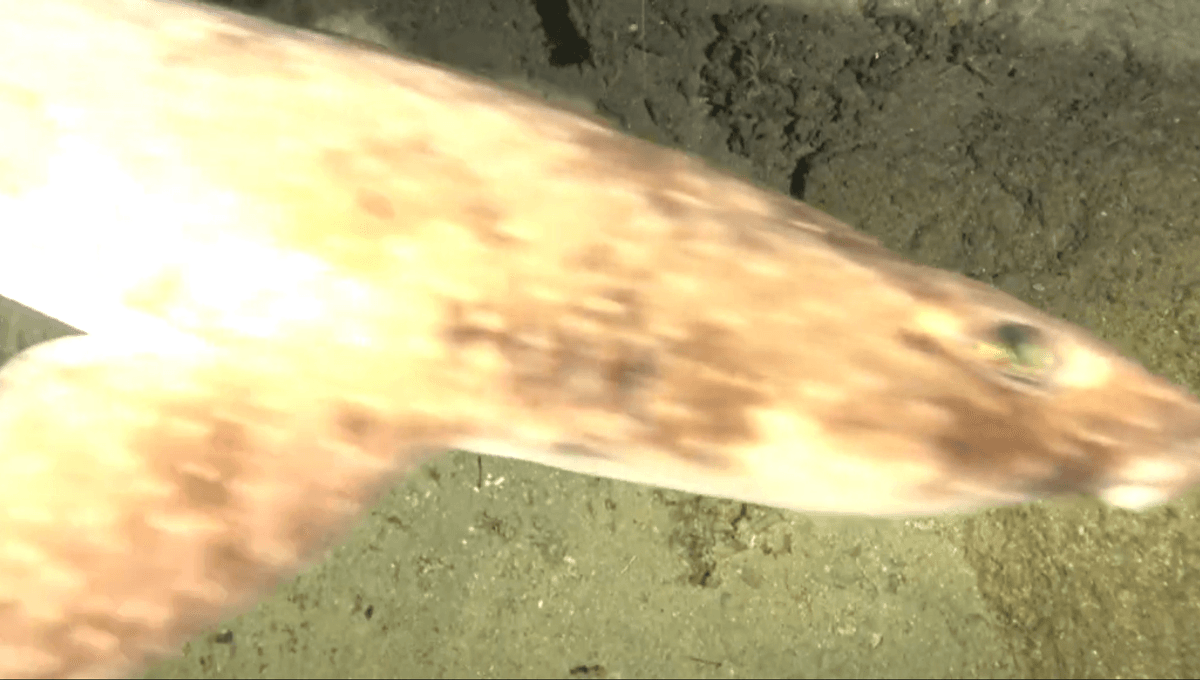
For the very first time, scientists have captured live footage of the painted swellshark (Cephaloscyllium pictum) — a super-elusive, blotchy catshark that until now had only been known from unlucky specimens hauled into Indonesian fish markets.
The video (below) was filmed in November 2024 during a recent project supported by the National Geographic Society that attempted to survey the deep-sea waters off the coast of Timor-Leste in Southeast Asia using drop-cameras. To their surprise, the cameras managed to spot a painted swellshark at depths of 536 and 570 meters (1,758 to 1,870 feet), swimming around the steep rocky slopes.
Identifying to the species level is quite a skill!
Louw Claassens
“Essentially, we just wanted to see what is down there – the painted swellshark was a bonus! But also a nice indication that there is loads to still explore and discover in Timor-Leste,” Louw Claassens, lead author of the new study and zoologist at Rhodes University, told IFLScience.
Identifying this character wasn’t easy, though. To ensure it really was a painted swellshark, the team looped in Dr Dave Ebert, known as the Lost Shark Guy for his efforts to find and identify unknown sharks, as well as Dr William White, a senior curator of the Australian National Fish Collection at CSIRO.
The newly filmed species belongs to the genus Cephaloscyllium, many of which have a strong, patchy colour pattern. However, it’s possible to differentiate the species by taking a closer look at their patterning and body shape.
“Identifying to the species level is quite a skill! What might look similar to me and you, can look clearly different to the trained eye,” explained Claassens.
Since the species was previously identified in Indonesian fish markets, the footage extends the species’ known range by around 1,100 kilometers (683 miles) and suggests it might not be as elusive as previously assumed.
“Researchers commonly make use of fish markets or fisher catch. This shark lives quite deep, and regular diver surveys will not detect it. So, the next best thing is to see if fishers catch it and use specimens from markets. The probability is much higher that you will find some specimens, as opposed to dropping a few cameras into the ocean,” commented Claassens.
The discovery is a boon for Timor-Leste, a young nation that has emerged from a turbulent history. Colonized by Portugal in the 16th century, it declared independence in 1975, only to be invaded and annexed by Indonesia shortly after. During the 24-year occupation, the Timorese people endured widespread violence and human rights abuses. They obtained full independence in 2002, but their country continues to be one of the poorest in the world.
This latest study further reveals that Timor-Leste is a vibrant hotspot of marine biodiversity, and is likely to be teeming with many more hidden treasures.
“What I like about this project is that we were able to actually do it. On a super small budget. And we dived into the deep ocean of Timor for the first time! For a least developed country, one of the world’s newest countries, this is quite big,” Claassens added.
The study is published in the journal Oryx.

Source Link: For The First Time, A Deep-Sea Painted Swellshark Is Filmed Alive In The Wild
