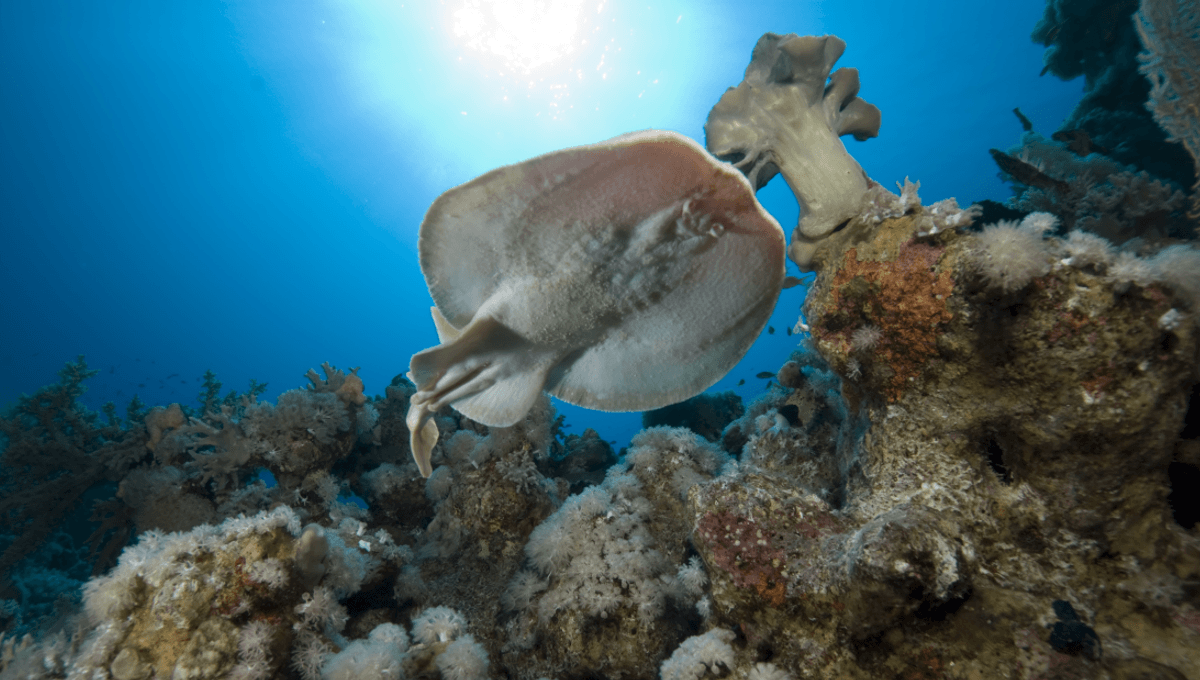
Scientists were puzzled as to why it was that the electric rays of Guadalupe Island, Mexico, were so confident in the face of pretty sizable sharks. Turns out, they can zap these would-be predators – and the message is very effective, as demonstrated in footage of the behavior.
“I believe this highlights the incredible defensive traits some animals have,” said study author and Assistant Professor at Florida International University, Yannis Papastamatiou, to IFLScience. “A lot of defensive traits appear ineffective against big predators (e.g. large sharks eat stingrays often; the barb doesn’t seem to deter them). At least from our limited observations, electric rays may be very effective at deterring large predators.”
It paints the picture of a highly effective defensive mechanism!
Yannis Papastamatiou
The team hadn’t set out to uncover the zapping tendencies of rays around the island. They were deploying camera tags on white sharks, intending to study their social hunting, but once they spotted what was going on, they (too) were stunned.
“I was so surprised I waited until there was more evidence, which we got when we saw the tiger shark footage,” said Papastamatiou. “When taken in combination with other observations, like their boldness in the water, it paints the picture of a highly effective defensive mechanism!”
Rays are more typically associated with defensive strategies like camouflage (some look like sandy pancakes), venom and barbs (hello stingrays), and spines that make them a less swallowable meal (though some get used as scratching posts), but as Papastamatiou highlighted, these rarely stop big sharks from eating them. Now, it appears that one group of rays has found a way to thrive in dangerous waters by sending out electric discharges to any sharks that get too close.
The rays here occupy a high position in the water column, which is about as dangerous as it gets when it comes to the ocean. There are an estimated 69 species of electric rays belonging to four separate families, all equipped with electric organ discharge (EOD) that in some of the larger species can go up to 50 volts. We didn’t know exactly how they were deploying that talent, however, until now.
Case study one, included in a new paper about the behavior, details the deployment of Customized Animal Tracking Solutions (CATS) biologgers attached to white sharks that revealed some intriguing data. One shark taking a casual cruise at 50 meters (164 feet) depth approached an electric ray in the midwater before suddenly ascending to 30 meters (100 feet). Two minutes later, it returned to the previous depth, but gave the ray a wide berth. The ray itself seemed totally unfazed by the entire episode, carrying on with its business like only a badass can.
Another case study included a shark that was captured on camera getting done in by the Gulf torpedo ray’s not-so-secret weapon. It was a tiger shark approaching a ray in Fuvahmulah, Maldives, only to whip out its nictitating membrane as it got near. Also known as the “third eyelid”, these membranes are deployed as a defensive strategy to shield the eye from harm.
The third case study looked at the electrical discharges produced by Pacific electric rays during field experiments off Palos Verdes, California. The rays were provoked into discharging defensive and predatory shocks to see how they differed, and the results showed that while they didn’t vary in maximum voltage, predatory shocks were longer and more abundant.
The study provides fresh insights into the evolution of defensive traits in marine animals, and it’s hoped that further study using biologging set ups could lift the lid on exactly what gives these rays so much damn confidence. “We still have so much to learn!” Papastamatiou said.
The study is published in Ethology.

Source Link: For The First Time, Wild Rays Have Been Filmed Telling Sharks To "Back Off!" With Electric Shocks
