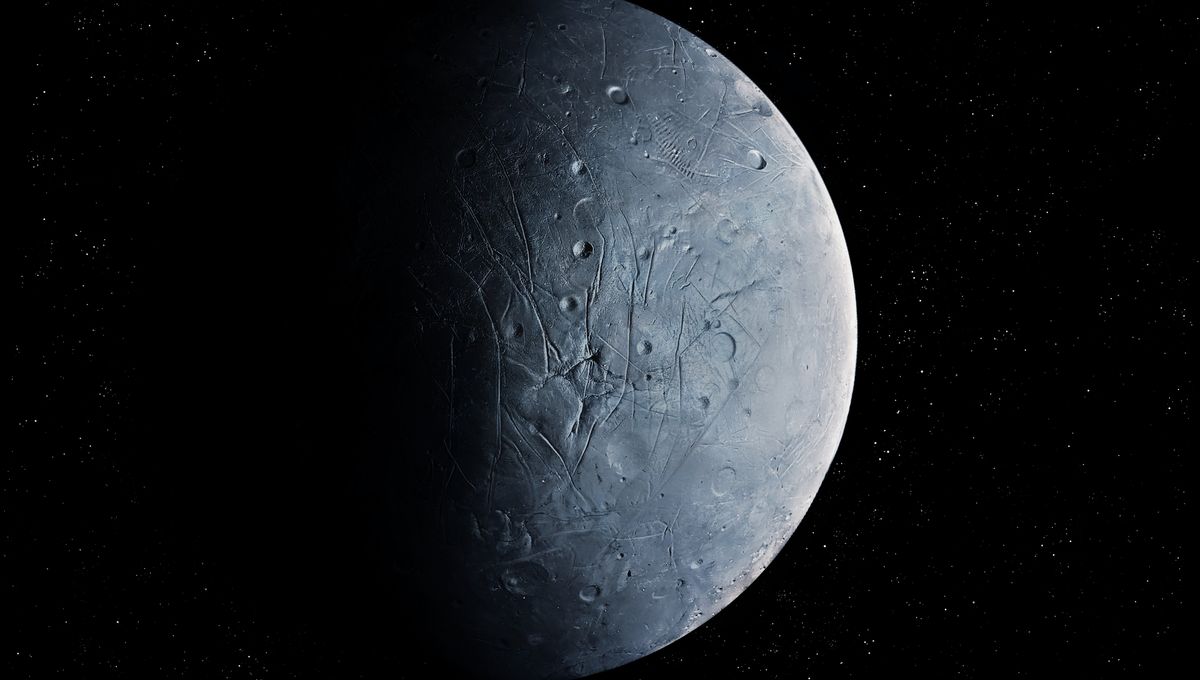
The Solar System does not have a clear border. The influence of the Sun in certain domains is small enough for the Voyager probes to have escaped into interstellar space, but there are comets and larger worlds orbiting our Sun at incredibly far distances. Astronomers have been wondering what might lurk in those dark regions, where the Sun is but another star in the sky. A team has now suggested the presence of a potential new planet, but not the one you may be thinking of.
The rest of this article is behind a paywall. Please sign in or subscribe to access the full content.
This is not the famous Planet 9, a world larger than Earth but smaller than Neptune that has been hypothesized to exist at least 300 times further out than Earth, if not farther. The idea of more unidentified planets in the Solar System is very old. Before the Planet 9 hypothesis, when Pluto was not yet demoted to dwarf planet, the idea took the name of Planet X – a joke on the meaning of X as 10 in Roman numerals and as the mathematical unknown.
Planet X has now been linked to Planet 9; hence, the team’s suggestion to call this new hypothetical world Planet Y in a new preprint paper accepted for publication. The suggested evidence for the presence of this hypothetical object comes from the warp in the plane of trans-Neptunian objects. Basically, their orbit seems consistently skewed compared to the plane of the Solar System.
There are many known trans-Neptunian objects, or TNOs, and likely many more await discovery. The team used planets that orbit the Sun between 50 and 400 astronomical units (the distance between the Earth and the Sun) away. They carefully removed TNOs whose orbits are in resonance with Neptune (like the one doing one orbit every 10 orbits of the ice giant planet) and looked at the distribution of the rest.
There is no warp in TNOs between 50 and 80 astronomical units, but between 80 and 200, and 80 and 400, there is statistical evidence of a warp of about 15 degrees. There is only a 2 percent chance that the warp found here is a fluke, and if that is the case, more TNO discoveries should show it.
If it’s not a fluke, then the researchers believe that it is best explained by a planet between the mass of Mercury and Earth, orbiting at between 100 and 200 astronomical units. A Pluto-mass world might work too, but it is not the preferred scenario. Anything bigger than Earth’s size would also cause a warp in the 50 to 80 bracket, and it would have likely been discovered already.
Independent previous research has also proposed a similar Planet Y to explain the warp or other features in the TNO population. The good news is that the existence of this planet might be confirmed or denied in a matter of years, thanks to the Vera Rubin Observatory and its decadal survey.
“Finally, we note that a hypothetical Planet Y as described in this work would likely be detectable by the upcoming Legacy Survey of Space and Time (LSST) on the Vera C. Rubin Observatory if it is currently located within the survey footprint,” the authors wrote in the paper. “If such a body exists but is not discoverable by LSST due to its on-sky location (i.e., high ecliptic latitude), LSST will nevertheless elucidate the details of the Kuiper belt mean plane warp induced by the planet.”
The paper is accepted for publication in the Monthly Notices of the Royal Astronomical Society and is available on the ArXiv.
[H/T: New Scientist]

Source Link: Forget Planet X! Beyond Neptune, There Might Be An Earth-Sized Planet Y
