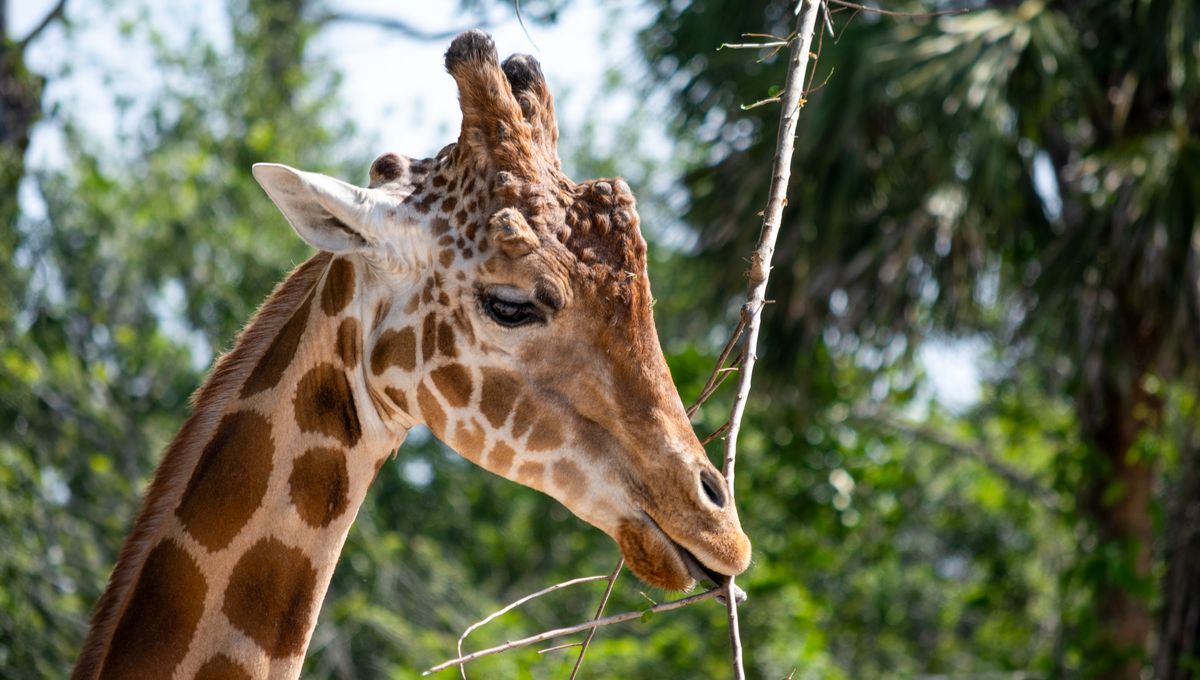
New research has thrown a spanner in the works for giraffe conservation, after analyzing the genetics of giraffes kept in human care in North America, and finding that most of those studied are in fact hybrids.
If we were talking about this prior to August 2025, there wouldn’t necessarily be a problem; before that point, giraffes were considered to be a single species with multiple subspecies. At least, that was the case officially. For around a decade, evidence towards the case for more than one species of giraffe began building up. Then, earlier this year, formal recognition of four distinct giraffe species arrived.
This has raised concerns about the status of giraffes kept in zoos and private collections. These populations can serve as “assurance stocks” – essentially, a group of healthy, genetically diverse animals that act as a safety net should wild populations end up on the brink of extinction, or disappear entirely.
Given that it’s possible that at least three of the four giraffe species are threatened, this backup group is as important as ever. However, if captive giraffe populations don’t effectively reflect the genetics of all the wild species, then that safety net is gone.
To determine if that could be the case in captive North American populations, researchers from the University of Illinois Urbana-Champaign and Morfeld Research & Conservation sequenced the whole genomes of 52 giraffes kept in human care across North America, and then compared them to genomes from 63 wild giraffes representing all four species.
It wasn’t good news; the team found that most of the giraffes had mixed genetic ancestry. “Only eight giraffes got close to representing a single species – reaching about a 90% match – but the rest were a mix of two and sometimes three species,” explained the study’s first author Wesley Au in a statement.
This, they concluded, was primarily the result of hybridization in captive populations. While it’s suspected that some of the giraffes in the studied group may have originated from a wild hybrid, that wasn’t the case for the rest. The four giraffe species are generally considered to be reproductively isolated in the wild, with breeding and hybridization between them rarely occurring; it’s a different situation in captivity.
“A lot of times, decisions to breed animals are based on, ‘She’s a nice female, he’s a nice male. Let’s put them together for breeding.’ The genetics aren’t usually considered in making breeding decisions for giraffes, but they should be,” said study co-author Kari Morfeld. “We have a responsibility to consider genetics, not only demeanor or physical characteristics, to do better for giraffe conservation.”
So, what happens now? “Captive breeding programs in zoos would be better off restarting with fresh stocks from the wild, if they want to maintain assurance stocks for the purposes of conservation,” said senior study author Alfred Roca.
Hybrid giraffes currently in zoos and private collections would be phased out from breeding programs, Roca and colleagues recommend, serving as ambassadors for the species, or potentially even as surrogates for new stocks.
But putting all of this into action is something that’s likely much easier said than done.
“Physically moving these huge animals between continents would be difficult,” explained Morfeld. If you have any doubt about that, look no further than the time that conservationists had to build rafts to transport giraffes from a shrinking island – and that was over a lake, let alone a whole ocean.
“A better way, in my opinion, is to develop reproductive technologies where you can move semen or embryos and proceed with artificial insemination, IVF, and embryo transfer. We do this all the time in livestock and other species. There’s no reason this can’t be applied to giraffes,” said Morfeld.
There are other moving parts to such a plan, too, like funding and politics. “It really comes down to establishing trusting relationships with African governments, conservation organizations, and scientists,” Morfeld added. “It’s one thing to conduct an artificial insemination, but you really have to ask the question of how all stakeholders will benefit.”
The study is published in the Journal of Heredity.

Source Link: Giraffes In North American Zoos Have Been Hybridizing – And That’s A Problem
