• Email Us: [email protected]
  • Contact Us: +1 718 874 1545
  • Skip to main content
  • Skip to primary sidebar

Medical Market Report

  • Home
  • All Reports
  • About Us
  • Contact Us

Gold Looks The Way It Does Because Of A Relativistic Effect

January 14, 2025 by Deborah Bloomfield

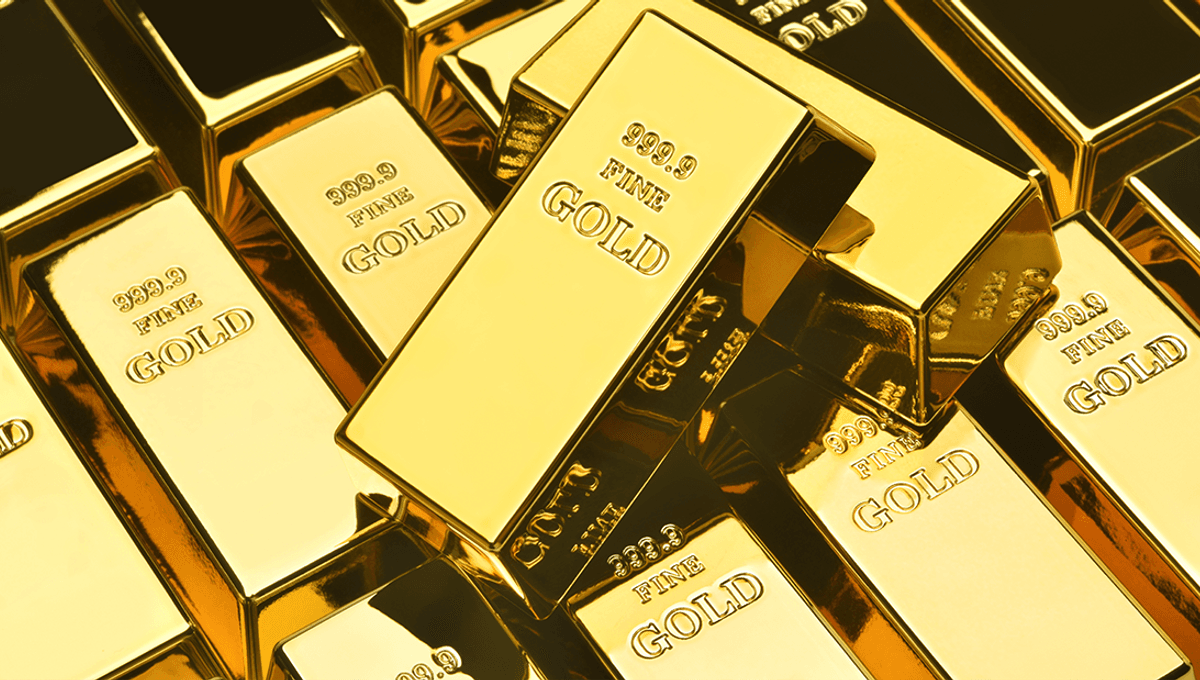
Gold, while deemed valuable by humans, isn’t that exciting as an element, being fairly unreactive with most of the other elements available to play around with.

Advertisement

Humans love the rare metal anyway, partly due to its rarity and unreactive nature making it an ideal element to use as currency, and its unique shiny color making it attractive when fashioned into jewelry. But what gives it that unique shine, we magpies humans love so much? It turns out that in order to answer that question, you need a little of quantum mechanics and a sprinkling of Einstein’s relativity. 

Advertisement


Relativistic effects are also present in mercury.

With a heavy nucleus (79 protons) and a lone electron in its outermost electron shell, gold should have fairly similar properties to silver, with its 47 protons and electrons, and a lone electron in the outermost or “valence” shell. Yet silver (Ag) is more reactive than gold, and for reasons that took a long while to figure out.

“The chemical difference between silver and gold has received a great deal of attention during the history of chemistry,” a 1978 paper on the topic explained. “It seems to be mainly a relativistic effect.”

Advertisement

Due to the large number of positively charged protons within a gold nucleus, negatively charged electrons on the innermost shells are pulled in closer to the nucleus, more than they are in silver. This close to the atom, in order to not fall into it, they must zip around the nucleus at over half the speed of light in contracted innermost shells.

While they zip around at relativistic speeds, gaining effective relativistic mass, the two outermost electron shells (also drawn in towards the heavy nucleus) are slightly closer to each other as a result of this relativistic contraction. This means it takes slightly less energy, when hit by photons of light, to kick an electron to transition to the higher energy state. 

In silver, the energy needed for this kick is in the ultraviolet frequency, meaning visible light is not absorbed during the transition, and is reflected, giving it its silvery appearance. In gold, however, the energy required to kick an electron to its higher energy state is lower, in visible blue light. Blue light is absorbed, but the rest of the visible range is reflected back, with the reds and greens combining to make the yellow/golden color we love to gawp at so much.

Deborah Bloomfield
Deborah Bloomfield

Related posts:

  1. Audi launches its newest EV, the 2022 Q4 e-tron SUV
  2. Dinosaur Prints Found Under Restaurant Table Confirmed As 100 Million Years Old
  3. Archax: Japanese Engineers Make Transformer Robot That Actually Works
  4. How Do We Know There Is Anything Beyond The Observable Universe?

Source Link: Gold Looks The Way It Does Because Of A Relativistic Effect

Filed Under: News

Primary Sidebar

  • The Science Of Magic: Find Out More In Issue 41 Of CURIOUS – Out Now
  • People Sailed To Australia And New Guinea 60,000 years ago
  • How Do Cells Know Their Location And Their Role In The Body?
  • What Are Those Strange Eye “Floaters” You See In Your Vision?
  • Have We Finally “Seen” Dark Matter? Mysterious Ancient Foot May Be From Our True Ancestor, And Much More This Week
  • The Unexpected Life Hiding Out in the Great Pacific Garbage Patch
  • Scientists Detect “Switchback” Phenomenon In Earth’s Magnetosphere For The First Time
  • Inside Your Bed’s “Dirty Hidden Biome” And How To Keep Things Clean
  • “Ego Death”: How Psychedelics Trigger Meditation-Like Brain Waves
  • Why We Thrive In Nature – And Why Cities Make Us Sick
  • What Does Moose Meat Taste Like? The World’s Largest Deer Is A Staple In Parts Of The World
  • 11 Of The Last Spix’s Macaws In The Wild Struck Down With A Deadly, Highly Contagious Virus
  • Meet The Rose Hair Tarantula: Pink, Predatory, And Popular As A Pet
  • 433 Eros: First Near-Earth Asteroid Ever Discovered Will Fly By Earth This Weekend – And You Can Watch It
  • We’re Going To Enceladus (Maybe)! ESA’s Plans For Alien-Hunting Mission To Land On Saturn’s Moon Is A Go
  • World’s Oldest Little Penguin, Lazzie, Celebrates 25th Birthday – But She’s Still Young At Heart
  • “We Will Build The Gateway”: Lunar Gateway’s Future Has Been Rocky – But ESA Confirms It’s A Go
  • Clothes Getting Eaten By Moths? Here’s What To Do
  • We Finally Know Where Pet Cats Come From – And It’s Not Where We Thought
  • Why The 17th Century Was A Really, Really Dreadful Time To Be Alive
  • Business
  • Health
  • News
  • Science
  • Technology
  • +1 718 874 1545
  • +91 78878 22626
  • [email protected]
Office Address
Prudour Pvt. Ltd. 420 Lexington Avenue Suite 300 New York City, NY 10170.

Powered by Prudour Network

Copyrights © 2025 · Medical Market Report. All Rights Reserved.

Go to mobile version